• Fri frakt över 249 kr
  • •
  • Snabba leveranser
  • •
  • Billiga böcker
Kundservice

Du är på sajten för privatpersoner.

Företag, bibliotek eller offentlig verksamhet?

Du handlar på classic.bokus.com, där alla dina funktioner finns intakta.
Till classic.bokus.com
Bokus logotyp. Gå till startsidan.
  • Erbjudanden
  • Nyheter
  • Student
  • Topplistor
  • Barn & ungdom
  • Bokus Play
  • E-böcker
  • Pocketböcker
  • Spel & pussel

10% rabatt på allt med kod: NYSTART10 →

Sidfot

Mina sidor

    Hjälp

    • Kundservice
    • Vanliga frågor och svar
    • Frakt och leverans
    • Retur vid ångerrätt
    • Reklamera vara
    • Betalning
    • Köpvillkor
    • Allmänna villkor
    • Information om webbplatsens tillgänglighet

    Om Bokus

    • Om oss
    • Pressrum
    • För studenter
    • För företag
    • För bibliotek och offentlig verksamhet
    • För leverantörer
    • Hållbarhet

    Populärt

    • Aktuella erbjudanden
    • Presentkort
    • Studentlitteratur
    • Nya böcker
    • Topplistor
    • Signerade böcker
    • Engelska böcker

    Inspiration

    • Boktips
    • BookTok
    • Populära bokserier
    • Barnbokskaraktärer
    • Populära författare
    Logotyp för Bokus
    Följ oss på Facebook (extern länk)Följ oss på Instagram (extern länk)Följ oss på YouTube (extern länk)Följ oss på TikTok (extern länk)
    bokus @ CookiesAnpassa cookiesIntegritetspolicyKöpvillkor
    Till Citymail hemsida (extern länk)Till Budbee hemsida (extern länk)Till Postnord hemsida (extern länk)Till Schenker hemsida (extern länk)Till Early Bird hemsida (extern länk)Till Walleys hemsida (extern länk)
    1. Samhälle och politik
    2. Samhälle och kultur
    3. Kultur och medier
    4. Referensverk och tvärvetenskap

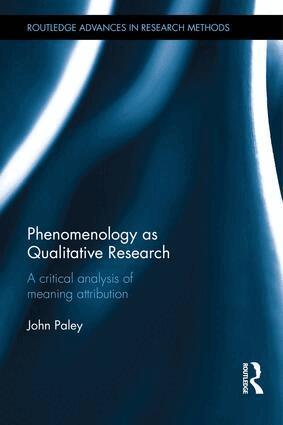
    Phenomenology as Qualitative Research

    A Critical Analysis of Meaning Attribution

    AvJohn Paley

    Inbunden, Engelska, 2016

    Del i serien Routledge Advances in Research Methods

    2 421 kr

    Beställningsvara. Skickas inom 10-15 vardagar. Fri frakt över 249 kr.

    Fler format och utgåvor

    Häftad

    803 kr

    E-bok

    922 kr

    E-bok

    922 kr

    Beskrivning

    Phenomenology originated as a novel way of doing philosophy early in the twentieth century. In the writings of Husserl and Heidegger, regarded as its founders, it was a non-empirical kind of philosophical enquiry. Although this tradition has continued in a variety of forms, ‘phenomenology’ is now also used to denote an empirical form of qualitative research (PQR), especially in health, psychology and education. However, the methods adopted by researchers in these disciplines have never been subject to detailed critical analysis; nor have the methods advocated by methodological writers who are regularly cited in the research literature.This book examines these methods closely, offering a detailed analysis of worked-through examples in three influential textbooks by Giorgi, van Manen, and Smith, Flowers and Larkin. Paley argues that the methods described in these texts are radically under-specified, and suggests alternatives to PQR as an approach to qualitative research, particularly the use of interview data in the construction of models designed to explain phenomena rather than merely describe or interpret them. This book also analyses, and aims to develop, the implicit theory of ‘meaning’ found in PQR writings. The author establishes an account of ‘meaning’ as an inference marker, and explores the methodological implications of this view.This book evaluates the methods used in phenomenology-as-qualitative-research, and formulates a more fully theorised alternative. It will appeal to researchers and students in the areas of health, nursing, psychology, education, public health, sociology, anthropology, political science, philosophy and logic.

    Produktinformation

    • Utgivningsdatum:2016-08-15
    • Mått:156 x 234 x 16 mm
    • Vikt:780 g
    • Format:Inbunden
    • Språk:Engelska
    • Serie:Routledge Advances in Research Methods
    • Antal sidor:198
    • Förlag:Taylor & Francis Ltd
    • ISBN:9781138652811

    Utforska kategorier

    • Referensverk och tvärvetenskap inom Samhälle och politik
    • Filosofiska discipliner inom Filosofi och religion

    Mer om författaren

    John Paley was formerly a senior lecturer at the University of Stirling, and is now a visiting fellow at Sheffield Hallam University, UK. He writes on topics related to philosophy and health care, including research methods, evidence, complexity, spirituality, the post-Francis debate about compassion, and nursing ethics.

    Recensioner i media

    "I think this book is a major milestone in the field of qualitative research… In his demolition of the claims made by a selection of phenomenologists… John Paley has pointed out the emperor’s lack of clothing and pushed him into the spotlight for all to see." - Roger Watson, University of Hull, Editor-in-Chief, Journal of Advanced Nursing"Engaging, incisive, forensic." - Alec Grant, University of Brighton, UK"The persuasive force and dogged logic of John Paley’s argument demands a response. Whether you agree or disagree with him, this book cannot be ignored. It will be required reading for any nurse contemplating undertaking a phenomenological study. Likewise, anyone commenting on phenomenology who does not engage with the arguments Paley advances has not meaningfully engaged with the subject. The influence of this book will ripple through nursing research and education for many years to come." - Martin Lipscomb, University of Worcester, UK"Paley’s book is a major contribution to nursing research, and social research more generally. It has the hallmarks of his work over the past 20 years and more: namely, formidable attention to scholarly detail, critical acumen and original thought." - Steven Edwards, Swansea University, UK

    Innehållsförteckning

    • 1. Introduction: The Undecided2. Meaning Attribution in Phenomenology3. Amedeo Giorgi: Jealousy4. Max van Manen: Being Left or Abandoned5. The Linguistics of Meaning6. Smith, Flowers, Larkin: The HIV Interview7. Meaning, Models and Mechanisms