• Fri frakt över 249 kr
  • •
  • Snabba leveranser
  • •
  • Billiga böcker
Kundservice

Du är på sajten för privatpersoner.

Företag, bibliotek eller offentlig verksamhet?

Du handlar på classic.bokus.com, där alla dina funktioner finns intakta.
Till classic.bokus.com
Bokus logotyp. Gå till startsidan.
  • Erbjudanden
  • Nyheter
  • Student
  • Topplistor
  • Barn & ungdom
  • Bokus Play
  • E-böcker
  • Pocketböcker
  • Spel & pussel

10% rabatt på allt med kod: NYSTART10 →

Sidfot

Mina sidor

    Hjälp

    • Kundservice
    • Vanliga frågor och svar
    • Frakt och leverans
    • Retur vid ångerrätt
    • Reklamera vara
    • Betalning
    • Köpvillkor
    • Allmänna villkor
    • Information om webbplatsens tillgänglighet

    Om Bokus

    • Om oss
    • Pressrum
    • För studenter
    • För företag
    • För bibliotek och offentlig verksamhet
    • För leverantörer
    • Hållbarhet

    Populärt

    • Aktuella erbjudanden
    • Presentkort
    • Studentlitteratur
    • Nya böcker
    • Topplistor
    • Signerade böcker
    • Engelska böcker

    Inspiration

    • Boktips
    • BookTok
    • Populära bokserier
    • Barnbokskaraktärer
    • Populära författare
    Logotyp för Bokus
    Följ oss på Facebook (extern länk)Följ oss på Instagram (extern länk)Följ oss på YouTube (extern länk)Följ oss på TikTok (extern länk)
    bokus @ CookiesAnpassa cookiesIntegritetspolicyKöpvillkor
    Till Citymail hemsida (extern länk)Till Budbee hemsida (extern länk)Till Postnord hemsida (extern länk)Till Schenker hemsida (extern länk)Till Early Bird hemsida (extern länk)Till Walleys hemsida (extern länk)
    1. Juridik
    2. Särskilda rättsområden
    3. Rättsordning

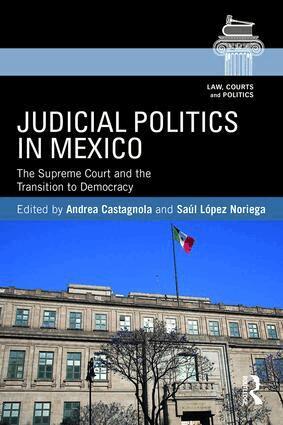
    Judicial Politics in Mexico

    The Supreme Court and the Transition to Democracy

    AvAndrea Castagnola,Saul Lopez Noriega

    Häftad, Engelska, 2016

    Del i serien Law, Courts and Politics

    678 kr

    Beställningsvara. Skickas inom 10-15 vardagar. Fri frakt över 249 kr.

    Beskrivning

    After more than seventy years of uninterrupted authoritarian government headed by the Partido Revolucionario Institucional (PRI), Mexico formally began the transition to democracy in 2000. Unlike most other new democracies in Latin America, no special Constitutional Court was set up, nor was there any designated bench of the Supreme Court for constitutional adjudication. Instead, the judiciary saw its powers expand incrementally. Under this new context inevitable questions emerged: How have the justices interpreted the constitution? What is the relation of the court with the other political institutions? How much autonomy do justices display in their decisions? Has the court considered the necessary adjustments to face the challenges of democracy?It has become essential in studying the new role of the Supreme Court to obtain a more accurate and detailed diagnosis of the performances of its justices in this new political environment. Through critical review of relevant debates and using original data sets to empirically analyze the way justices voted on the three main means of constitutional control from 2000 through 2011, leading legal scholars provide a thoughtful and much needed new interpretation of the role the judiciary plays in a country’s transition to democracyThis book is designed for graduate courses in law and courts, judicial politics, comparative judicial politics, Latin American institutions, and transitions to democracy. This book will equip scholars and students with the knowledge required to understand the importance of the independence of the judiciary in the transition to democracy.

    Produktinformation

    • Utgivningsdatum:2016-10-27
    • Mått:152 x 229 x 14 mm
    • Vikt:232 g
    • Format:Häftad
    • Språk:Engelska
    • Serie:Law, Courts and Politics
    • Antal sidor:176
    • Förlag:Taylor & Francis Ltd
    • ISBN:9781138697829

    Utforska kategorier

    • Rättsordning inom Juridik
    • Statsskick: demokrati inom Samhälle och politik

    Mer om författaren

    Andrea Castagnola is a Post-Doctoral Fellow in the Comparative Politics Department at the University of Bergen and is Assistant Professor at FLACSO-Mexico. Her research focuses on judicial politics in Latin America and comparative politics.Saúl López Noriega is Associate Professor at the Centro de Investigación y Docencia Económica (CIDE). He teaches courses on constitutional law and democracy, power, and media. His research focuses on issues of constitutional justice, democracy and constitutional courts, and media concentration.

    Recensioner i media

    "This book extends the boundaries of our understanding of the evolving role of the Court in the political evolution in Mexico from 1917 to the more recent process of democratization in this country. Throughout all of the authors’ contributions, this work is a fine-grained analysis that permits us to understand the institutional changes in the Supreme Court and in its relations to other socio-political actors. Employing a wide collection of methodologies and theoretical approaches, the authors contribute in a remarkable way to elucidate not only the Mexican case but also the role of the courts in the dynamics of democratization from a comparative perspective. Indeed, this book is an exciting new contribution for scholars of Mexico and for other interested in the field of comparative judicial politics. To be sure, this edited book will be a useful toolkit for lawyers and political scientists, and for professors and students."Rodolfo Sarsfield, Universidad Autónoma de Querétaro"What role does the Mexican Supreme Court play in democratization? This collection answers this question by examine mechanisms by which the court has become empowered and activated throughout the consolidation phrase as well as the court’s decision-making logic and impact on Mexican democracy. It combines qualitative and quantitative analysis, novel data collections, and a host of perspectives into fresh insights on this emblematic case. The result is a compelling analysis that makes a theoretical contribution with practical implications for institutional design."Ryan Carlin, Georgia State University"… opens important avenues for future comparative research."Latin American Research Review

    Innehållsförteckning

    • IntroductionTom GinsburgChapter 1: The Transformations of the Role of the Mexican Supreme CourtAndrea Pozas-Loyo and Julio Ríos-FigueroaChapter 2: The Law as Power: Strategic Litigation in MexicoPedro Salazar UgarteChapter 3: Are Mexican Justices true arbiters among political elites? An empirical analysis of the Court´s rulings from 2000-2011Andrea Castagnola and Saúl López Noriega Chapter 4: The Supreme Court and the (no) Rights Revolution. An Empirical Analysis of the Court´s Rulings 2000-2011 Andrea Castagnola and Saúl López NoriegaChapter 5: Constitutional Change and the Supreme Court Institutional Architecture: Decisional Indeterminacy as an Obstacle to Legitimacy Francisca Pou Giménez ConclusionMatthew C. Ingram