• Fri frakt över 249 kr
  • •
  • Snabba leveranser
  • •
  • Billiga böcker
Kundservice

Du är på sajten för privatpersoner.

Företag, bibliotek eller offentlig verksamhet?

Du handlar på classic.bokus.com, där alla dina funktioner finns intakta.
Till classic.bokus.com
Bokus logotyp. Gå till startsidan.
  • Erbjudanden
  • Student
  • Topplistor
  • Barn & ungdom
  • Bokus Play
  • E-böcker
  • Ljudböcker
  • Pocketböcker
  • Spel och pussel

Pocketfynda! Hundratals böcker för 49 kr/st →

Sidfot

Mina sidor

    Hjälp

    • Kundservice
    • Vanliga frågor och svar
    • Frakt och leverans
    • Retur vid ångerrätt
    • Reklamera vara
    • Betalning
    • Köpvillkor
    • Allmänna villkor
    • Information om webbplatsens tillgänglighet

    Om Bokus

    • Om oss
    • Pressrum
    • För studenter
    • För företag
    • För bibliotek och offentlig verksamhet
    • För leverantörer
    • Hållbarhet

    Populärt

    • Aktuella erbjudanden
    • Presentkort
    • Studentlitteratur
    • Nya böcker
    • Topplistor
    • Signerade böcker
    • Engelska böcker

    Inspiration

    • Boktips
    • BookTok
    • Barnbokskaraktärer
    • Populära författare
    Logotyp för Bokus
    Följ oss på Facebook (extern länk)Följ oss på Instagram (extern länk)Följ oss på YouTube (extern länk)Följ oss på TikTok (extern länk)
    bokus @ CookiesAnpassa cookiesIntegritetspolicyKöpvillkor
    Till Citymail hemsida (extern länk)Till Budbee hemsida (extern länk)Till Postnord hemsida (extern länk)Till Schenker hemsida (extern länk)Till Early Bird hemsida (extern länk)Till Walleys hemsida (extern länk)
    1. Samhälle och politik
    2. Samhälle och kultur

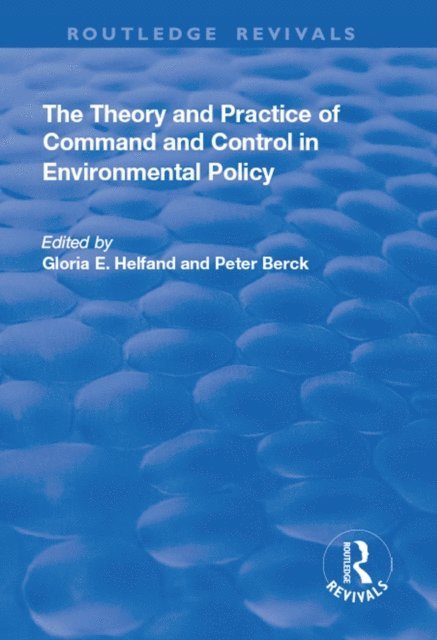
    Theory and Practice of Command and Control in Environmental Policy

    AvPeter Berck,Gloria E. Helfand

    Inbunden, Engelska, 2017

    Del i serien Routledge Revivals

    2 410 kr

    Beställningsvara. Skickas inom 10-15 vardagar. Fri frakt över 249 kr.

    Fler format och utgåvor

    Häftad

    538 kr

    E-bok

    2 883 kr

    E-bok

    2 883 kr

    Beskrivning

    This title was first published in 2003. Economists have had increasing success in arguing the merits of market-based approaches to environmental problems. By making polluting expensive, market-based approaches provide polluters with incentives to clean up, rather than mandates to stop polluting. These approaches include pollution taxes, transferable emissions permits and subsidies for pollution abatement. The purpose of this volume is to explore the situations where Command and Control (CAC) may not be all bad, and in fact might even have some advantages over market-based instruments (MBI).

    Produktinformation

    • Utgivningsdatum:2017-11-24
    • Mått:168 x 243 x 34 mm
    • Vikt:1 120 g
    • Format:Inbunden
    • Språk:Engelska
    • Serie:Routledge Revivals
    • Antal sidor:518
    • Förlag:Taylor & Francis Ltd
    • ISBN:9781138715905

    Utforska kategorier

    • Samhälle och kultur inom Samhälle och politik
    • Ekonomisk historia inom Ekonomi och Ledarskap
    • Miljövetenskap och miljöpolitik inom Naturvetenskap och teknik

    Recensioner i media

    ’This book provides a unique collection of core publications from the literature of the past 30 years, hence is an excellent companion for further reading by interested students. For the wide and diverse group of those interested in or applying environmental policy in practice, this book will provide insight and understanding of the roots, the evolution and the current application windows of these basic instruments of environmental policy.’ International Journal of Environment and Pollution

    Innehållsförteckning

    • Contents: Part I: What is CAC?: Standards versus standards: the effects of different pollution restrictions, Gloria E. Helfand; Performance versus design standards in the regulation of pollution, David Besanko; Agricultural runoff as a nonpoint externality: a theoretical development, Ronald C. Griffin and Daniel W. Bromley. Part II: Sensibly Designed CAC: The new 'Contractarian' paradigm in environmental regulation; David A. Dana; Emission trading vs. rigid regulations in the control of vehicle emissions, Catherine L. Kling; Why CAFE worked, David L. Greene. Part III: Monitoring Costs: When is command-and-control efficient? Institutions, technology and the comparative efficiency of alternative regulatory regimes for environmental protection; Daniel H. Cole and Peter Z. Grossman; The triumph of technology-based standards, Wendy E. Wagner; The use of economic incentives in developing countries: lessons from international experience with industrial air pollution; Allen Blackman and Winston Harrington; Environmental policy for developing countries, Ruth Greenspan Bell and Clifford Russell; Reevaluating the relationship between transferable property rights and command-and-control regulation, Robert W. Hahn and Robert L. Axtell. Part IV: Non-Uniform Conditions: The Net benefits of incentive-based regulation: a case study of environmental standard setting, Wallace E. Oates, Paul R. Portney and Albert M. McGartland; Effluent charges: a critique, Susan Rose-Ackerman; Cost-effective policies to improve urban air quality in Santiago, Chile, Raúl E. O'Ryan. Part V: Uncertainty: Prices vs. quantities, Martin L. Weitzman; Ex Post liability for harm vs. Ex Ante safety regulation: substitutes or complements?, Charles D. Kolstad, Thomas S. Ulen and Gary V. Johnson. Part VI: Imperfect Competition and Information: Regulation of prices and pollution under incomplete information, David P. Baron; Welfare consequences of emission credit trading programs, David A. Malueg; Market power and transferable property rights, Robert W. Hahn. Part VII: Non-Economic Factors: Political Economy and Philosophy: Polluters' profits and political response: direct controls versus taxes, James M. Buchanan and Gordon Tullock; Polluters' profits and political response: direct control versus taxes: comment, Philip R.P. Coelho; Polluters' profits and political response: direct control versus taxes: comment, Robert S. Main and Charles W. Baird; Polluters' profits and political response: direct control versus taxes: comment, Gary W. Yohe; Polluters' profits and political response: direct controls versus taxes: reply, James M. Buchanan and Gordon Tullock; A positive theory of environmental quality regulation, Michael T. Maloney and Robert E. McCormick; Economists and the environmental muddle, Steven Kelman; Regulation by prices and by command, Amihai Glazer and Charles Lave; Explaining market mechanisms, Thomas W. Merrill; Name index.