• Fri frakt över 249 kr
  • •
  • Snabba leveranser
  • •
  • Billiga böcker
Kundservice

Du är på sajten för privatpersoner.

Företag, bibliotek eller offentlig verksamhet?

Du handlar på classic.bokus.com, där alla dina funktioner finns intakta.
Till classic.bokus.com
Bokus logotyp. Gå till startsidan.
  • Erbjudanden
  • Nyheter
  • Student
  • Topplistor
  • Barn & ungdom
  • Bokus Play
  • E-böcker
  • Pocketböcker
  • Spel & pussel

10% rabatt på allt med kod NYSTART10 →

Sidfot

Mina sidor

    Hjälp

    • Kundservice
    • Vanliga frågor och svar
    • Frakt och leverans
    • Retur vid ångerrätt
    • Reklamera vara
    • Betalning
    • Köpvillkor
    • Allmänna villkor
    • Information om webbplatsens tillgänglighet

    Om Bokus

    • Om oss
    • Pressrum
    • För studenter
    • För företag
    • För bibliotek och offentlig verksamhet
    • För leverantörer
    • Hållbarhet

    Populärt

    • Aktuella erbjudanden
    • Presentkort
    • Studentlitteratur
    • Nya böcker
    • Topplistor
    • Signerade böcker
    • Engelska böcker

    Inspiration

    • Boktips
    • BookTok
    • Populära bokserier
    • Barnbokskaraktärer
    • Populära författare
    Logotyp för Bokus
    Följ oss på Facebook (extern länk)Följ oss på Instagram (extern länk)Följ oss på YouTube (extern länk)Följ oss på TikTok (extern länk)
    bokus @ CookiesAnpassa cookiesIntegritetspolicyKöpvillkor
    Till Citymail hemsida (extern länk)Till Budbee hemsida (extern länk)Till Postnord hemsida (extern länk)Till Schenker hemsida (extern länk)Till Early Bird hemsida (extern länk)Till Walleys hemsida (extern länk)
    1. Psykologi och pedagogik
    2. Psykologi
    3. Psykologi: känslor

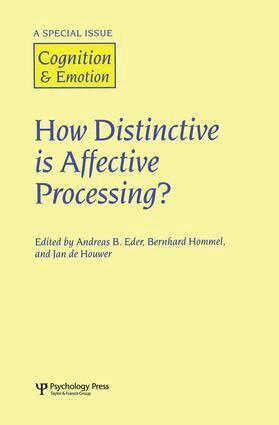
    How Distinctive is Affective Processing?

    A Special Issue of Cognition and Emotion

    AvAndreas. B Eder,Bernhard Hommel

    Häftad, Engelska, 2015

    Del i serien Special Issues of Cognition and Emotion

    744 kr

    Beställningsvara. Skickas inom 10-15 vardagar. Fri frakt över 249 kr.

    Beskrivning

    Influential theories on affect and emotion propose a fundamental differentiation between emotion and cognition, and research paradigms designed to test them focus on differences rather than similarities between affective and cognitive processes. This research orientation is increasingly challenged by the widespread and successful use of cognitive research paradigms in the study of affect and emotion – a challenge with far-reaching implications. Where and on what basis do theorists draw the line between cognition and emotion, and when is it useful to do so? Should researchers build more global, integrative models of cognition and emotion, or should they rely on local, content-specific models that draw attention to a differentiation between affective and cognitive processes? This special issue compiles different viewpoints on fundamental issues in the relationship between affect and cognition.

    Produktinformation

    • Utgivningsdatum:2015-06-25
    • Mått:156 x 234 x 13 mm
    • Vikt:340 g
    • Format:Häftad
    • Språk:Engelska
    • Serie:Special Issues of Cognition and Emotion
    • Antal sidor:236
    • Förlag:Taylor & Francis Ltd
    • ISBN:9781138883178

    Utforska kategorier

    • Psykologi: känslor inom Psykologi och pedagogik
    • Kognitiv psykologi inom Psykologi och pedagogik

    Mer om författaren

    Andreas. B Eder, Bernhard Hommel, Jan De Houwer

    Innehållsförteckning

    • A.B. Eder, B. Hommel, J. De Houwer, How Distinctive is Affective Processing? On the Implications of Using Cognitive Paradigms to Study Affect and Emotion. P.J. Barnard, D.J. Duke, R.W. Byrne, I. Davidson, Differentiation in Cognitive and Emotional Meanings: An Evolutionary Analysis. S. Duncan, L. Feldman Barrett, Affect is a Form of Cognition: A Neurobiological Analysis. J. Storbeck, G.L. Clore, On the Interdependence of Cognition and Emotion. A. Moors, Can Cognitive Methods be Used to Study the Unique Aspect of Emotion: An Appraisal Theorist's Answer. T. Lavender, B. Hommel, Affect and Action: Towards an Event-coding Account. A.B. Eder, K.C. Klauer, Common Valence Coding in Action and Evaluation: Affective Blindness towards Response-Compatible Stimuli. M. Rotteveel, R.H. Phaf, Mere Exposure in Reverse: Mood and Motion Modulate Memory Bias. J.T. Cacioppo, Affective Distinctiveness: Illusory or Real?