• Fri frakt över 249 kr
  • •
  • Snabba leveranser
  • •
  • Billiga böcker
Kundservice

Du är på sajten för privatpersoner.

Företag, bibliotek eller offentlig verksamhet?

Du handlar på classic.bokus.com, där alla dina funktioner finns intakta.
Till classic.bokus.com
Bokus logotyp. Gå till startsidan.
  • Erbjudanden
  • Student
  • Topplistor
  • Barn & ungdom
  • Bokus Play
  • E-böcker
  • Ljudböcker
  • Pocketböcker
  • Spel & pussel

10% rabatt på allt med kod NYSTART10 →

Sidfot

Mina sidor

    Hjälp

    • Kundservice
    • Vanliga frågor och svar
    • Frakt och leverans
    • Retur vid ångerrätt
    • Reklamera vara
    • Betalning
    • Köpvillkor
    • Allmänna villkor
    • Information om webbplatsens tillgänglighet

    Om Bokus

    • Om oss
    • Pressrum
    • För studenter
    • För företag
    • För bibliotek och offentlig verksamhet
    • För leverantörer
    • Hållbarhet

    Populärt

    • Aktuella erbjudanden
    • Presentkort
    • Studentlitteratur
    • Nya böcker
    • Topplistor
    • Signerade böcker
    • Engelska böcker

    Inspiration

    • Boktips
    • BookTok
    • Populära bokserier
    • Barnbokskaraktärer
    • Populära författare
    Logotyp för Bokus
    Följ oss på Facebook (extern länk)Följ oss på Instagram (extern länk)Följ oss på YouTube (extern länk)Följ oss på TikTok (extern länk)
    bokus @ CookiesAnpassa cookiesIntegritetspolicyKöpvillkor
    Till Citymail hemsida (extern länk)Till Budbee hemsida (extern länk)Till Postnord hemsida (extern länk)Till Schenker hemsida (extern länk)Till Early Bird hemsida (extern länk)Till Walleys hemsida (extern länk)
    1. Psykologi och pedagogik
    2. Pedagogik
    3. Skolväsen och utbildningssystem
    4. Examination och betygsättning

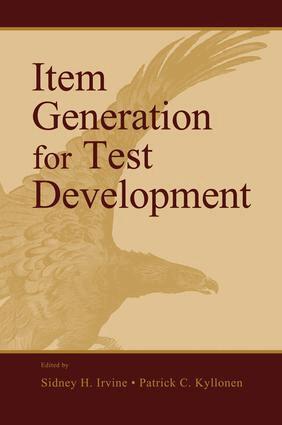
    Item Generation for Test Development

    AvSidney H. Irvine,Patrick C. Kyllonen

    Häftad, Engelska, 2015

    770 kr

    Beställningsvara. Skickas inom 10-15 vardagar. Fri frakt över 249 kr.

    Beskrivning

    Since the mid-80s several laboratories around the world have been developing techniques for the operational use of tests derived from item-generation. According to the experts, the major thrust of test development in the next decade will be the harnessing of item generation technology to the production of computer developed tests. This is expected to revolutionize the way in which tests are constructed and delivered.This book is a compilation of the papers presented at a symposium held at ETS in Princeton, attended by the world's foremost experts in item-generation theory and practice. Its goal is to present the major applications of cognitive principles in the construction of ability, aptitude, and achievement tests. It is an intellectual contribution to test development that is unique, with great potential for changing the ways tests are generated. The intended market includes professional educators and psychologists interested in test generation.

    Produktinformation

    • Utgivningsdatum:2015-11-24
    • Mått:152 x 229 x 24 mm
    • Vikt:589 g
    • Format:Häftad
    • Språk:Engelska
    • Antal sidor:444
    • Förlag:Taylor & Francis Ltd
    • ISBN:9781138973473

    Utforska kategorier

    • Examination och betygsättning inom Psykologi och pedagogik
    • Psykologisk metod inom Psykologi och pedagogik

    Mer om författaren

    Irvine, Sidney H.; Kyllonen, Patrick C.

    Recensioner i media

    "Item Generation for Test Development is an achievement in the field of psychometrics. The compilation of the efforts made by the book's authors serve as a resource and inspiration to educators and psychologists who strive to create solid, secure, convenient parallel tests. Individuals who want to learn more about designing rigorous tests with parallel forms should read this book."—Contemporary Psychology

    Innehållsförteckning

    • Contents: H. Braun, Foreword. S.H. Irvine, Item Generation for Test Development: An Introduction. Prologue and Epilogue: Remembering Samuel J. Messick. Part I:Psychometric and Cognitive Theory of Item Generation.S.H. Irvine, The Foundations of Item Generation for Mass Testing. S. Newstead, P. Bradon, S. Handley, J. Evans, I. Dennis, Using the Psychology of Reasoning to Predict the Difficulty of Analytical Reasoning Problems. I. Dennis, S. Handley, P. Bradon, J. Evans, S. Newstead, Approaches to Modeling Item-Generative Tests. L. Swanson, Discussant Remarks. Discussion. Part II:Construct-Oriented Approaches to Item Generation.R.J. Mislevy, L.S. Steinberg, R.G. Almond, On the Roles of Task Model Variables in Assessment Design. M.K. Enright, K.M. Sheehan, Modeling the Difficulty of Quantitative Reasoning Items: Implications for Item Generation. L.F. Hornke, Item-Generation Models for Higher Order Cognitive Functions. C. Lewis, Discussant Remarks. Discussion. Part III:From Theory to Implementation.I.I. Bejar, Generative Testing: From Conception to Implementation. S.E. Embretson, Generating Abstract Reasoning Items With Cognitive Theory. P.C. Kyllonen, Item Generation for Repeated Testing of Human Performance. D. Wright, Scoring Tests When Items Have Been Generated. H. Wainer, On the Automatic Generation of Test Items: Some Whens, Whys, and Hows. Part IV:Applications of Item-Generative Principles.D. Bartram, The MICROPAT Pilot Selection Battery: Applications of Generative Techniques for Item-Based and Task-Based Tests. K-M. Goeters, B. Lorenz, On the Implementation of Item Generation Principles for the Design of Aptitude Testing in Aviation. M.K. Singley, R.E. Bennett, Item Generation and Beyond: Applications of Schema Theory to Mathematics Assessment. R. Morgan, Discussant Remarks. Discussion.