• Fri frakt över 249 kr
  • •
  • Snabba leveranser
  • •
  • Billiga böcker
Kundservice

Du är på sajten för privatpersoner.

Företag, bibliotek eller offentlig verksamhet?

Du handlar på classic.bokus.com, där alla dina funktioner finns intakta.
Till classic.bokus.com
Bokus logotyp. Gå till startsidan.
  • Erbjudanden
  • Nyheter
  • Student
  • Topplistor
  • Barn & ungdom
  • Bokus Play
  • E-böcker
  • Pocketböcker
  • Spel & pussel

10% rabatt på allt med kod NYSTART10 →

Sidfot

Mina sidor

    Hjälp

    • Kundservice
    • Vanliga frågor och svar
    • Frakt och leverans
    • Retur vid ångerrätt
    • Reklamera vara
    • Betalning
    • Köpvillkor
    • Allmänna villkor
    • Information om webbplatsens tillgänglighet

    Om Bokus

    • Om oss
    • Pressrum
    • För studenter
    • För företag
    • För bibliotek och offentlig verksamhet
    • För leverantörer
    • Hållbarhet

    Populärt

    • Aktuella erbjudanden
    • Presentkort
    • Studentlitteratur
    • Nya böcker
    • Topplistor
    • Signerade böcker
    • Engelska böcker

    Inspiration

    • Boktips
    • BookTok
    • Populära bokserier
    • Barnbokskaraktärer
    • Populära författare
    Logotyp för Bokus
    Följ oss på Facebook (extern länk)Följ oss på Instagram (extern länk)Följ oss på YouTube (extern länk)Följ oss på TikTok (extern länk)
    bokus @ CookiesAnpassa cookiesIntegritetspolicyKöpvillkor
    Till Citymail hemsida (extern länk)Till Budbee hemsida (extern länk)Till Postnord hemsida (extern länk)Till Schenker hemsida (extern länk)Till Early Bird hemsida (extern länk)Till Walleys hemsida (extern länk)
    1. Språk och ordböcker
    2. Språkvetenskap och lingvistik

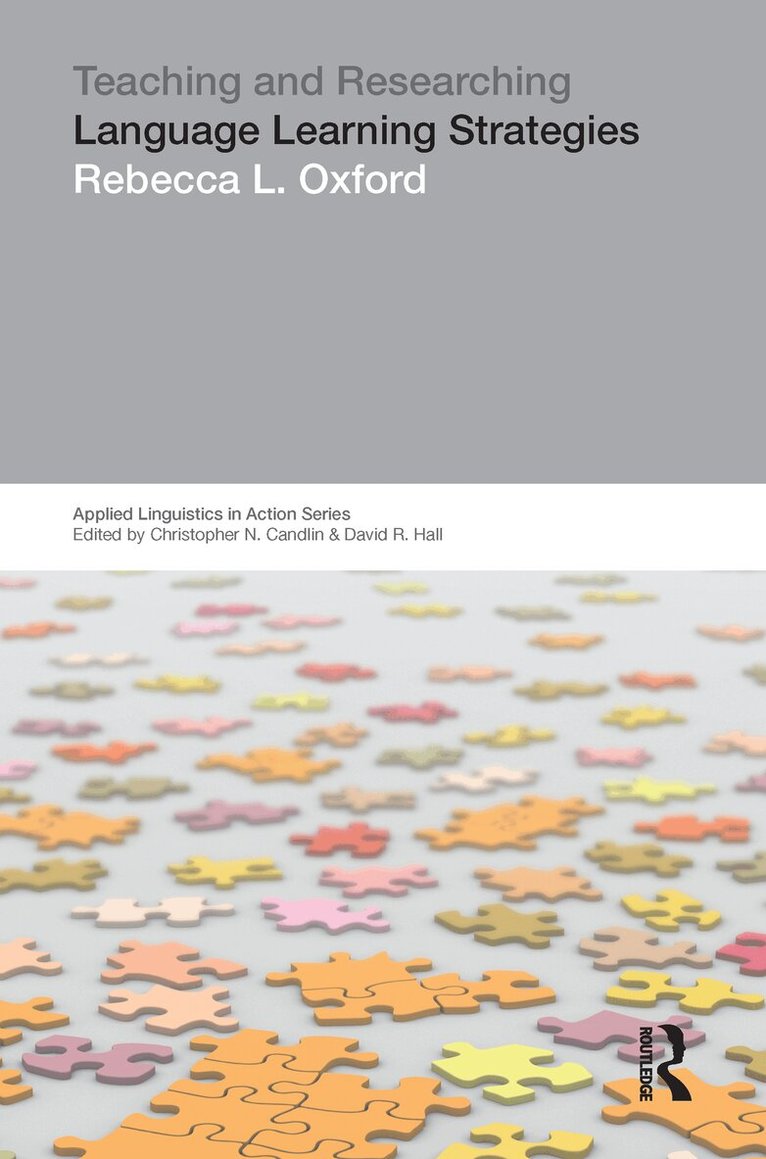
    Teaching & Researching: Language Learning Strategies

    AvRebecca L. Oxford

    E-bok
    Engelska, 2013

    Del i serien Applied Linguistics in Action

    743 kr

    Läs direkt i Bokus Reader – eller ladda ned till din enhet

    Fler format och utgåvor

    Inbunden

    2 495 kr

    E-bok

    745 kr

    Beskrivning

    Over the past thirty years, the field of language learning strategies has generated a massive amount of interest and research in applied linguistics. Teaching and Researching Language Learning Strategies redraws the landscape of language learning strategies at just the right time. In this book Rebecca Oxford charts the field systematically and coherently for the benefit of language learning practitioners, students, and researchers. Offering practical, innovative suggestions for assessing, teaching, and researching language learning strategies, she provides examples of strategies and tactics from all levels, from beginners to distinguished-level learners, as well as a new taxonomy of strategies for language learning.In demonstrating why self-regulated learning strategies are necessary for language proficiency, Oxford integrates socio-cultural, cognitive, and affective dimensions, and argues convincingly for the need for conceptual cross-fertilization. Providing clear and concise explanations of the advantages and limitations of the different approaches, this book is full of practical value and theoretical insights.The book is designed to guide the reader with the use of a range of features, including:key quotes and concept boxespreview questions and chapter overviewsglossary and end-of-chapter further readingssources and resources section

    Produktinformation

    • Utgivningsdatum:2013-11-26
    • Språk:Engelska
    • Filformat:EPUB
    • Kopieringsskydd:LCP
    • ISBN:9781317877998
    • Förlag:Taylor & Francis Ltd
    • Serie:Applied Linguistics in Action

    Utforska kategorier

    • Språkvetenskap och lingvistik inom Språk och ordböcker
    • Referensverk och tvärvetenskap inom Samhälle och politik

    Mer om författaren

    Rebecca L. Oxford is Professor Emerita, University of Maryland. She is the author of Language Learning Strategies: What Every Teacher Should Know (1990) and edited Language Learning Strategies: Cross-Cultural Perspectives (1996). She is currently working as Professor of Language Education and Research for the U.S. Air Force Culture and Language Center.

    Recensioner i media

    "Presents a relatively compact, well-resourced, and authoritative guide to the learning strategies field." - ELT Journal

    Innehållsförteckning

    • Table of ContentsForewordPart I: The Strategic Self-Regulation (S2R) Model of language learningChapter 1 Introducing the Strategic Self-Regulation (S2R) Model of language learning1.1Overview1.2 The S2R Model1.3 ConclusionFurther ReadingChapter 2 Dimension 1 (cognitive): Strategies for remembering and processing language2.1 Linked metaphors for metacognitive strategies and cognitive strategies2.2 Metacognitive knowledge, metacognitive strategies and metacognition2.3 Cognitive strategies2.4 Relevant theories and concepts2.5 ConclusionFurther ReadingChapter 3 Dimension 2 (affective): Strategies for emotions, beliefs, attitudes and motivation3.1 Linked metaphors for meta-affective and affective strategies3.2 Meta-affective knowledge, meta-affective strategies, and meta-affect3.3 Affective strategies3.4 Relevant theories and concepts3.5 ConclusionFurther ReadingChapter 4 Dimension 3 (sociocultural-interactive): Strategies for contexts, communication and culture4.1 Linked metaphors of meta-SI strategies and SI strategies4.2 Meta-SI knowledge, meta-SI strategies and the ‘meta’ level sociocultural-interaction4.3 SI strategies4.4 Relevant theories and concepts4.5 ConclusionFurther ReadingPart II: Authentic Uses of Strategy Assessment and Strategy AssistanceChapter 5 Strategy assessment in the S2R Model5.1 Purposes of strategy assesssment5.2 Key issues at the outset5.3 Strategy observations5.4 Actual-task verbal reports5.5 Colour-coding of actual-task strategies5.6 Learner portfolios that include task-related strategy assessment 5.7 Individual interviews for strategy assessment5.8 Group interviews and discussions for strategy assessment5.9 Discourse analysis for strategy assessment 5.10 Strategy questionnaires5.11 Narratives for strategy assessment5.12 Quality of strategy assessment tools5.13 ConclusionFurther ReadingChapter 6 Strategy instruction and other types of strategy assistance in the S2R Model6.1 Key terms6.2 Culture as a factor in excellent strategy assistance6.3 Strategy instruction in separate learning-to-learn courses or programmes6.4 Direct strategy instruction integrated into regular L2 courses6.5 Integrating strategy instruction into L2 textbooks and course materials6.6 The learning consultation service model6.7 Strategy instruction through learner guidebooks6.8 Strategy instruction in distance learning6.9 ConclusionFurther ReadingPart III: Researching Learning StrategiesChapter 7 A guide to conducting research on self-regulated L2 learning strategies7.1 Worldviews underlying various research methods7.2 Overview of methods for research 7.3 Quantitative research methods, models and validity7.4 Qualitative research methods, models and validity7.5 Mixed methods7.6 Action research7.7 General cautions in thinking about validity7.8 Reminders about research quality and utility regardless of method7.9 Ethics in L2 learning strategy research7.10 ConclusionFurther ReadingChapter 8 What we know from L2 learning strategy research8.1 L2 reading strategies8.2 L2 writing strategies8.3 L2 listening strategies8.4 L2 speaking strategies8.5 L2 vocabulary learning strategies8.6 L2 grammar learning strategies8.7 Comparisons across L2 areas8.8 Findings across more general strategy studies8.9 ConclusionFurther ReadingPart IV: Exploring FurtherChapter 9 Strategic ‘intellectual geography’ and resources for further exploration9.1 Part 1 of the geography lesson: review of landmarks of the S2R Model9.2 Part 2 of the geography lesson: the terrain of self-regulated L2 learning strategies9.3 Resources9.4 Strengthening relationships while expanding strategy research and instruction9.5 ConclusionFurther Reading