371 kr
Skickas inom 3-6 vardagar
371 kr
Skickas inom 3-6 vardagar
371 kr
Skickas inom 3-6 vardagar
2 552 kr
Skickas inom 10-15 vardagar
2 789 kr
Skickas inom 10-15 vardagar
836 kr
Skickas inom 10-15 vardagar
922 kr
Läs direkt efter köp
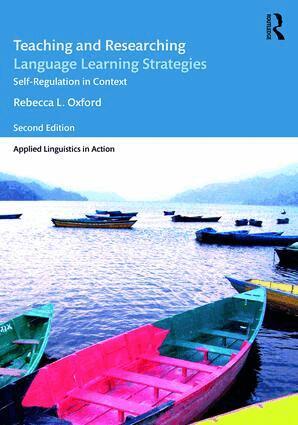
Now in its second edition, Teaching and Researching Language Learning Strategies: Self-Regulation in Context charts the field systematically and coherently for the benefit of language learning practitioners, students, and researchers. This volume carries on the author''s tradition of linking theoretical insights with readability and practical utility and offers an enhanced Strategic Self-Regulation Model. It is enriched by many new features, such as the first-ever major content analysis of published learning strategy definitions, leading to a long-awaited, encompassing strategy definition that, to a significant degree, brings order out of chaos in the strategy field. Rebecca L. Oxford provides an intensive discussion of self-regulation, agency, and related factors as the "soul of learning strategies." She ushers the strategy field into the twenty-first century with the first in-depth treatment of strategies and complexity theory.
A major section is devoted to applications of learning strategies in all language skill areas and in grammar and vocabulary. The last chapter presents innovations for strategy instruction, such as ways to deepen and differentiate strategy instruction to meet individual needs; a useful, scenario-based emotion regulation questionnaire; insights on new research methods; and results of two strategy instruction meta-analyses. This revised edition includes in-depth questions, tasks, and projects for readers in every chapter. This is the ideal textbook for upper-level undergraduate and graduate courses in TESOL, ELT, education, linguistics, and psychology.
866 kr
Läs direkt efter köp
Now in its second edition, Teaching and Researching Language Learning Strategies: Self-Regulation in Context charts the field systematically and coherently for the benefit of language learning practitioners, students, and researchers. This volume carries on the author''s tradition of linking theoretical insights with readability and practical utility and offers an enhanced Strategic Self-Regulation Model. It is enriched by many new features, such as the first-ever major content analysis of published learning strategy definitions, leading to a long-awaited, encompassing strategy definition that, to a significant degree, brings order out of chaos in the strategy field. Rebecca L. Oxford provides an intensive discussion of self-regulation, agency, and related factors as the "soul of learning strategies." She ushers the strategy field into the twenty-first century with the first in-depth treatment of strategies and complexity theory.
A major section is devoted to applications of learning strategies in all language skill areas and in grammar and vocabulary. The last chapter presents innovations for strategy instruction, such as ways to deepen and differentiate strategy instruction to meet individual needs; a useful, scenario-based emotion regulation questionnaire; insights on new research methods; and results of two strategy instruction meta-analyses. This revised edition includes in-depth questions, tasks, and projects for readers in every chapter. This is the ideal textbook for upper-level undergraduate and graduate courses in TESOL, ELT, education, linguistics, and psychology.
750 kr
Läs direkt efter köp
745 kr
Läs direkt efter köp
2 017 kr
Skickas inom 10-15 vardagar
519 kr
Läs direkt efter köp
519 kr
Läs direkt efter köp
481 kr
Skickas inom 10-15 vardagar
704 kr
Skickas inom 5-8 vardagar
1 192 kr
Skickas inom 5-8 vardagar
499 kr
Läs direkt efter köp
Transformative eco-education is environmental education that is literally needed to transform and save our planet, especially during the global ecological crises of our present century. Such education demands inner transformation of many deeply rooted ideas, such as the following: the Earth exists merely to provide for human comfort; the extinction or reduction of other species does not matter; we are free to consume or destroy natural resources at will but are safe from destruction ourselves; and the Earth will continue to sustain us, even if we do not sustain the Earth. Unless these concepts are changed, we will increase global warming and add to the ruin of much of the Earth.
This book presents powerful ideas for transformative eco-education. At this time of ever-increasing ecological crisis, such education is needed more than ever before. We urge readers to use the ideas and activities in this book with your students, develop them further, and create new conceptions to share with other educators and students.
The chapters in this book provide key principles, of which the following are just a few. First, educators can and should prepare students for natural disasters. Second, stories, case studies, the arts, and hands-on environmental experience, all enriched by reflection and discussion, can offer profound learning about ecology. Third, education at all levels can benefit from a true ecological emphasis. Fourth, teachers must receive preparation in how to employ transformative eco-education. Fifth, Indigenous wisdom can offer important, holistic, spiritual paths to understanding and caring for nature, and other spiritual traditions also provide valid ways of comprehending humans as part of the universal web of existence. Sixth, transformative eco-education can be an antidote to not only to environmental breakdown, but also to materialistic overconsumption and moral confusion. Seventh, we can only heal the Earth by also healing ourselves. If we heed these principles, together we can make transformative eco-education a blazing torch to light the path for the current century and beyond.
684 kr
Skickas inom 5-8 vardagar
1 158 kr
Skickas inom 5-8 vardagar
485 kr
Läs direkt efter köp
684 kr
Skickas inom 5-8 vardagar
1 158 kr
Skickas inom 5-8 vardagar
485 kr
Läs direkt efter köp
This book will expand the horizon of higher education, helping students, faculty and administrators to return to their roots and be in touch with their whole being. This book stresses that learning is much more than just accumulating knowledge and skills. Learning includes knowing ourselves—mind, body, and spirit. The learning of compassion, care, and service are as crucial or even more important in higher education in order for universities to address students’ individual needs and the society’s needs. Higher education must contribute to a better world. The book acknowledges that knowing not only comes from outside, but also comes from within. Wisdom is what guides students to be whole, true to themselves while learning. There are many ancient and modern approaches to gaining wisdom and wellness. This book talks about contemplative methods, such as meditation, qigong, yoga, arts, and dance, that help people gain wisdom and balance in their lives and enhance their ability to be reflective and transformative educators and learners.
694 kr
Skickas inom 5-8 vardagar
1 175 kr
Skickas inom 5-8 vardagar
492 kr
Läs direkt efter köp
Understanding Peace Cultures is exceptionally practical as well as theoretically grounded. As Elise Boulding tells us, culture consists of the shared values, ideas, practices, and artifacts of a group united by a common history. Rebecca Oxford explains that peace cultures are cultures, large or small, which foster any of the dimensions of peace – inner, interpersonal, intergroup, international, intercultural, or ecological – and thus help transform the world. As in her earlier book, The Language of Peace: Communicating to Create Harmony, Oxford contends here that peace is a serious and desirable option.
Excellent educators help build peace cultures. In this book, Shelley Wong and Rachel Grant reveal how highly diverse public school classrooms serve as peace cultures, using activities and themes founded on womanist and critical race theories. Yingji Wang portrays a peace culture in a university classroom. Rui Ma’s model reaches out interculturally to Abraham’s children: Jewish, Christian, and Muslim youth, who share an ancient heritage. Children’s literature (Rebecca Oxford et al.) and students’ own writing (Tina Wei) spread cultures of peace.
Deep traditions, such as African performance art, Buddhism, Daoism, Confucianism and Islam, give rise to peace cultures, as shown here by John Grayzel, Sister Jewel (a colleague of Thich Nhat Hanh), Yingji Wang et al., and Dian Marissa et al. Peace cultures also emerge in completely unexpected venues, such as gangsta rap, unveiled by Charles Blake et al., and a prison where inmates learn Lois Liggett’s “spiritual semantics.” Finally, the book includes perspectives from Jerusalem (by Lawrence Berlin) and North Korea and South Korea (by Carol Griffiths) to help us envision – and hope for – new, transformative peace cultures where now there is strife.
634 kr
Skickas inom 5-8 vardagar
1 122 kr
Skickas inom 5-8 vardagar
449 kr
Läs direkt efter köp
Spirituality and spiritual experiences have been the bedrock of every civilization and together form one of the highest mechanisms for making sense of the world for billions of people. Current research paradigms, due to their limitation to empirical, sensory, psychologically, or culturally constructed realities, fail to provide a framework for exploring this essential area of human experience. The development of a spiritual research paradigm will provide researchers from the social sciences and education the tools and abilities to systematically explore fundamental questions regarding human spiritual experiences and spiritual growth.
A spiritual research paradigm requires an ontology that considers all reality to be multidimensional, interconnected, and interdependent. It requires an epistemology that integrates knowing from outer sources as well as inner contemplation, acknowledging our integration of soul and spirit with the body and mind. Three additional aspects are useful to a spiritual research paradigm: axiology, methodology, and teleology. An axiology concerns what is valued, good, and ethical. A methodology is the appropriate approach to systematic inquiry. A fifth and less frequently mentioned aspect is teleology, an explanation of the goal or end (telos) to which new knowledge is applied, such as gaining wisdom and truth, touching the divine, increasing inner peace, exploring hidden dimensions, or improving society. This book takes the first step to develop such a research paradigm. We draw from world spiritual traditions as well as scholarship that has arisen from contemplative practices. We also attempt to build a bridge between science and spirituality. Spiritual research is not necessarily opposed to scientific research; in fact, each can shed light on the other.
Innovations in Theory and Practice
589 kr
Skickas inom 5-8 vardagar
Innovations in Theory and Practice
1 868 kr
Skickas inom 5-8 vardagar