• Fri frakt över 249 kr
  • •
  • Snabba leveranser
  • •
  • Billiga böcker
Kundservice

Du är på sajten för privatpersoner.

Företag, bibliotek eller offentlig verksamhet?

Du handlar på classic.bokus.com, där alla dina funktioner finns intakta.
Till classic.bokus.com
Bokus logotyp. Gå till startsidan.
  • Erbjudanden
  • Nyheter
  • Student
  • Topplistor
  • Barn & ungdom
  • Bokus Play
  • E-böcker
  • Pocketböcker
  • Spel & pussel

10% rabatt på allt med kod NYSTART10 →

Sidfot

Mina sidor

    Hjälp

    • Kundservice
    • Vanliga frågor och svar
    • Frakt och leverans
    • Retur vid ångerrätt
    • Reklamera vara
    • Betalning
    • Köpvillkor
    • Allmänna villkor
    • Information om webbplatsens tillgänglighet

    Om Bokus

    • Om oss
    • Pressrum
    • För studenter
    • För företag
    • För bibliotek och offentlig verksamhet
    • För leverantörer
    • Hållbarhet

    Populärt

    • Aktuella erbjudanden
    • Presentkort
    • Studentlitteratur
    • Nya böcker
    • Topplistor
    • Signerade böcker
    • Engelska böcker

    Inspiration

    • Boktips
    • BookTok
    • Populära bokserier
    • Barnbokskaraktärer
    • Populära författare
    Logotyp för Bokus
    Följ oss på Facebook (extern länk)Följ oss på Instagram (extern länk)Följ oss på YouTube (extern länk)Följ oss på TikTok (extern länk)
    bokus @ CookiesAnpassa cookiesIntegritetspolicyKöpvillkor
    Till Citymail hemsida (extern länk)Till Budbee hemsida (extern länk)Till Postnord hemsida (extern länk)Till Schenker hemsida (extern länk)Till Early Bird hemsida (extern länk)Till Walleys hemsida (extern länk)
    1. Skönlitteratur
    2. Dramatik
    • Nyhet

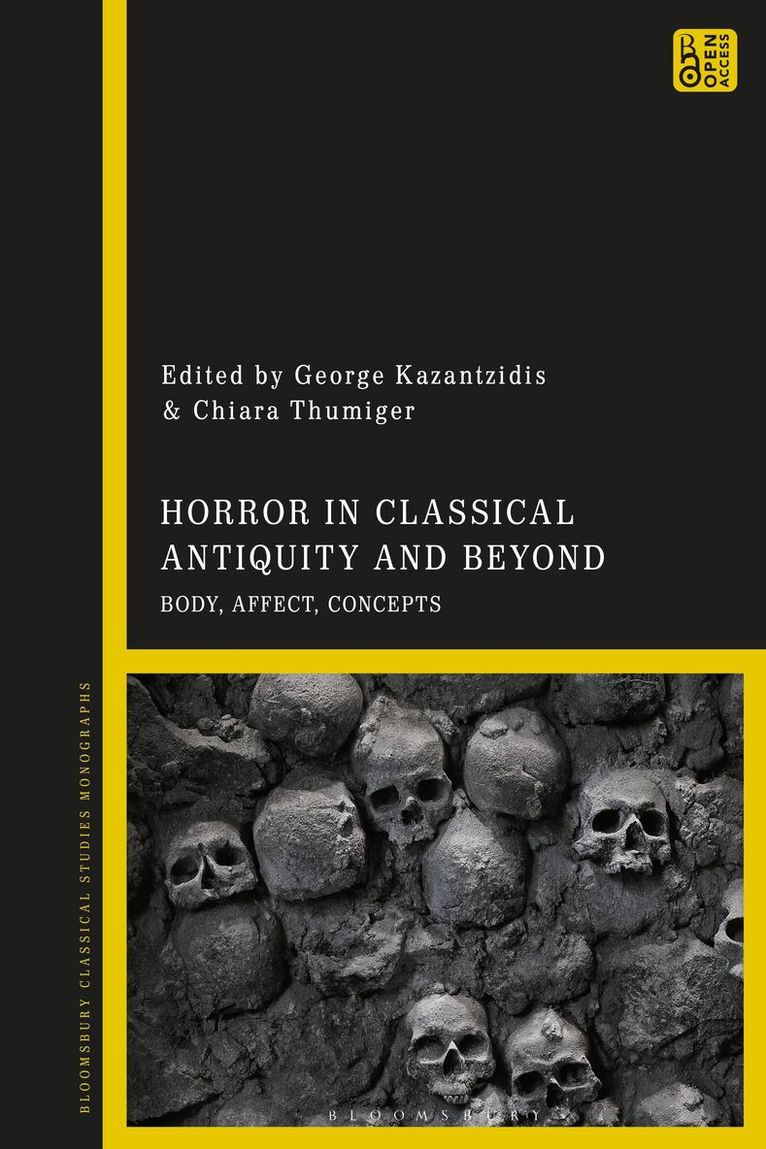
    Horror in Classical Antiquity and Beyond

    Body, Affect, Concepts

    AvChiara Thumiger,George Kazantzidis

    Häftad, Engelska, 2026

    398 kr

    Beställningsvara. Skickas inom 10-15 vardagar. Fri frakt över 249 kr.

    Beskrivning

    This open-access volume is the first to explore systematically and comprehensively the concept and category of ‘horror’ in antiquity. The contributors retrieve the ancient grammar of horror by paying equal attention to its affective and cognitive dimensions, and by looking at it as an embodied, enactive and full-rounded existential experience. They explore how horrifying experiences in antiquity are construed as embodied events while being conceptually rooted in cultural frameworks. They also showcase the ways in which the body itself can turn into a source of deep horror, be it in literary or medical texts and traditions in the Greek and Roman world, from the classical period to late antiquity.While maintaining a firm awareness of the fact that ‘horror’, a largely post-Romantic concept, is not unproblematic when applied to Graeco-Roman antiquity, this collection of studies shows that our Graeco-Roman past can shed substantial light on the ways in which the horrific is understood today, as a category of art but also of life itself.The eBook editions of this book are available open access under a CC BY-NC-ND 4.0 licence on bloomsburycollections.com. Open access was funded by the Exzellenzcluster ROOTS, Christian-Albrechts-Universität zu Kiel (Germany).

    Produktinformation

    • Utgivningsdatum:2026-09-17
    • Mått:156 x 234 x 17 mm
    • Vikt:446 g
    • Format:Häftad
    • Språk:Engelska
    • Antal sidor:320
    • Förlag:Bloomsbury Publishing PLC
    • ISBN:9781350380653

    Utforska kategorier

    • Dramatik inom Skönlitteratur
    • Kulturvetenskap inom Samhälle och politik
    • Psykologi inom Psykologi och pedagogik

    Mer om författaren

    George Kazantzidis is Associate Professor of Latin at the University of Patras, Greece. He is author of Lucretius on Disease: The Poetics of Morbidity in De rerum natura (2021), and co-editor of Body and Machine in Classical Antiquity (2023) and Medical Understandings of Emotions in Antiquity (2022).Chiara Thumiger is Research Fellow within the Cluster of Excellence Roots at Kiel University, Germany, and Guest Research Fellow at Humboldt University, Berlin. She is author of Phrenitis and the Pathology of the Mind in Western Medical Thought (2023), A History of the Mind and Mental Health in Classical Greek Medical Thought (2017) and Hidden Paths: Notions of Self, Tragic Characterization: Euripides’ Bacchae (2007).

    Recensioner i media

    This is a wide-ranging collection, dealing with many different aspects of how people might have experienced the emotion of horror in antiquity. Students and scholars with interests in this area will find much value in these pages.

    Innehållsförteckning

    • List of IllustrationsAcknowledgementsIntroduction: Embodied Experience, Literary Representations and Human Knowledge: Horror in Greco-Roman Antiquity and its Legacy1. Horror Now and Horror Then: Horror’s Long Reach from Antiquity to Modernity and Back Again, Kathleen Noelle Cruz (University of California–Davis, USA)2. Horror in the Odyssey: A Few Notes on Leodes’ Beheading (22.326–329), Giulia Maria Chesi (University of Humboldt, Germany)3. The Visceral Thrills of Tragedy: Flesh, Blood and Guts Off and On the Tragic Stage, Evina Sistakou (Aristotle University, Greece)4. The Horrific Body in Sophocles, Glenn Most (University of Chicago, USA)5. Naming the Monster: Forensic Horror and Collective Trauma in Cicero’s Pro Roscio, Sophia Luise Häberle (University of Humboldt, Germany)6. Fearful Laughter: Bodily Horror in Roman Sexual Humour, Jesse Weiner (Hamilton College, USA)7. Cruor in flores mutabitur: Horrific Hybridisations in the Metamorphoses of Ovid, Aline Estèves (University of Montpellier, France)8. Landscapes and Bodies of Horror in Seneca’s Thyestes, Simona Martorana (University of Kiel, Germany)9. The Vocabulary of Homicidal Horror in Libanius’ Against a Murderer, Debbie Felton (University of Massachusetts Amherst, USA)10. At the Borders of Horror and Science: The Social Contexts of Roman Dissection, Claire Bubb (Institute for the Study of the Ancient World–New York University, USA)11. Overcoming Horror: ‘Numbness’ and Medical Agents. Some Thoughts on Medical Horror in Antiquity and Today’, Lutz Alexander Graumann (Justus-Liebig-University Gießen–University Hospital, Germany)12. Recipes for Horror in Greco-Roman Magic and Medicine, Sean Coughlin (Institute of Philosophy–Czech Academy of Sciences, Czech Republic)13. Horror, Writing and Dissection in Sheridan LeFanu’s In a Glass Darkly, Arden Hegele (Columbia University, USA) NotesBibliographyIndex rerum et nominumIndex Locorum