• Fri frakt över 249 kr
  • •
  • Snabba leveranser
  • •
  • Billiga böcker
Kundservice

Du är på sajten för privatpersoner.

Företag, bibliotek eller offentlig verksamhet?

Du handlar på classic.bokus.com, där alla dina funktioner finns intakta.
Till classic.bokus.com
Bokus logotyp. Gå till startsidan.
  • Erbjudanden
  • Nyheter
  • Student
  • Topplistor
  • Barn & ungdom
  • Bokus Play
  • E-böcker
  • Pocketböcker
  • Spel & pussel

10% rabatt på allt med kod NYSTART10 →

Sidfot

Mina sidor

    Hjälp

    • Kundservice
    • Vanliga frågor och svar
    • Frakt och leverans
    • Retur vid ångerrätt
    • Reklamera vara
    • Betalning
    • Köpvillkor
    • Allmänna villkor
    • Information om webbplatsens tillgänglighet

    Om Bokus

    • Om oss
    • Pressrum
    • För studenter
    • För företag
    • För bibliotek och offentlig verksamhet
    • För leverantörer
    • Hållbarhet

    Populärt

    • Aktuella erbjudanden
    • Presentkort
    • Studentlitteratur
    • Nya böcker
    • Topplistor
    • Signerade böcker
    • Engelska böcker

    Inspiration

    • Boktips
    • BookTok
    • Populära bokserier
    • Barnbokskaraktärer
    • Populära författare
    Logotyp för Bokus
    Följ oss på Facebook (extern länk)Följ oss på Instagram (extern länk)Följ oss på YouTube (extern länk)Följ oss på TikTok (extern länk)
    bokus @ CookiesAnpassa cookiesIntegritetspolicyKöpvillkor
    Till Citymail hemsida (extern länk)Till Budbee hemsida (extern länk)Till Postnord hemsida (extern länk)Till Schenker hemsida (extern länk)Till Early Bird hemsida (extern länk)Till Walleys hemsida (extern länk)
    1. Data och IT
    2. Systemvetenskap och AI
    3. Artificiell intelligens

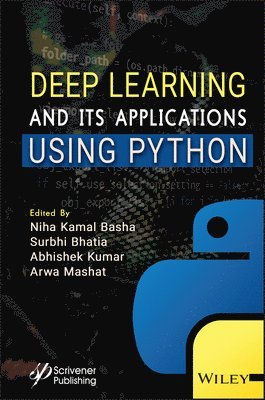
    Deep Learning and its Applications using Python

    AvNiha Kamal Basha,Surbhi Bhatia

    Inbunden, Engelska, 2023

    1 917 kr

    Beställningsvara. Skickas inom 5-8 vardagar. Fri frakt över 249 kr.

    Beskrivning

    DEEP LEARNING AND ITS APPLICATIONS USING PYTHON This practical book gives a detailed description of deep learning models and their implementation using Python programming relating to computer vision, natural language processing, and other applications. This book thoroughly explains deep learning models and how to use Python programming to implement them in applications such as NLP, face detection, face recognition, face analysis, and virtual assistance (chatbot, machine translation, etc.). It provides hands-on guidance in using Python for implementing deep learning application models. It also identifies future research directions for deep learning. Readers/users will discover A precise description of deep learning history, fundamental concepts, and background information relating to deep learning;A detailed introduction to several concepts including tensorflow and keras, starting from the fundamentals to the application-based concept implementation using Python;Explanations of multilayer perceptron, convolutional neural network, recurrent neural network, and long short-term memory in terms of applications like chatbot, face detection and recognition;Advanced deep learning concepts along with their future research advancements;Assist in building the reader’s understanding through intuitive explanations and practical examples by exploring challenging concepts in the related applications of computer vision, natural language processing, and other models.Audience The book is ideal for computer science researchers, industry professionals, as well as postgraduate and undergraduate students who want to learn how to program deep learning models using Python.

    Produktinformation

    • Utgivningsdatum:2023-10-16
    • Vikt:676 g
    • Format:Inbunden
    • Språk:Engelska
    • Antal sidor:256
    • Förlag:John Wiley & Sons Inc
    • ISBN:9781394166466

    Utforska kategorier

    • Artificiell intelligens inom Data och IT

    Mer om författaren

    Niha Kamal Basha is an assistant professor in the Department of Information Security, School of Computer Science and Engineering, Vellore Institute of Science and Technology, India. She has received a number of awards and published numerous research articles in peer-reviewed journals. Surbhi Bhatia, PhD, is an assistant professor in the Department of Information Systems, College of Computer Sciences and Information Technology, King Faisal University, Saudi Arabia. She has more than 10 years of teaching experience in different universities in India and Saudi Arabia. She has published many articles in peer-reviewed journals, authored or edited 9 books, and has been granted 8 national and international patents. Abhishek Kumar gained his PhD in computer science from the University of Madras, India in 2019. He is assistant director/associate professor in the Computer Science & Engineering Department, Chandigarh University, Punjab, India. He has more than 100 publications in peer-reviewed international and national journals, books & conferences. His research interests include artificial intelligence, image processing, computer vision, data mining, and machine learning. Arwa Mashat, gained her PhD in Instructional Design and Technology from Old Dominion University, Virginia, USA in 2017. She has a rich 14 years of teaching and academic experience. She is currently an assistant professor at the College of Computing and Information Technology, King Abdulaziz University, Saudi Arabia. She is currently the Vice Dean for two colleges; the College of Computing and Information Technology and the Applied College at King Abdulaziz University. She has published many research papers in reputed journals.

    Innehållsförteckning

    • Preface ix1 Introduction to Deep Learning 11.1 History of Deep Learning 11.2 A Probabilistic Theory of Deep Learning 41.3 Back Propagation and Regularization 141.4 Batch Normalization and VC Dimension 171.5 Neural Nets--Deep and Shallow Networks 181.6 Supervised and Semi-Supervised Learning 191.7 Deep Learning and Reinforcement Learning 212 Basics of TensorFlow 252.1 Tensors 252.2 Computational Graph and Session 272.3 Constants, Placeholders, and Variables 282.4 Creating Tensor 322.5 Working on Matrices 352.6 Activation Functions 362.7 Loss Functions 392.8 Common Loss Function 392.9 Optimizers 402.10 Metrics 413 Understanding and Working with Keras 453.1 Major Steps to Deep Learning Models 453.2 Load Data 473.3 Pre-Process Data 483.4 Define the Model 483.5 Compile the Model 493.6 Fit and Evaluate the Mode 513.7 Prediction 523.8 Save and Reload the Model 523.9 Additional Steps to Improve Keras Models 533.10 Keras with TensorFlow 554 Multilayer Perceptron 574.1 Artificial Neural Network 574.2 Single-Layer Perceptron 604.3 Multilayer Perceptron 614.4 Logistic Regression Model 614.5 Regression to MLP in TensorFlow 634.6 TensorFlow Steps to Build Models 634.7 Linear Regression in TensorFlow 634.8 Logistic Regression Mode in TensorFlow 674.9 Multilayer Perceptron in TensorFlow 694.10 Regression to MLP in Keras 724.11 Log-Linear Model 724.12 Keras Neural Network for Linear Regression 734.13 Keras Neural Network for Logistic Regression 734.14 MLPs on the Iris Data 754.15 MLPs on MNIST Data (Digit Classification) 764.16 MLPs on Randomly Generated Data 785 Convolutional Neural Networks in Tensorflow 815.1 CNN Architectures 815.2 Properties of CNN Representations 825.3 Convolution Layers, Pooling Layers - Strides - Padding and Fully Connected Layer 825.4 Why TensorFlow for CNN Models? 845.5 TensorFlow Code for Building an Image Classifier for MNIST Data 845.6 Using a High-Level API for Building CNN Models 885.7 CNN in Keras 885.8 Building an Image Classifier for MNIST Data in Keras 885.9 Building an Image Classifier with CIFAR-10 Data 895.10 Define the Model Architecture 905.11 Pre-Trained Models 916 RNN and LSTM 956.1 Concept of RNN 956.2 Concept of LSTM 966.3 Modes of LSTM 976.4 Sequence Prediction 986.5 Time-Series Forecasting with the LSTM Model 996.6 Speech to Text 1006.7 Examples Using Each API 1026.8 Text-to-Speech Conversion 1056.9 Cognitive Service Providers 1066.10 The Future of Speech Analytics 1077 Developing Chatbot's Face Detection and Recognition 1097.1 Why Chatbots? 1097.2 Designs and Functions of Chatbot's 1097.3 Steps for Building a Chatbot's 1107.4 Best Practices of Chatbot Development 1167.5 Face Detection 1167.6 Face Recognition 1177.7 Face Analysis 1177.8 OpenCV--Detecting a Face, Recognition and Face Analysis 1177.8.1 Face Detection 1177.8.2 Face Recognition 1207.9 Deep Learning-Based Face Recognition 1247.10 Transfer Learning 1277.11 API's 1318 Advanced Deep Learning 1338.1 Deep Convolutional Neural Networks (AlexNet) 1338.2 Networks Using Blocks (VGG) 1378.3 Network in Network (NiN) 1408.4 Networks with Parallel Concatenations (GoogLeNet) 1448.5 Residual Networks (ResNet) 1488.6 Densely Connected Networks (DenseNet) 1518.7 Gated Recurrent Units (GRU) 1548.8 Long Short-Term Memory (LSTM) 1568.9 Deep Recurrent Neural Networks (D-RNN) 1588.10 Bidirectional Recurrent Neural Networks (Bi-RNN) 1598.11 Machine Translation and the Dataset 1608.12 Sequence to Sequence Learning 1619 Enhanced Convolutional Neural Network 1679.1 Introduction 1679.2 Deep Learning-Based Architecture for Absence Seizure Detection 1789.3 EEG Signal Pre-Processing Strategy and Channel Selection 1809.4 Input Formulation and Augmentation of EEG Signal for Deep Learning Model 1889.5 Deep Learning Based Feature Extraction and Classification 1969.6 Performance Analysis 2009.7 Summary 20110 Conclusion 20510.1 Introduction 20510.2 Future Research Direction and Prospects 20510.3 Research Challenges in Deep Learning 21010.4 Practical Deep Learning Case Studies 21010.4.1 Medicine: Epilepsy Seizure Onset Prediction 21910.4.2 Using Data from Test Drills to Predict where to Drill for Oil 23210.5 Summary 235References 235Index 239