• Fri frakt över 249 kr
  • •
  • Snabba leveranser
  • •
  • Billiga böcker
Kundservice

Du är på sajten för privatpersoner.

Företag, bibliotek eller offentlig verksamhet?

Du handlar på classic.bokus.com, där alla dina funktioner finns intakta.
Till classic.bokus.com
Bokus logotyp. Gå till startsidan.
  • Erbjudanden
  • Nyheter
  • Student
  • Topplistor
  • Barn & ungdom
  • Bokus Play
  • E-böcker
  • Pocketböcker
  • Spel & pussel

10% rabatt på allt med kod: NYSTART10 →

Sidfot

Mina sidor

    Hjälp

    • Kundservice
    • Vanliga frågor och svar
    • Frakt och leverans
    • Retur vid ångerrätt
    • Reklamera vara
    • Betalning
    • Köpvillkor
    • Allmänna villkor
    • Information om webbplatsens tillgänglighet

    Om Bokus

    • Om oss
    • Pressrum
    • För studenter
    • För företag
    • För bibliotek och offentlig verksamhet
    • För leverantörer
    • Hållbarhet

    Populärt

    • Aktuella erbjudanden
    • Presentkort
    • Studentlitteratur
    • Nya böcker
    • Topplistor
    • Signerade böcker
    • Engelska böcker

    Inspiration

    • Boktips
    • BookTok
    • Populära bokserier
    • Barnbokskaraktärer
    • Populära författare
    Logotyp för Bokus
    Följ oss på Facebook (extern länk)Följ oss på Instagram (extern länk)Följ oss på YouTube (extern länk)Följ oss på TikTok (extern länk)
    bokus @ CookiesAnpassa cookiesIntegritetspolicyKöpvillkor
    Till Citymail hemsida (extern länk)Till Budbee hemsida (extern länk)Till Postnord hemsida (extern länk)Till Schenker hemsida (extern länk)Till Early Bird hemsida (extern länk)Till Walleys hemsida (extern länk)
    1. Naturvetenskap och teknik
    2. Teknik och industri
    3. Energiteknik

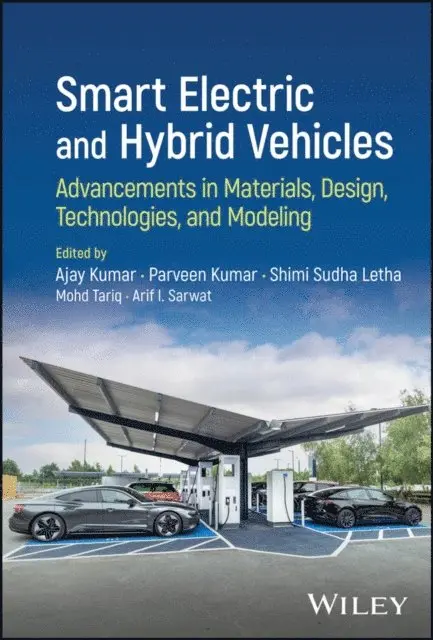
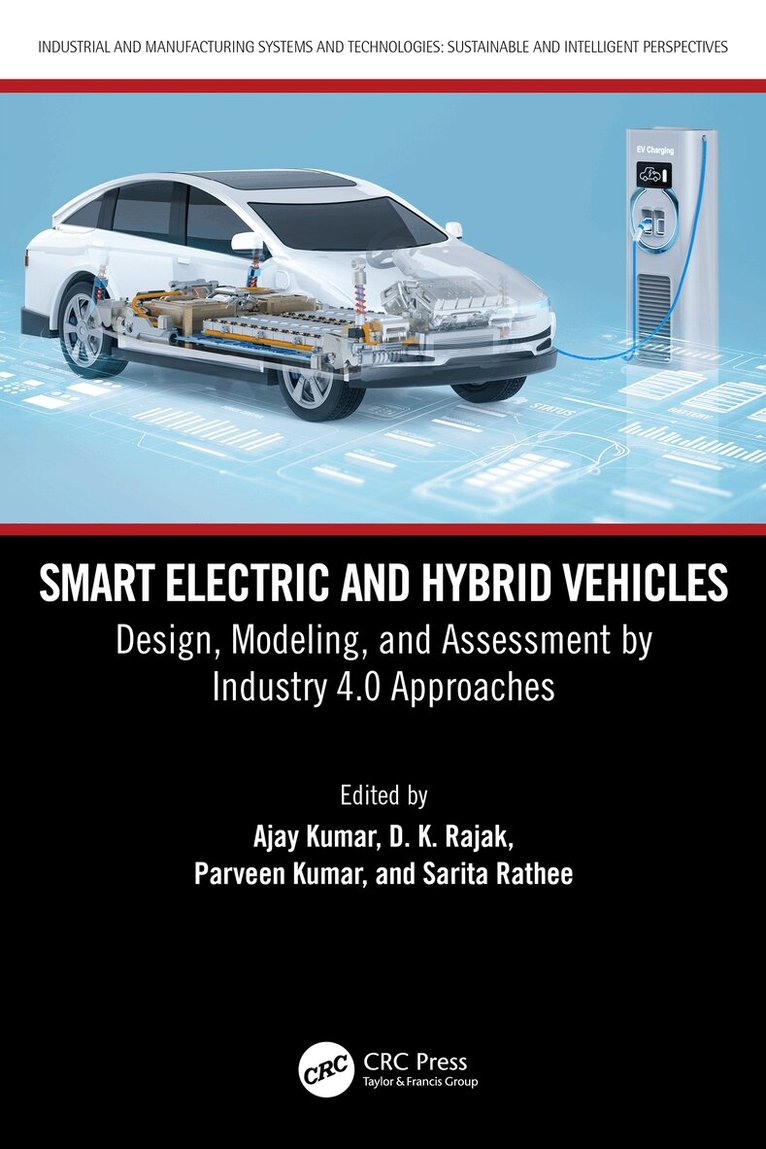
    Smart Electric and Hybrid Vehicles

    Advancements in Materials, Design, Technologies, and Modeling

    AvAjay Kumar,Mohd. Tariq

    Inbunden, Engelska, 2024

    1 512 kr

    Beställningsvara. Skickas inom 5-8 vardagar. Fri frakt över 249 kr.

    Beskrivning

    Thorough reference on technologies, designs, and strategies for electric and hybrid electric vehicles, featuring contributions from international experts Designed for readers who need to review different types of electric and hybrid vehicle designs and strategies in a single book, Smart Electric and Hybrid Vehicles: Advancements in Materials, Design, Technologies, and Modeling provides a broad overview of the field with additional resources to explore individual topics in greater depth. Abstracts, case studies, references to key data, and relevant numerical simulations are included throughout the text to aid in reader comprehension. This book introduces the global landscape of hybrid and electric vehicles, covering the available technologies from both a mechanical and electrical engineering perspective, presenting mathematical aspects of modeling and analysis, and surveying emerging trends and economic impacts. It also explains all fundamentals, regulations, policies, perceptions, and market competition aspects of intelligent electric vehicles, as well as how smart electric and hybrid vehicles can be utilized to reduce harmful emissions and reliance on fossil fuels over the lifecycle of a vehicle. Edited by a team of highly qualified academics, with contributions by an array of international experts, Smart Electric and Hybrid Vehicles: Advancements in Materials, Design, Technologies, and Modeling includes information on: Electric machine and inverter designs, maximum speed considerations, component cooling, power density, and material performanceBattery systems, fuel cells, plug-in vehicles, mechanical drives and storage systems, and the role of power electronics toolsThe impact of trends and technologies like AI, machine vision, and digital twins, as well as related cyber security considerationsOptimization of manufacturing waste, charging stations, sensing control, road trajectory prediction, and navigation systemsElectrical interfaces to protect against electric shock and cost effectiveness compared to gasoline-powered vehiclesSmart Electric and Hybrid Vehicles: Advancements in Materials, Design, Technologies, and Modeling is an essential reference on the subject for mechanical engineers, industrial engineers, and academic researchers working in the automotive sector. It is also an ideal learning resource for post-graduate students in the automotive field.

    Produktinformation

    • Utgivningsdatum:2024-11-14
    • Mått:165 x 237 x 26 mm
    • Vikt:694 g
    • Format:Inbunden
    • Språk:Engelska
    • Antal sidor:320
    • Förlag:John Wiley & Sons Inc
    • ISBN:9781394225019

    Utforska kategorier

    • Energiteknik inom Naturvetenskap och teknik
    • Motorfordon inom Naturvetenskap och teknik
    • Maskinteknik och material inom Naturvetenskap och teknik

    Mer om författaren

    Ajay Kumar, PhD, is a Professor in the Mechanical Engineering Department, School of Engineering and Technology, at JECRC University, Jaipur, India. Parveen Kumar is an Assistant Professor and Head of the Department of Mechanical Engineering at Rawal Institute of Engineering and Technology, Faridabad, Haryana, India. Shimi Sudha Letha, PhD, is an Associate Professor in the Electrical Engineering Department at Punjab Engineering College. Mohd Tariq, PhD, is a Postdoctoral Fellow at Florida International University. Arif I. Sarwat, PhD, is an Eminent Scholar Chaired Professor with the Department of Electrical and Computer Engineering at Florida International University.

    Innehållsförteckning

    • About the Editors xiiiList of Contributors xixPreface xxiiiAcknowledgments xxvii1 State Estimation and Cell Balancing for Lithium-Ion Batteries Powering Electrical Vehicles 1Ankit Kumar Sharma, Shimi Sudha Letha, Poonam Syal, Sarita Rathee, and Ajay Kumar1.1 Introduction 11.2 Battery Technologies Used in Electric Vehicles 41.2.1 Lead–Acid Battery 41.2.2 Nickel-Based Batteries 41.2.2.1 Nickel Cadmium 41.2.2.2 Nickel–Metal Hydride 41.2.3 Lithium-Ion Batteries 51.2.4 Sodium-Based Batteries 51.2.5 Metal–Air Batteries 61.2.6 Solid-State Batteries 61.3 Comparing Various Battery Technologies 61.4 Battery Management System 71.5 State Estimation 101.5.1 State of Charge 101.5.2 State of Health/Remaining Useful Life 111.5.3 Approaches for State Estimation 111.5.3.1 Direct Method 121.5.3.2 Model-Based Method 131.5.3.3 Data-Driven Method 151.6 Cell Balancing 191.6.1 Passive Cell Balancing 191.6.1.1 Fixed Shunt Resistor 201.6.1.2 Switched Shunt Resistor 201.6.2 Active Cell Balancing 211.6.2.1 Capacitor-Based Balancing 231.6.2.2 Inductor-Based Balancing 251.6.2.3 Transformer-Based Balancing 281.6.2.4 Converter-Based Balancing 301.7 Conclusion 38References 382 Impacts Due to Vehicle-to-Grid and Solar Photovoltaic Integration with the Grid 55S.L. Shimi, Roger Alves de Oliveira, Ajay Kumar, and Parveen Kumar2.1 Introduction 552.2 Issues Due to Photovoltaic System and Electric Vehicle Integration with Grid 562.3 V2G Power Converters Responsible for Power Quality Issues 582.4 Advanced Control Strategies of Bidirectional Converters 642.5 Wireless Battery Chargers with V2G Facility 652.6 Soft Computing Techniques to Evaluate Power Quality Issues 662.7 Conclusion 67References 673 Electric and Hybrid Vehicles 71Even Sekhri, Mahmoud Ibrahim, Rolando Gilbert Zequera, and Anton RassõlkinList of Abbreviations 713.1 Introduction 733.2 Energy Storage Systems for EVs and HEVs 733.3 EV/HEV Electromechanical Drive System 783.3.1 Electric Motors 793.3.1.1 Brushless Direct Current Motor 803.3.1.2 Induction Motors (IMs) 813.3.1.3 Permanent Magnet Synchronous Motor (PMSM) 823.3.1.4 Externally Excited Synchronous Motor (EESM) 833.3.1.5 Hybrid Excitation Synchronous Motors (HESMs) 833.3.1.6 Switched Reluctance Motor (SRM) 843.3.1.7 Permanent Magnet Assisted Synchronous Reluctance Motors (PMSynRMs) 853.3.2 Inverter and Controller 873.3.3 Control Strategies 883.3.3.1 Field Oriented Control (FOC) 893.3.3.2 Direct Torque Control (DTC) 913.3.3.3 Model Predictive Control (MPC) 913.3.3.4 Adaptive Control Strategy 923.4 Transmission Systems in EVs and HEVs 953.4.1 Types of Transmission Systems Used in EVs/HEVs 963.4.1.1 Single-Speed Transmission (SST) 963.4.1.2 Two-Speed Transmissions (TST) 983.4.1.3 Multi-Speed Transmissions (MST) 993.4.1.4 Continuously Variable Transmission (CVT) 1003.4.1.5 Infinitely Variable Transmission (IVT) 1013.4.1.6 Dual-Clutch Transmission (DCT) 1013.4.2 Comparative Studies Between Distinct Kinds of Transmission Systems 1023.4.3 Considerations for the Transmission Systems of HEVs 1033.4.4 Transmission Efficiency and Future of Transmission Systems for EVs and HEVs 1043.5 Differential System 1043.5.1 Differentials in EVs and HEVs 1053.5.2 Drivetrains of EVs and HEVs 1063.5.2.1 In-Wheel Motor Drivetrain 1063.5.2.2 Distributed EV Drivetrains 1073.6 Future Directions in EVs/HEVs 1083.7 Summary of the Chapter 109Acknowledgment 109Conflict of Interest 109References 1094 A Systematic Review on the Integration of Electric Vehicles in Maintaining Grid Stability 127Vineet Kumar, Rintu Khanna, Ajay Kumar, and Parveen Kumar4.1 Introduction 1274.2 Review on EV Integration for Energy Management of Grid-Connected RESs 1284.3 Review of EV Integration for Load Frequency Regulation 1314.4 Review of EV Integration for Power Quality Enhancement 1334.5 Challenges and Motivations for Future 135References 1375 Enhancing Efficiency 141Khadim Moin Siddiqui, Abhinav K. Gautam, and Beer Singh5.1 Introduction 1415.2 Modeling of Electric Vehicle Charger 1435.3 Working of Proposed Onboard EV Charger 1435.4 Simulation Model of Charger: Methodology and Implementation 1455.5 Analysis of Results: Insights and Findings 1495.5.1 Ideal Switching of Totem-Pole Converter 1495.5.2 Practical Switching of Totem-Pole Converter 1525.6 Conclusion 1555.7 Future Scope 155References 1576 A State of the Art of Recent Trends in Electric Vehicles Planning 159Pankaj Kumar Dubey, Bindeshwar Singh, Abhinav K. Gautam, Deependra Singh, and Marut Nandan Tripathi6.1 Introduction 1596.1.1 Categorization of Electric Vehicles 1606.1.2 Mathematical Problem Formulation 1616.2 Results and Discussions 1626.2.1 The Literature Survey of EVs Planning 1626.3 Market Scenarios of EVs 1726.4 Conclusion and Future Scope 173References 1737 Smart Electric and Hybrid Vehicle’s Role Toward Economic and Environmental Aspects 177B. Reji and Anu Singla7.1 Introduction 1777.1.1 Transportation Sector 1797.1.2 Electric Vehicle Market 1817.2 Environmental Aspects of EVs and HEVs 1847.2.1 Local Air Quality 1847.2.2 Greenhouse Gas Emission 1867.2.3 Battery Production and Its Recycling 1877.3 Economic Aspects of EVs and HEVs 1897.3.1 Economic Aspects in User’s Perspective 1897.3.1.1 Cost of Vehicles 1897.3.1.2 Low Maintenance and Running Cost 1907.3.1.3 Tax, Subsidy, and Other Incentives 1917.3.2 Economic Aspects in Social Perspective 1937.3.2.1 Employment Creation 1937.3.2.2 New Industrial Establishments 1957.4 Conclusion 195References 1968 Modeling and Simulation Study for Power Management and Battery Degradation of Smart Electric Vehicles 199Akhil Nigam, Hemant Sharma, Parveen Kumar, and Ajay Kumar8.1 Introduction 1998.2 Existing Challenges in Electric Vehicle Technology 2008.2.1 Limited Driving Range 2018.2.2 Insufficient Charging Infrastructure 2018.2.3 Long Charging Times 2018.2.4 Cost of Electric Vehicles 2018.2.4.1 Battery Life and Durability 2018.2.4.2 Environmental Impacts 2028.2.4.3 Grid Integration and Energy Management 2028.3 Existing Review of Electric Vehicle 2038.4 Emerging Techniques of Electric Vehicles 2048.4.1 Transportation System 2048.4.2 Electricity Market 2048.4.3 Distribution System Planning 2048.5 Types of Electric Vehicles 2058.6 Modeling Study of Electric Vehicle 2068.7 Circuit Description 2068.8 Operation of the System 2078.8.1 Variation in Speed 2078.8.2 Load Variation 2088.9 Results and Discussion 2088.10 Future Scope of Electric Vehicle 209References 2129 Design and Analysis of Bidirectional Charging Stations for Sustainability Roadmap for Smart Electric Vehicles 215Sarasij Adhikary and Pabitra Kumar Biswas9.1 Introduction 2159.2 Utilization of Electricity Grid 2179.3 EV Charging with Grid Integration 2189.4 Benefits and Impacts of Grid Integration of EV Battery 2199.4.1 Smart EV Charging and User Behavior Prediction and Impact on EV Smart Charging 2209.5 Bidirectional Converter 2219.5.1 Converter Explanation 2229.5.2 Active Front End (AFE) Converter 2239.5.3 DC–DC Converter 2239.5.4 Safety Features of Bidirectional Controller 2259.6 Mathematical Equation 2259.7 Simulation Model of Bidirectional Converter 2269.8 Result and Analysis 2279.9 Miscellaneous 2279.10 Conclusion 2279.11 Future Scope 229References 22910 Enhancing Accessibility and Interaction in Autonomous Vehicles 233G. Shanmugasundar, Janjhyam Venkata Naga Ramesh, Krishnasamy Karthik, Sampath Muthukumarasamy, Velumayil Ramesh, Sarita Rathee, and Ajay Kumar10.1 Introduction 23310.2 Related Works 23510.3 Materials and Methods 23710.3.1 Measurement and Hypotheses 23710.3.2 Architecture of HMI 23810.3.3 Procedure 23910.3.4 Measurement of Situational Awareness 24110.3.5 Evaluating the Acceptance of HMI 24110.4 Results and Discussion 24210.4.1 Situational Analysis 24310.4.2 Discomfort Feeling Assessment 24410.4.3 HMI Acceptance Evaluation 24610.5 Conclusion 247References 24811 Smart Electric and Hybrid Vehicles 251Athule Ngqalakwezi, Getrude Marape, Ashma Singh, and Parveen Kumar11.1 Introduction 25111.2 Mining Industry 25211.3 Decarbonization Strategy 25311.3.1 Electric Vehicles 25311.3.1.1 Hybrid Electric Hybrid (HEVs) 25411.3.1.2 Plug-in Hybrid Electric Vehicles (PHEVs) 25411.3.1.3 Battery Electric Vehicles (BEVs) 25511.3.1.4 Extended Range EVs (ER-EVs) 25511.3.1.5 Fuel Cell EVs (FCEVs) 25611.4 Electrification of Heavy Mining Haul Trucks 25611.4.1 Hybrid Mining Haul Trucks (Hydrogen and Battery-Powered) 25611.4.2 Mining Haul Trucks with ERS Systems 25711.5 Electric Vehicle Critical Components 25811.5.1 Batteries 25811.5.1.1 Lithium-Ion Batteries 25911.5.2 Fuel Cells 25911.6 Conclusion 261References 262Index 267