• Fri frakt över 249 kr
  • •
  • Snabba leveranser
  • •
  • Billiga böcker
Kundservice

Du är på sajten för privatpersoner.

Företag, bibliotek eller offentlig verksamhet?

Du handlar på classic.bokus.com, där alla dina funktioner finns intakta.
Till classic.bokus.com
Bokus logotyp. Gå till startsidan.
  • Erbjudanden
  • Nyheter
  • Student
  • Topplistor
  • Barn & ungdom
  • Bokus Play
  • E-böcker
  • Pocketböcker
  • Spel & pussel

10% rabatt på allt med kod NYSTART10 →

Sidfot

Mina sidor

    Hjälp

    • Kundservice
    • Vanliga frågor och svar
    • Frakt och leverans
    • Retur vid ångerrätt
    • Reklamera vara
    • Betalning
    • Köpvillkor
    • Allmänna villkor
    • Information om webbplatsens tillgänglighet

    Om Bokus

    • Om oss
    • Pressrum
    • För studenter
    • För företag
    • För bibliotek och offentlig verksamhet
    • För leverantörer
    • Hållbarhet

    Populärt

    • Aktuella erbjudanden
    • Presentkort
    • Studentlitteratur
    • Nya böcker
    • Topplistor
    • Signerade böcker
    • Engelska böcker

    Inspiration

    • Boktips
    • BookTok
    • Populära bokserier
    • Barnbokskaraktärer
    • Populära författare
    Logotyp för Bokus
    Följ oss på Facebook (extern länk)Följ oss på Instagram (extern länk)Följ oss på YouTube (extern länk)Följ oss på TikTok (extern länk)
    bokus @ CookiesAnpassa cookiesIntegritetspolicyKöpvillkor
    Till Citymail hemsida (extern länk)Till Budbee hemsida (extern länk)Till Postnord hemsida (extern länk)Till Schenker hemsida (extern länk)Till Early Bird hemsida (extern länk)Till Walleys hemsida (extern länk)
    1. Medicin
    2. Andra medicinska specialiteter
    3. Rättsmedicin

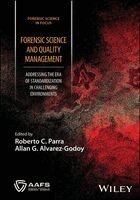
    Forensic Science and Quality Management

    Addressing the Era of Standardization in Challenging Environments

    AvRoberto C. Parra,Allan G. Alvarez-Godoy

    Inbunden, Engelska, 2026

    Del i serien Forensic Science in Focus

    1 720 kr

    Beställningsvara. Skickas inom 5-8 vardagar. Fri frakt över 249 kr.

    Beskrivning

    Explores how global standards in forensic science can be applied across diverse and challenging contexts The global move toward standardisation in forensic sciences promises reliability, transparency, and a shared professional language. Forensic Science and Quality Management examines how these aspirations intersect with the realities of working in politically, socially, and economically challenging environments. Through expert analysis and international case studies, the volume examines how rigorous standards can—and must—be adapted to function ethically and effectively in contexts marked by limited resources, instability, and humanitarian crises. Contributions from internationally recognised experts and field practitioners emphasise that achieving quality in forensic science extends beyond procedural compliance—it requires balancing technical accuracy with ethical awareness, contextual understanding, and sensitivity to human rights. In-depth chapters examine the implementation of quality management frameworks in regions around the world, the adaptation of various international protocols, and the application of advanced technologies such as DNA analysis and artificial intelligence. By bringing together theory, practice, and lived experience, this collection challenges the notion that standardisation alone guarantees justice. Illustrating how forensic professionals innovate within constraints while demonstrating resilience and integrity in the pursuit of human rights, victims’ dignity, and the fight against impunity. Forensic Science and Quality Management: Analyses how global forensic standards can be adapted to varied social, political, and economic environmentsDraws on real-world examples from Latin America, Africa, and other regions affected by conflict and limited resourcesOffers critical insight into the evolving relationship between standardisation, ethics, and justice — recognising modern forensic science principles as first-order foundations for credibility and accountabilityDiscusses the tension between accreditation and genuine institutional strengtheningHighlights the role of forensic science in promoting accountability, human rights, respect for victims’ dignity, and the pursuit of transitional justiceForensic Science and Quality Management: Addressing the Era of Standardisation in Challenging Environments is essential reading for forensic scientists, criminologists, criminalistics, legal professionals, transitional justice experts, political actors and human rights investigators working in both stable and complex environments. It is also a valuable text for postgraduate courses in forensic science, criminal justice, transitional justice and human rights law within degrees in law, forensic science, humanitarian actions, and social sciences.

    Produktinformation

    • Utgivningsdatum:2026-05-07
    • Mått:184 x 263 x 20 mm
    • Vikt:925 g
    • Format:Inbunden
    • Språk:Engelska
    • Serie:Forensic Science in Focus
    • Antal sidor:304
    • Förlag:John Wiley & Sons Inc
    • ISBN:9781394240371

    Utforska kategorier

    • Rättsmedicin inom Medicin

    Mer om författaren

    Roberto C. Parra, A Peruvian forensic specialist with 25 years of professional experience, he combines scientific rigor and Quality Assurance with extensive work in challenging forensic environments to strengthen institutions. He is currently a member of the forensic team of the United Nations Joint Human Rights Office (UNJHRO) of the Office of the United Nations High Commissioner for Human Rights (OHCHR) in the Democratic Republic of the Congo, contributing to transitional justice processes and the fight against impunity. Allan G. Alvarez-Godoy, a Guatemalan forensic specialist with extensive international experience, he works for international organizations, where he applies scientific and technical expertise to the investigation of serious crimes. He has worked in challenging and high-risk environments, contributing to transitional justice and the fight against impunity, while strengthening institutions and promoting human rights in conflict and post-conflict contexts.

    Innehållsförteckning

    • About the Editors xvList of Contributors xviiPreface xixSeries Preface xxiAcknowledgments xxiiiIntroduction xxv1 Forensic Quality Management and Era of Standardization: Where the Rubber Meets the Road in Challenging Environments 1Roberto C. Parra Eva Bruenisholz and Claude Roux1.1 Introduction 11.1.1 Historical Development and the Rise of Standardization 11.1.2 Refocusing on Quality: From Checklist Culture to Scientific Judgment 41.1.3 Balancing Standardization and Professional Autonomy 61.1.4 The Epistemic Gap and the Need for Scientific Culture 61.1.5 From Administrative Compliance to Critical Forensic Science 71.1.6 Chapter Roadmap 81.2 Quality Management in Forensic Science: From Tradition to Transformation 91.2.1 Purposes and Institutional Justification 91.2.2 Toward a Forensic Scientific Culture 111.3 The Standardization Era: The Forensic Shift and Industrial Ideals 131.3.1 Mean vs. Purpose 141.3.2 The Forensic Quality Paradox 161.4 Quality in Challenging Environments: Where the Rubber Meets the Road 171.4.1 Brief Overview of the Sydney Declaration 201.4.2 The Sydney Declaration as an Overarching Strategic Quality Framework for Challenging Environments 221.4.2.1 Enhancing Reliability Through Scientific Grounding 231.4.2.2 Ensuring Relevance 241.4.2.3 Supporting Effectiveness and Relevance in Diverse Contexts 251.4.2.4 Enabling Flexibility and Adaptability 251.4.2.5 Encourage Innovation While Maintaining Integrity 261.4.3 Forensic Science in Practice: Intersecting the Mechanisms of Compliance with Epistemic Logic 281.5 Conclusion: How Should the Road Actually Appear? 30References 332 Artificial Intelligence in Forensic Science: An Important Opportunity for Challenging Environments 37Roberto C. Parra Gian Carlo Iannacone and Allan G. Alvarez-Godoy2.1 Introduction 372.2 Impact of Artificial Intelligence on Forensic Sciences Within the Framework of the Principles of the Sydney Declaration 402.2.1 Evidence Identification with AI and Nanotechnology 402.2.2 Automation and Robotization in Forensic Analysis 412.2.3 Association of Traces with Context and Time 422.2.4 Interpretation of Results and Generation of Forensic Reports 432.3 Critical Points to Consider in the Implementation of Forensic AI 462.3.1 Neural Networks 462.3.2 Large Language Models (LLMs) 462.3.3 Data Quality and Representativeness 472.3.4 Cross-validation 472.3.5 Overfitting 472.3.6 Explainability (XAI) 482.4 Improving Quality Standards in Countries Without ISO Certification 482.5 Ethical Risks and Challenges of Artificial Intelligence in Forensic Science 502.5.1 The Black Box in Forensic Artificial Intelligence: Balancing Technical Effectiveness with Epistemological Vulnerability 522.5.2 Ethical Crossroads in Forensic Science: Navigating the AI Revolution and the Future of the Forensic Professional 542.6 Forensic Quality Operational Skepticism and Artificial Intelligence as a Bridge Between Standards and Innovation 562.7 Conclusion 58References 583 A Universal Guidance Model: The Minnesota Protocol in Challenging Environments 63Roberto C. Parra Pierre Perich Allan G. Alvarez-Godoy Michael Pollanen Daouda Traore Jorge L. Vasquez-Guerrero Omer O. Adjibode John Mbewu-Bodji and Sami El Jundi3.1 Introduction 633.2 Foundations of the Minnesota Protocol (2016) 653.3 The Duty to Investigate in Challenging Environments 683.4 Implementation Strategies Adapted to Challenging Contexts 713.5 Best Practices and Relevant Experiences 743.6 Recurring Challenges 773.7 Value of the Protocol as a Universal Standard in the Fight Against Impunity 783.8 Conclusions 80References 824 Deaths in Custody Are a Silent Global Tragedy: An Analysis of Burkina Faso’s Challenging Environment in Dialogue with International Experiences 83Daouda Traore Roberto C. Parra Norbert W. Ramde Béraré Doudoulgou Ratouissamda Kagambega Omer O. Adjibode and Jorge L. Vasquez-Guerrero4.1 Introduction 834.2 Death in Custody and Limits on Institutions in Burkina Faso 854.2.1 The Rules and Structure of Detention in Burkina Faso 854.2.2 Design of Forensic Study 854.2.3 Profile of the Victim 864.2.4 Structural Problems and Conditions of Detention 864.2.5 Forensic Findings and Circumstances of Death 864.2.6 Critical Analysis 874.3 Considerations of International Good Practices that Land in the Practice of Challenging Environments 874.3.1 The ICRC Approach: Essential Elements that Should be Known Regarding Forensic Work 884.3.2 Broadening the Definition 884.3.3 Comparative Evidence: The Chinese Case 894.3.4 United Nations Observations: Report A/HRC/53/29 894.3.5 Documentation to Prevent 894.4 The Debate About What It Means to Death in Custody: Bioethical and Structural Aspects 904.4.1 Beyond the Physical Location: The Continuum of State Custody 904.4.2 Strategies for Institutional Evasion and Dispersed Accountability 904.4.3 Natural Death vs. Preventable Death: Ethical and Forensic Consequences 914.4.4 Invisibility Underreporting and Access to the Truth 914.4.5 Last Reflections 924.5 Comparison with China: A Proven System Faces Persistent Structural Challenges 934.5.1 Comparative Profile: Quantity Age and Etiologies of Mortality 944.5.2 The Contradiction of Accreditation Devoid of Reflexive Transformation 944.5.3 The Function of Forensic Medicine in Both Scenarios 944.5.4 Mechanisms for External Control and Oversight 954.5.5 The Weight of Political and Cultural Contexts 954.5.6 Last Reflections 954.6 Recommendations for Action in Challenging Environments 964.6.1 Changing the Idea of State Custody 964.6.2 Treat all Deaths in Custody as Potentially Suspicious 964.6.3 Ensuring the Independence of Experts and the Integrity of the Forensic Process 974.6.4 Create National Registries and External Oversight Mechanisms 984.6.5 Training Prison and Judicial Officials 994.6.6 Guarantee Participation and Reparation for Victims and their Families 994.7 Conclusion: Protecting Life on the Margins of the System 99References 1015 From Conflict to Cooperation: ICRC’s Forensic Humanitarian Efforts in Challenging Contexts 103Denise Abboud Vincent Mazraani Rafael De Abreu E Souza Maria Dolores Morcillo Mendez Jane Taylor and Pierre Guyomarc’h5.1 Introduction 1035.2 The Establishment of the Forensic Unit: An ICRC Commitment to Forensic Humanitarian Action 1045.3 The ICRC Forensic Unit 1055.4 Forensic Humanitarian Action by ICRC 1075.5 Strengthening of Medico Legal Systems in Challenging Environments: Medico-legal Systems and their Role in the Response to Issues of Humanitarian Concern 1085.5.1 Gaps and Challenges 1105.6 Implementation of Quality Management Systems 1125.6.1 Good Governance in Forensic Practices 1135.6.2 Total Quality Management (TQM) Principles Applied to Forensic Practices 1135.6.3 Process-based Approach to Quality Management System 1145.6.4 Six Mandatory Factors for Effective Forensic Process Management 1145.6.5 Implementation Steps 1155.7 Maintaining Quality Management in Forensics 1165.8 Challenges and Solutions in Forensic Operations 1165.9 Future Directions and Recommendations 1205.9.1 Recommendations for Advancing Forensic Science Capacity in the Arab World 1215.10 Conclusion 124References 1256 Sexual Violence in Armed Conflict: Promoting Forensic Evidence as a Humanitarian Action 127Roberto C. Parra Allan G. Alvarez-Godoy Daouda Traore Pierre Perich Omer O. Adjibode John Mbewu-Bodji and Sami EL Jundi6.1 Introduction: Naming the Unspeakable Preserving the Invaluable 1276.2 Contemporary Approaches to Sexual Violence in Conflict 1296.2.1 Sexual Violence as an International Crime and as Structural Violence 1296.2.2 From Silence to Litigation: Evolution of the Forensic Approach 1316.2.3 Emergence of the Forensic Science in Humanitarian Model 1326.3 Structural and Operational Challenges in Conflict Contexts 1336.3.1 Scenarios of Protracted Conflict and Institutional Weakening 1346.3.2 Systemic Impunity and Obstacles to Access to Justice 1346.3.3 Forensic Limitations: Lack of Protocols Training and Resources 1356.3.4 Time as a Forensic Enemy: Delay Disappearance and Deterioration 1356.3.5 Inequality in the Capacities of Medical and Judicial Personnel 1366.3.6 Risks for Victims and Intervening Personnel 1376.4 Case Study: DRC Post-conflict and the Implementation of the International Protocol 1376.4.1 X Case: Clinical Documentation with Humanitarian Approach 1386.4.2 Y Case: Direct Application of the International Forensic Protocol 1396.4.3 Comparative Analysis and Lessons Learned 1406.4.4 Role of Forensic Team UNJHRO and the Implementation of the International Protocol 1416.4.5 Local Adaptation: Inclusion of Sociocultural and Clinical Variables 1426.4.6 Adaptation Results: Quality Completeness and Forensic Utility 1436.5 Lessons Learned and Replicability 1436.6 Methodological Comparison: International Protocol vs. Clinical Form 1446.6.1 Differences in Objectives: Medical Assistance vs. Forensic Evidence Collection 1446.6.2 Form Structure: Level of Detail and Organization of Information 1456.6.3 Technical Language vs. Clinical Accessibility 1456.6.4 Consent Confidentiality and Data Protection 1466.6.5 Judicial Value and Use in Litigation 1476.6.6 Adaptability to Adverse Contexts 1476.7 Forensic Protection as a Humanitarian Act 1486.7.1 Beyond Evidence: Forensic Science in Humanitarian Contexts 1496.7.2 The Ethics of Care in Forensic Contexts 1496.7.3 The Role of Informed Consent as a Pillar of Dignity 1506.7.4 Documenting to Protect: Prevention as a Humanitarian Dimension 1506.7.5 The Role of the Community and Local Knowledge 1516.7.6 Forensic Science and Humanitarian Action: A Necessary Link 1516.8 Ethical Considerations and Protection of Information 1526.8.1 Confidentiality in Contexts of Risk 1526.8.2 Risks of Revictimization Coercion or Misuse of Data 1536.8.3 Principles of the International Protocol and ICRC Standards 1536.8.4 Emerging Technologies: Advantages and Risks in Forensic Documentation (MediCapt GBVIMS) 1546.9 Towards a Resilient Forensic System in Adverse Contexts 1556.9.1 Training of Local Personnel with International Standards 1566.9.2 Flexible Yet Robust Protocols Adaptable to Multiple Scenarios 1566.9.3 Articulation Between Health Justice and Humanitarian Action 1576.9.4 The Integrated Forensic Approach in Transitional Justice 1576.10 Conclusion 158References 1607 Quality Management in Forensic Science in Panama: Advances Challenges and Perspectives 165José Vicente Pachar Lucio7.1 Introduction 1657.2 Regulatory Framework and International Context 1667.3 Accreditation Progress in Panama 1677.4 Challenges Faced During the Process 1687.4.1 Technical and Operational Challenges 1687.4.2 Staff Training and Competence 1687.4.3 Documentation and Information Management 1687.4.4 Financial and Economic Resources 1697.4.5 Quality Management and Organizational Culture 1697.4.6 Integration with Other Systems and Their Users 1697.5 Institutional and Social Impact 1707.6 Conclusions 170References 1708 Peruvian Efforts to Strengthen the Quality of Forensic Practice: Limitations and Advances in Standardization 173Gian Carlo Iannacone Marleny Huerta-Valdivia Jorge Vasquez-Guerrero and Roberto C. Parra8.1 Introduction 1738.2 Brief Review of the IMLFC-Perú 1748.3 Macro-level Process Flow of the IMLFC-Perú Forensic Services 1788.4 Integration of Processes Within the Framework of the Sydney Declaration 1798.5 Strategies from IMLFC-Peru for Quality Assurance: Applying the Declaration of Sydney as an Efficient Alternative 1828.5.1 Preconditions in the Framework of Forensic Process 1828.5.2 Planning and Evaluation of Biases for a Correct Forensic Analysis 1858.5.3 Analysis of Forensic Results 1888.5.3.1 Necropsy Attention in Remote Areas of Peru 1898.5.3.2 Opportunity for Auxiliary Services in Thanatology and Forensic Clinic 1918.5.3.3 DNA Databank in Cases of Sexual and Criminal Violence 1928.5.4 Multidisciplinary Interpretation of Forensic Results 1958.5.5 Presentation in Court by the Forensic Professionals 1968.6 Conclusion 197References 1989 Guatemalan’s Efforts to Strengthen the Quality of Forensic Practice: Limitations and Advances 203Ruth Garcia-Marroquin and Allan G. Alvarez-Godoy9.1 Introduction 2039.1.1 Generalities About Guatemala 2039.1.2 Dispersion of Guatemalan Forensic Science and the Need to Harmonize Management 2059.2 National Institute of Forensic Sciences of Guatemala (INACIF) 2069.2.1 Acoustics Laboratory 2089.2.2 Environmental Analysis Laboratory 2089.2.3 Laboratory of Anthropology and Archaeology 2099.2.4 Ballistics Laboratory 2099.2.5 Forensic Entomology Laboratory 2119.2.6 Documentoscopy Laboratory 2129.2.7 Physical Chemistry Laboratory 2139.2.8 Vehicle Identification Laboratory 2139.2.9 Computer Forensic Laboratory 2149.2.10 Linguistics Laboratory 2149.2.11 Controlled Substances Laboratory 2149.2.12 Toxicology Laboratory 2159.2.13 Lophoscopy Laboratory 2159.2.14 Serology and Genetics Laboratory 2159.3 Support from International Cooperation 2169.3.1 Accreditation Process 2169.3.2 The Role of International Cooperation in the Strengthening and Accreditation of INACIF’s Crime Laboratories 2199.3.3 Challenges for INACIF to Maintain the Accreditation of Its Laboratories 2219.4 Conclusion 222References 22310 Latin America in Forensic Action: Quality Standards Alone Do Not Provide an Infallible Quality Assurance 225Roberto C. Parra Gian Carlo Iannacone Allan G. Alvarez-Godoy Daniel Castellanos Ruth Garcia-Marroquin and Jorge L. Vasquez-Guerrero10.1 Introduction 22510.1.1 The Mirage of Forensic Quality in Latin America 22710.2 International Standards: Foundations and Limitations in their Forensic Applicability 22810.2.1 A Standard Outside Its Original Context 22910.2.2 The Risk of Operational Fragmentation 22910.2.3 The Internal Logic of the Accreditation Drive 23010.2.4 Costs Documentation and Sustainability 23010.2.5 Toward a Contextual and Integrated Vision of Quality 23110.3 Accreditation and Forensic Practice: Diverse Trajectories in Latin America 23110.3.1 Colombia: Institutional Articulation and Technical Maturity 23410.3.2 Chile: Expert Modernization and Systemic Approach 23410.3.3 Brazil: Technical Leadership in Tension with Structural Inequality 23510.3.4 Guatemala: Technical Advances and Sustained Institutional Will 23510.3.5 Peru: Structural Fragmentation and Quality Stagnation 23610.4 Myths and Realities of Quality Discourse: Between the Normative Symbol and Effective Transformation 23710.4.1 Myth 1: Accreditation as an Automatic Guarantee of Quality 23710.4.2 Myth 2: The Standard Is Universally Applicable Without Adaptation 23810.4.3 Myth 3: More Documentation Equals More Control 23810.4.4 Myth 4: Technical Quality Guarantees Scientific Integrity 23910.4.5 Conditions for Overcoming Quality Fetishism 23910.4.6 Toward a Meaningful Culture of Quality 24010.5 Elements for Contextual and Comprehensive Quality: From the Sydney Declaration to Its Applicability in Latin America 24110.5.1 Shifting the Focus: From Tools to Fundamentals 24110.5.2 Overcoming the Illusion of Accreditation as the Ultimate Goal 24210.5.3 Building Systems Centered on Human Potential and Knowledge 24310.5.4 Ensure Systemic Approach and Operational Coherence 24410.5.5 Promote a Scientific Culture Instead of an Administrative Culture 24510.5.6 Toward a Contextualized Normative Architecture 24610.5.7 Applicability and Projection of the Sydney Declaration in Latin America 24710.5.8 Final Reflection: A New Look at Latin American Forensic Quality 249References 25011 The Sydney Declaration as an Operational Approach to Challenging Forensic Environments 251Roberto C. Parra and Claude Roux11.1 Introduction 25111.2 Reflections Throughout the Volume 25211.3 Conclusion 254References 255Index 257