• Fri frakt över 249 kr
  • •
  • Snabba leveranser
  • •
  • Billiga böcker
Kundservice

Du är på sajten för privatpersoner.

Företag, bibliotek eller offentlig verksamhet?

Du handlar på classic.bokus.com, där alla dina funktioner finns intakta.
Till classic.bokus.com
Bokus logotyp. Gå till startsidan.
  • Erbjudanden
  • Nyheter
  • Student
  • Topplistor
  • Barn & ungdom
  • Bokus Play
  • E-böcker
  • Pocketböcker
  • Spel & pussel

10% rabatt på allt med kod: NYSTART10 →

Sidfot

Mina sidor

    Hjälp

    • Kundservice
    • Vanliga frågor och svar
    • Frakt och leverans
    • Retur vid ångerrätt
    • Reklamera vara
    • Betalning
    • Köpvillkor
    • Allmänna villkor
    • Information om webbplatsens tillgänglighet

    Om Bokus

    • Om oss
    • Pressrum
    • För studenter
    • För företag
    • För bibliotek och offentlig verksamhet
    • För leverantörer
    • Hållbarhet

    Populärt

    • Aktuella erbjudanden
    • Presentkort
    • Studentlitteratur
    • Nya böcker
    • Topplistor
    • Signerade böcker
    • Engelska böcker

    Inspiration

    • Boktips
    • BookTok
    • Populära bokserier
    • Barnbokskaraktärer
    • Populära författare
    Logotyp för Bokus
    Följ oss på Facebook (extern länk)Följ oss på Instagram (extern länk)Följ oss på YouTube (extern länk)Följ oss på TikTok (extern länk)
    bokus @ CookiesAnpassa cookiesIntegritetspolicyKöpvillkor
    Till Citymail hemsida (extern länk)Till Budbee hemsida (extern länk)Till Postnord hemsida (extern länk)Till Schenker hemsida (extern länk)Till Early Bird hemsida (extern länk)Till Walleys hemsida (extern länk)
    1. Psykologi och pedagogik
    2. Psykologi
    3. Psykologisk metod

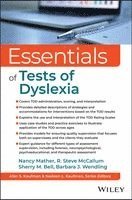
    Essentials of Tests of Dyslexia�

    AvNancy Mather,R. Steve McCallum

    Häftad, Engelska, 2026

    Del i serien Essentials of Psychological Assessment

    817 kr

    Beställningsvara. Skickas inom 5-8 vardagar. Fri frakt över 249 kr.

    Beskrivning

    Administer, score, and interpret the TOD-S, TOD-E, and TOD-C dyslexia assessments Essentials of the Tests of Dyslexia (TOD) provides important insights into the administration, scoring, and interpretation of the three direct dyslexia assessment components and the co-normed rating scales. The book shows how the TOD instructional guide facilitates linking assessment results to interventions and is designed to expand understanding of the underlying linguistic abilities and related reading and spelling skills that are impacted for individuals with dyslexia. With numerous case studies and case reports that provide guided practice in interpreting scores and score reports, this book delivers insights on: Sample/potential questions to ask young children, such as “Do you have a lot of books at home?”Accurate calculation of chronological age before beginning an evaluationPotential administration errors, such as adding a schwa sound when pronouncing consonant sounds when administering the TOD-EThe three levels of interpretation as a framework to interpret scores and score profiles and relative differences among scoresConfidence bands (intervals) as a standardized method to reflect the confidence that the examinee’s true score falls within an identified rangeEssentials of the Tests of Dyslexia (TOD) is a complete resource for assessment professionals, reading specialists, and educators who are interested in understanding reading difficulties and evaluating and serving individuals with dyslexia.

    Produktinformation

    • Utgivningsdatum:2026-06-22
    • Mått:150 x 221 x 20 mm
    • Vikt:363 g
    • Format:Häftad
    • Språk:Engelska
    • Serie:Essentials of Psychological Assessment
    • Antal sidor:320
    • Upplaga:26001
    • Förlag:John Wiley & Sons Inc
    • ISBN:9781394382699

    Utforska kategorier

    • Psykologisk metod inom Psykologi och pedagogik

    Mer om författaren

    NANCY MATHER, PHD, is a Professor Emerita from the University of Arizona. She specializes in the areas of assessment and intervention for individuals with dyslexia. She has co-authored several books in the Essentials series, including Essentials of Dyslexia, 2nd edition, with Barbara J. Wendling. She is also a co-author of several tests, including the TOD and the Woodcock-Johnson V. R. STEVE McCALLUM, PHD, is a Professor Emeritus of School Psychology (University of Tennessee) and a licensed psychologist. He is the author of books, journal articles, and tests focusing on assessment of cognition and the assessment–intervention link, an American Psychological Association (APA) Fellow, and recognized as an outstanding alumnus by both the University of Georgia and Georgia Southern University. SHERRY M. BELL, PHD, is a Professor Emerita of special education and most recently Director of Literacy Initiatives at the University of Tennessee. She is a practicing psychologist, licensed by the Tennessee Health Related Boards and certified by the National Association of School Psychologists (NASP), and has authored over 70 scholarly articles focusing on literacy assessment and instruction, learning disabilities, and dyslexia. BARBARA J. WENDLING, MA, is an educational consultant focusing on learning disabilities, including dyslexia. She has co-authored a number of publications including several books in the Essentials series, the Woodcock Interpretation and Instructional Program, and the Woodcock-Johnson V.

    Innehållsförteckning

    • Series Preface xAcknowledgments xiiOne Overview of Dyslexia and the Rationale for the TOD™ 1What is Dyslexia? 1Revising the Definition of Dyslexia 2Introduction to the TOD 3Reading and Spelling Skills Affected by Dyslexia 4Untimed and Timed Word Reading 5Regular Word Spelling and Irregular Word Reading and Spelling 5Multiple Linguistic Risk Factors 5Phonological Awareness 6Rapid Automatized Naming 6Auditory Working Memory 8Orthographic Processing 8Visual- Verbal Paired Associate Learning 8Vocabulary and Reasoning 9Risk and Diagnostic Indexes 9Clinical Pattern of Dyslexia 11Rating Scales 11Family History 12Early Speech and Language Difficulties 12Cattell–Horn–Carroll Theory of Cognitive Abilities 12Dyslexia Interventions and Recommendations Guide 14Test Yourself 14Answers 15References 15Two General Administration Procedures for the TOD™ 18Getting Ready to Test 19TOD- Screener (TOD- S) 20TOD- Comprehensive (TOD- C) and TOD- Early (TOD- E) 20Confidentiality of Test Materials 22Free Online Scoring 30Test Yourself 32Answers 33References 33Three Administration of the TOD- Screener and the TOD- Early 34TOD- Screener 34Picture Vocabulary (TOD- 1S) 35Letter and Word Choice (TOD- 2S) 37Word Reading Fluency (TOD- 3Sa) 38Question Reading Fluency (TOD- 3Sb) 39TOD- Early (TOD- E) 41Sounds and Pseudowords (TOD- 4E) 41Rhyming (TOD- 5E) 43Early Rapid Number and Letter Naming (TOD- 6E) 44Letter and Sight Word Recognition (TOD- 7E) 46Early Segmenting (TOD- 8E) 47Letter and Sound Knowledge (TOD- 9E) 49Test Yourself 50Answers 51Four Administration of the TOD- Comprehensive 52Organization of the TOD- c 52Administration and Scoring of the TOD- C Tests 54Phonological Manipulation (TOD- 4C) 54Irregular Word Spelling (TOD- 5C) 56Rapid Letter Naming (TOD- 6C) 57Pseudoword Reading (TOD- 7C) 58Word Pattern Choice (TOD- 8C) 59Word Memory (TOD- 9C) 60Picture Analogies (TOD- 10C) 61Irregular Word Reading (TOD- 11C) 62Oral Reading Efficiency (TOD- 12C) 64Blending (TOD- 13C) 65Segmenting (TOD- 14C) 67Regular Word Spelling (TOD- 15C) 69Silent Reading Efficiency (TOD- 16C) 70Rapid Number and Letter Naming (TOD- 17C) 72Letter Memory (TOD- 18C) 74Rapid Pseudoword Reading (TOD- 19C) 75Rapid Irregular Word Reading (TOD- 20C) 76Symbol to Sound Learning (TOD- 21C) 77Listening Vocabulary (TOD- 22C) 79Geometric Analogies (TOD- 23C) 80Test Yourself 81Answers 82Reference 82Five Understanding and Interpreting The TOD Scores and Comparisons 83Levels of Interpretation 83Grade- or Age- Based Norms 85TOD Scores 86Communicating Performance Levels 93Interpreting Standard Score or Percentile Ranges 96Comparing TOD Scores 97Importance of Instructional History in Decision- Making and Instructional Planning 99Using TOD Tests, Composites, and Indexes to Identify Dyslexia Characteristics and/or a Specific Learning Disability in Reading 99Linking Test Selection to Diagnosis, Recommendations, and Interventions 100Test Yourself 102Answers 103References 104Six Use of the TOD Rating Scales in the Identification of Dyslexia 105Descriptions of the TOD Rating Scales 106Development of the Rating Scales 109Standardization of the TOD Rating Scales 110Psychometric Properties of the TOD Rating Scales 111Administration, Scoring, and Interpreting the TOD Rating Scales 114Test Yourself 122Answers 123References 123Seven Psychometric Properties of The TOD 125Pilot Studies 125Standardization 126Reliability 130Validity 134Independent Research 142Test Yourself 144Answers 145References 145Eight Using the TOD Results to Inform Interventions 147Structured Literacy 147Phonological and Phonemic Awareness 148Basic Reading Skills 152Online Instruction and Teacher Training 160Structural Analysis 161Reading Fluency 163Spelling 165Accommodations 169Test Yourself 174Answers 175References 175Nine Illustrative Case Reports for The TOD- S and TOD- E 177Case 1: Confidential Psychoeducational Report 178Reason for Referral and Background Information 178Assessment Procedures and Instruments 179Tests of Dyslexia- Screener (TOD- S) 180TOD- C Rating Scales 180Summary and Recommendations 181Case 2: TOD- S Evaluation 183Conclusions 186Case 3: Confidential Psychoeducational Report 187Reason for Referral and Background Information 187Assessment Procedures and Instruments 188Tests of Dyslexia- Screener (TOD- S) 188TOD- C Self- Rating Scale 190Summary and Recommendations 190Case 4: Confidential Psychoeducational Report 191Reason for Referral and Background Information 192Tests of Dyslexia- Screener (TOD- S) 194TOD- E Rating Scales 195Tests of Dyslexia- Early (TOD- E) 195Summary and Recommendations 198Case 5: Psychoeducational Evaluation 200Reason for Referral 200Background 200Behavioral Observations 201Tests Administered 201Explanation of Scores and Score Ranges 202Test Results 202Indexes 205TOD- E Parent/Caregiver Rating Scale 206Summary 206Diagnostic Impressions 207Recommendations 207Test Yourself 210Answers 211References 211Ten Illustrative Case Reports for the TOD‐ C 212Case 1: Confidential Psychoeducational Report 213Reason for Referral and Background Information 213Tests of Dyslexia‐ Screener (TOD‐ S) and Comprehensive (TOD‐ C) 215Tests of Dyslexia Rating Scales 217Summary and Recommendations 217Case 2: Psychoeducational Evaluation 218Reason for Referral 219Background Information 219Observations 219Tests Administered 219TOD‐ C Rating Scales 223Conclusions 223Recommendations 223TOD Test Results 225Case 3: Confidential Psychoeducational Report 229Reason for Referral and Background Information 229Tests of Dyslexia‐ Screener 231Tests of Dyslexia‐ Comprehensive 232Tests of Dyslexia Rating Scales 239Summary and Recommendations 240Classroom and Standardized Testing Accommodation Recommendations 242Test Yourself 242Answers 244References 244Appendix A Commonly Asked Questions 245Appendix B Analyzing TOD Score Reports 255Background 255Reason for Referral 255Tests Administered 256DDI, RSI, and LPI 256Test Scores within the DDI 257TOD- C Composite Scores 258Selecting Tests to Administer 260Error Analyses 260TOD- C Rating Scales 261Conclusions 264Reason for Referral 269Tod- S 269TOD- C Results 270Parent/Caregiver Rating Scale 272Appendix C TOD-E and TOD-C Dyslexia Profiles 275Permission List 283Index 288