• Fri frakt över 249 kr
  • •
  • Snabba leveranser
  • •
  • Billiga böcker
Kundservice

Du är på sajten för privatpersoner.

Företag, bibliotek eller offentlig verksamhet?

Du handlar på classic.bokus.com, där alla dina funktioner finns intakta.
Till classic.bokus.com
Bokus logotyp. Gå till startsidan.
  • Erbjudanden
  • Nyheter
  • Student
  • Topplistor
  • Barn & ungdom
  • Bokus Play
  • E-böcker
  • Pocketböcker
  • Spel & pussel

10% rabatt på allt med kod NYSTART10 →

Sidfot

Mina sidor

    Hjälp

    • Kundservice
    • Vanliga frågor och svar
    • Frakt och leverans
    • Retur vid ångerrätt
    • Reklamera vara
    • Betalning
    • Köpvillkor
    • Allmänna villkor
    • Information om webbplatsens tillgänglighet

    Om Bokus

    • Om oss
    • Pressrum
    • För studenter
    • För företag
    • För bibliotek och offentlig verksamhet
    • För leverantörer
    • Hållbarhet

    Populärt

    • Aktuella erbjudanden
    • Presentkort
    • Studentlitteratur
    • Nya böcker
    • Topplistor
    • Signerade böcker
    • Engelska böcker

    Inspiration

    • Boktips
    • BookTok
    • Populära bokserier
    • Barnbokskaraktärer
    • Populära författare
    Logotyp för Bokus
    Följ oss på Facebook (extern länk)Följ oss på Instagram (extern länk)Följ oss på YouTube (extern länk)Följ oss på TikTok (extern länk)
    bokus @ CookiesAnpassa cookiesIntegritetspolicyKöpvillkor
    Till Citymail hemsida (extern länk)Till Budbee hemsida (extern länk)Till Postnord hemsida (extern länk)Till Schenker hemsida (extern länk)Till Early Bird hemsida (extern länk)Till Walleys hemsida (extern länk)
    1. Filosofi och religion
    2. Filosofi
    3. Filosofiska discipliner

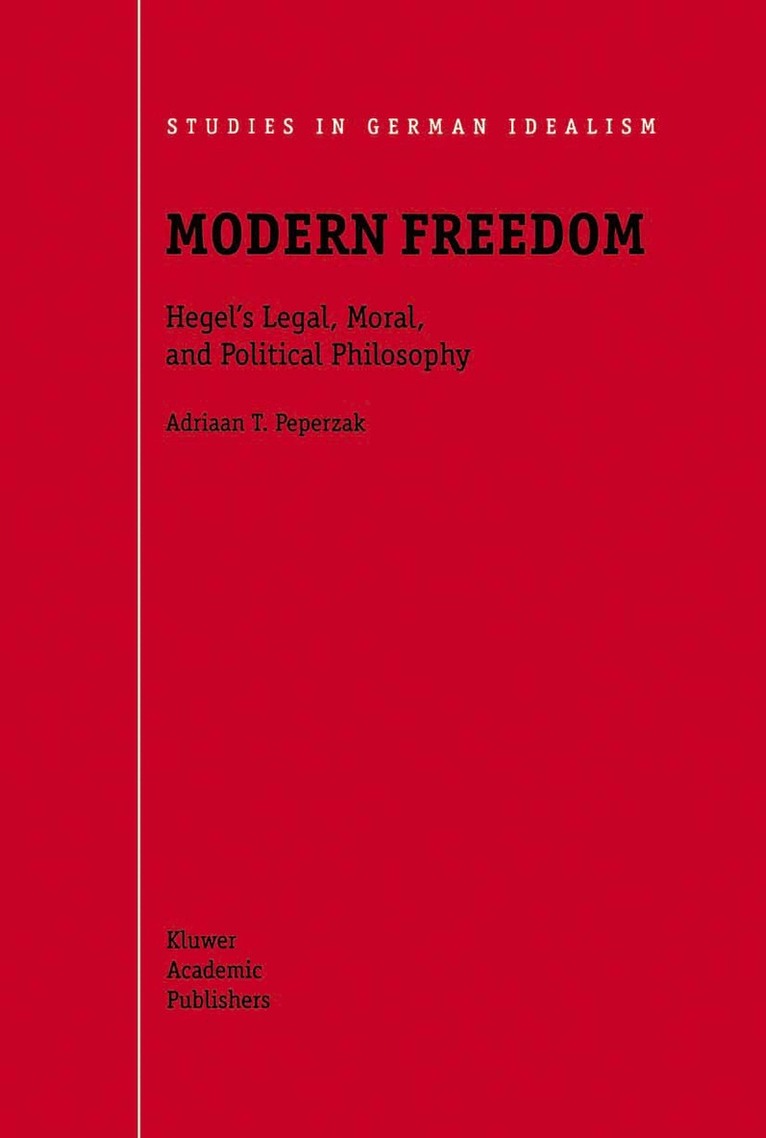
    Modern Freedom

    Hegel’s Legal, Moral, and Political Philosophy

    AvAdriaan T Peperzak

    Häftad, Engelska, 2001

    Del 1 i serien Studies in German Idealism

    3 240 kr

    Beställningsvara. Skickas inom 10-15 vardagar. Fri frakt över 249 kr.

    Fler format och utgåvor

    Inbunden

    3 240 kr

    E-bok

    3 937 kr

    Beskrivning

    '0 ~{oc; ~paxuc;, ~ O£ 't£XVll ~a1(pft (Hippokrates) That life is short needs no proof when we are engaged in ambitious projects. When I began this book, almost forty years ago, I did not forsee that its completion would take such a long time, although I was well aware that some of Hegel's texts stubbornly resist a thorough deciphering of their meaning and argumenta­ tion. Having written a dissertation on the young Hegel's moral, political, and religious philosophy (Lejeune Hegel et la vision morale du monde, 1960'), I was asked to teach ethics, social philosophy, and philosophy of law at various universities of The Netherlands. While studying and teaching the classics of ethics and politics, I began to focus on the textbook that Hegel had written for his courses on practical philosophy: Elements of the Philosophy of Right (1820). The first result of my research was a study of the historical and philosophical context of this text (Philosophy and Politics: A Commentary on the Preface to Hegel's Philosophy of Right, 1981/1987), but the interpretation of its content proceeded slowly. While con­ ferences and colloquia occasioned fragments whose traces can be found in the following pages, the ramifications of Hegel's thought and the overwhelming amount of secondary literature demanded a great deal of time and attention and other interests continued to interrupt the project.

    Produktinformation

    • Utgivningsdatum:2001-11-30
    • Mått:155 x 235 x 38 mm
    • Vikt:1 042 g
    • Format:Häftad
    • Språk:Engelska
    • Serie:Studies in German Idealism
    • Antal sidor:675
    • Upplaga:2001
    • Förlag:Kluwer Academic Publishers
    • ISBN:9781402002885

    Utforska kategorier

    • Filosofiska discipliner inom Filosofi och religion

    Innehållsförteckning

    • Preface.- Abbreviations.- Metaphysics?.- Philosophy and Historical Reconstruction.- Purpose.- Systematic Connections.- Student Notes.- Genetic Connections.- Sources.- Texts and Translations.- Exegesis.- Commentary.- Obscurities.- Reconstruction.- The Place of the Rechtsphilosophie.- The Historical Context.- Plan.- A Selection of Studies.- I. LOGIC.- Truth.- Reason (Vernunft) and Intellect (Verstand) (Enc A 1–3).- Aristotle on Thought.- The Identity of Thought and Being.- Onto-theo-logy.- Hegel’s Logic and Its Role in His Philosophy of Right.- Comprehension.- Deduction.- Self-Determination.- Concept-Judgment-Syllogism.- Finitude and Infinity.- Sollen.- Hegel’s Pantheism.- From Substance to Subject.- The Logic of the Grundlinien.- Plan and Procedure.- II. SPIRIT.- The Context of Right (Grl 1–2 and 4).- Spirit (Enc A 299–399).- Schema of the Encyclopedia.- The Abstract Concept of Spirit (Enc A 299–305).- Philosophy of Spirit (Enc A 305–307).- Phenomenology and Philosophy of Spirit (Enc A 329–362).- Consciousness (Enc A 329–334).- How Consciousness Becomes Rational (Enc A 335–363).- Interpretation of Enc A 345–362.- Spirit (Enc A 363).- The Concept of Spirit (Enc A 363–366).- The Identity of Intelligence and Will (Enc A 366–388).- III. FROM FREE WILL TO RIGHT.- The Subject Matter of the Philosophy of Right (§§ 1–2).- Natural and Positive Right (§ 3).- Spirit-Will-Right (§ 4).- The Deduction of Right in Grl 1–33 and Enc A 388–401.- The Will as Practical Reason (Enc A 386–387).- The Deduction in Grl 1–32.- Résumé (Grl 5–30).- A Schematic Overview (Grl 1–33).- Right (Grl 29–30).- Method (Grl 31–32).- Division (Grl 33).- IV. PERSON AND PROPERTY.- Immediate Right (§§ 34–39).- Sollen (§ 36).- The Foundation of Abstract Right(§ 36).- The Differentiation of Immediate Right (§ 40).- Property (§§ 41–70).- Intermezzo.- Life, Body, Property (§§ 47–48).- The Genesis of Property (§§ 49–52).- Personality and Interpersonality (§§ 49R and 51).- Rethinking Private Law (§§ 53 ff.).- Singularity or Mutuality?.- Discussion.- Appropriation (§§ 54–64).- Slavery (§§ 35R, 57R, and 66R).- V. CONTRACT AND CRIME.- Contract (§§ 71–81).- Crime and Punishment (§§ 82–103).- The Fragility of (Abstract) Right (§ 81).- VI. MORALITY.- Morality in Enc (1817) §§ 415–429.- Morality in the Grundlinien §§ 103–140.- VII. SITTLICHKEIT.- The Concept of Sittlichkeit (§ 142).- The Structure of §§ 142–156.- Analysis.- Consequences for Moral Behavior and Ethics.- Hegel’s Concrete Ethics.- VIII. THE FAMILY.- Love (§§ 158–168).- Unity and Dispersion (§§ 169–172 and 178–181).- Education (§§ 173–177).- IX. SOCIETY.- Civil Society According to the Encyclopedia (BC 518–538).- X. THE STATE.- The State and “The State” (§§ 257–260).- The State Is Not a Contract: Part One (§§ 258R and 75).- Philosophy and History (§§ 258R and M-32).- The State Is Not a Contract: Part Two (§ 258R).- Against Historicism (§ 258R and note).- State-Family-Civil Society (§§ 261–265).- Constitution and Political Disposition (§§ 266–270).- Politics and Religion (§ 270R).- Discussion About Constitutional Law (§§ 271 ff.).- Constitution (§§ 271–273).- The People (§ 274).- The Constitutional Monarchy (§§ 265–267; 272–274).- The Rational Organization of the State (§§ 260–274).- The State Is a Monarchy (§§ 275–286).- Hereditary Monarchy (§§ 280–281).- Universality and Particularity of the Monarch (§§ 283–286).- The Monarch According to the Course of1817–18.- The Government (Regierungsgewalt, §§ 287–297).- The Legislative Power (§§ 298–314).- The Democratic Element (§§ 301–303).- The Political Function of the Stände (§§ 303–314).- Actuality and Reform.- Public Opinion (§§ 315–319).- Freedom of the Press (§ 319).- The State is a Conclusion of Conclusions.- The Sovereign Nation State (§§ 320–329).- XI. INTERNATIONAL POLITICS.- The International Order (§§ 330–333).- War (§§ 334–339).- Humanity and the Nations (§§ 336–337).- Wartime Law (§§ 338–339).- Transition to World History (§ 340).- XII. WORLD HISTORY.- Weltgeschichte (§§ 341–342).- History and Wisdom (§ 343).- The Nations (§§ 344–351).- World-Historical Individuals (§ 348).- Nation-States and Other Peoples (§§ 349–351).- Four Realms (§§ 352–360).- XIII. ETHICS AND RELIGION.- The State Knows What It Wills (§§ 257–270).- Religion (Enc A 453–471).- Religion and State (Grl 270R).- The Principle of Protestantism (Preface, §270R).- National State and Universal Religion.- Freedom of Religion? (§ 270R).- EPILOGUE.- The Nation State.- Individuals.- In tersubjectivity.- Nationalism and Humanity.- Right and Love.- Perfection and Imperfection.- Spirit as Self-Appropriation.- Tasks.