• Fri frakt över 249 kr
  • •
  • Snabba leveranser
  • •
  • Billiga böcker
Kundservice

Du är på sajten för privatpersoner.

Företag, bibliotek eller offentlig verksamhet?

Du handlar på classic.bokus.com, där alla dina funktioner finns intakta.
Till classic.bokus.com
Bokus logotyp. Gå till startsidan.
  • Erbjudanden
  • Nyheter
  • Student
  • Topplistor
  • Barn & ungdom
  • Bokus Play
  • E-böcker
  • Pocketböcker
  • Spel & pussel

10% rabatt på allt med kod NYSTART10 →

Sidfot

Mina sidor

    Hjälp

    • Kundservice
    • Vanliga frågor och svar
    • Frakt och leverans
    • Retur vid ångerrätt
    • Reklamera vara
    • Betalning
    • Köpvillkor
    • Allmänna villkor
    • Information om webbplatsens tillgänglighet

    Om Bokus

    • Om oss
    • Pressrum
    • För studenter
    • För företag
    • För bibliotek och offentlig verksamhet
    • För leverantörer
    • Hållbarhet

    Populärt

    • Aktuella erbjudanden
    • Presentkort
    • Studentlitteratur
    • Nya böcker
    • Topplistor
    • Signerade böcker
    • Engelska böcker

    Inspiration

    • Boktips
    • BookTok
    • Populära bokserier
    • Barnbokskaraktärer
    • Populära författare
    Logotyp för Bokus
    Följ oss på Facebook (extern länk)Följ oss på Instagram (extern länk)Följ oss på YouTube (extern länk)Följ oss på TikTok (extern länk)
    bokus @ CookiesAnpassa cookiesIntegritetspolicyKöpvillkor
    Till Citymail hemsida (extern länk)Till Budbee hemsida (extern länk)Till Postnord hemsida (extern länk)Till Schenker hemsida (extern länk)Till Early Bird hemsida (extern länk)Till Walleys hemsida (extern länk)
    1. Psykologi och pedagogik
    2. Psykologi
    3. Biologisk psykologi och neuropsykologi

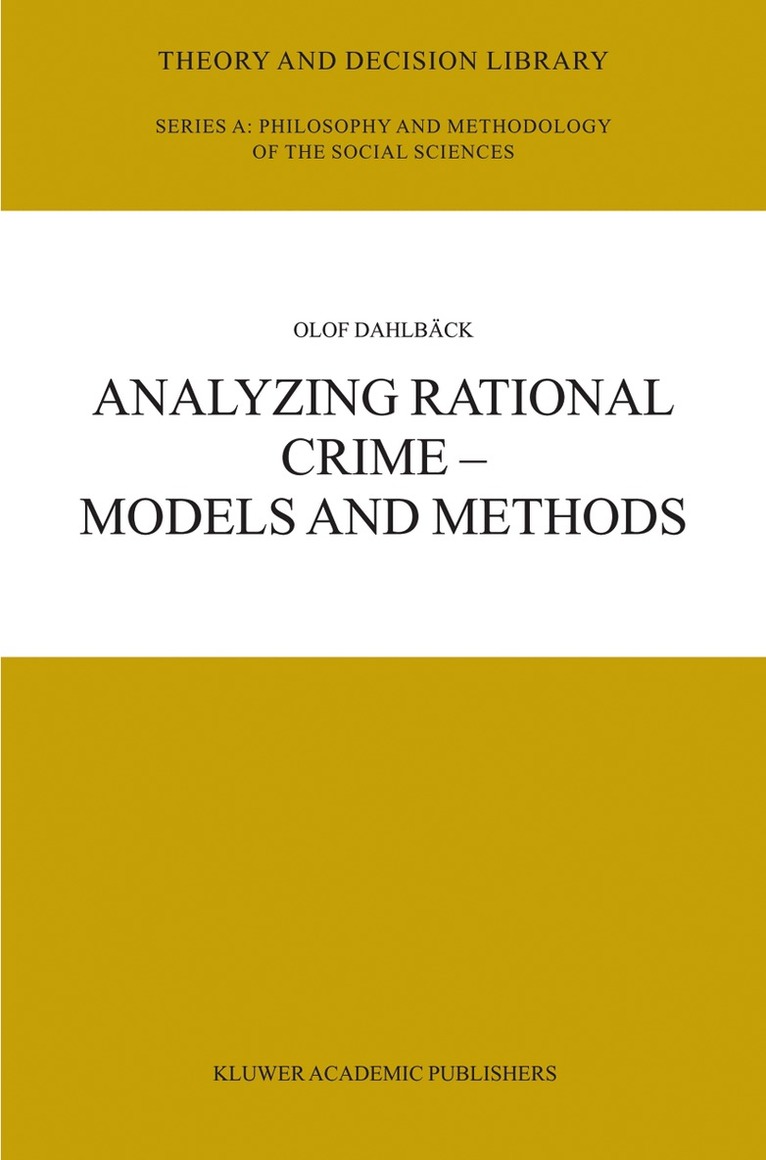
    Analyzing Rational Crime — Models and Methods

    AvOlof Dahlbäck

    Inbunden, Engelska, 2003

    Del 36 i serien Theory and Decision Library A:

    1 054 kr

    Beställningsvara. Skickas inom 10-15 vardagar. Fri frakt över 249 kr.

    Fler format och utgåvor

    Häftad

    1 085 kr

    Beskrivning

    Olof Dahlbäck's book breaks new ground for the analysis of crime from a rationality perspective by presenting models and methods that go far beyond those with which researchers have hitherto been equipped. The book examines single crimes, individual criminality, and societal crime, and it discusses thoroughly the general decision theoretical presuppositions necessary for analyzing these various types of crime. An expected utility maximization model for a single discrete choice regarding the commission of a crime is the foundation of most of the analyses presented. A version of this model is developed that permits interpersonal comparisons, and this basic model is used when deriving more complex models of crime as well as when analyzing the potential for such derivations. The rigorous, powerful methods suggested provide considerable opportunities for improving research and for seeing old problems in a new light.

    Produktinformation

    • Utgivningsdatum:2003-10-31
    • Mått:210 x 297 x 18 mm
    • Vikt:518 g
    • Format:Inbunden
    • Språk:Engelska
    • Serie:Theory and Decision Library A:
    • Antal sidor:218
    • Upplaga:2003
    • Förlag:Kluwer Academic Publishers
    • ISBN:9781402016578

    Utforska kategorier

    • Biologisk psykologi och neuropsykologi inom Psykologi och pedagogik
    • Brottslighet och kriminologi inom Samhälle och politik

    Innehållsförteckning

    • 1. The Assumption of Rationality.- 2. Rational Decisions under Conditions of Risk.- 3. Descriptive Validity of the Rationality Theories of Expected Utility Maximization.- 4. Interpersonal Comparison of Utility.- 5. Previous Research.- 6. Research Strategies.- 7. Analyzing the Bivariate Linear Relationships between Choice and Punishment Factors.- 8. Experimental Analysis.- 9. Nonexperimental Analysis.- 10. Applying the Rationality Model to Individual Criminality.- 11. Rationality and Proneness to Taking Risks.- 12. Societal Crime.- 13. Previous Research on Individual Criminality.- 14. Previous Research on Societal Crime.- 15. An Aggregation Model.- 16. Basing the Analysis on Crime Opportunity and Crime Propensity Factors.- Summary and Conclusions.- References.- Appendix 1. A General Method for the Simultaneous Determination of Outcome Utility and Risk-Taking.- • Equivalencies in utility • Problems in determining the functions • The method.- Appendix 2. Derivation of Formulas in Chapter 7.- Appendix 3. Proof of Statement in Chapter 7.