• Fri frakt över 249 kr
  • •
  • Snabba leveranser
  • •
  • Billiga böcker
Kundservice

Du är på sajten för privatpersoner.

Företag, bibliotek eller offentlig verksamhet?

Du handlar på classic.bokus.com, där alla dina funktioner finns intakta.
Till classic.bokus.com
Bokus logotyp. Gå till startsidan.
  • Erbjudanden
  • Nyheter
  • Student
  • Topplistor
  • Barn & ungdom
  • Bokus Play
  • E-böcker
  • Pocketböcker
  • Spel & pussel

10% rabatt på allt med kod: NYSTART10 →

Sidfot

Mina sidor

    Hjälp

    • Kundservice
    • Vanliga frågor och svar
    • Frakt och leverans
    • Retur vid ångerrätt
    • Reklamera vara
    • Betalning
    • Köpvillkor
    • Allmänna villkor
    • Information om webbplatsens tillgänglighet

    Om Bokus

    • Om oss
    • Pressrum
    • För studenter
    • För företag
    • För bibliotek och offentlig verksamhet
    • För leverantörer
    • Hållbarhet

    Populärt

    • Aktuella erbjudanden
    • Presentkort
    • Studentlitteratur
    • Nya böcker
    • Topplistor
    • Signerade böcker
    • Engelska böcker

    Inspiration

    • Boktips
    • BookTok
    • Populära bokserier
    • Barnbokskaraktärer
    • Populära författare
    Logotyp för Bokus
    Följ oss på Facebook (extern länk)Följ oss på Instagram (extern länk)Följ oss på YouTube (extern länk)Följ oss på TikTok (extern länk)
    bokus @ CookiesAnpassa cookiesIntegritetspolicyKöpvillkor
    Till Citymail hemsida (extern länk)Till Budbee hemsida (extern länk)Till Postnord hemsida (extern länk)Till Schenker hemsida (extern länk)Till Early Bird hemsida (extern länk)Till Walleys hemsida (extern länk)
    1. Naturvetenskap och teknik
    2. Matematik och naturvetenskap
    3. Matematik
    4. Optimering

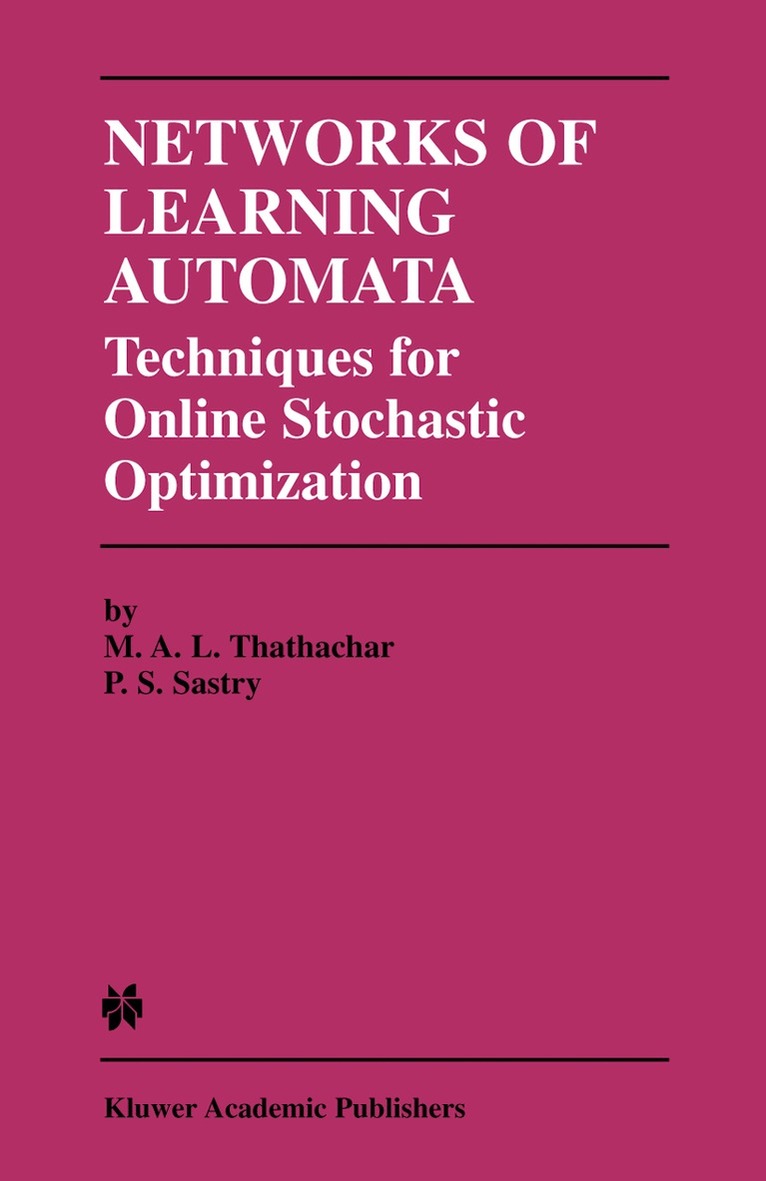
    Networks of Learning Automata

    Techniques for Online Stochastic Optimization

    AvM.A.L. Thathachar,P.S. Sastry

    Inbunden, Engelska, 2003

    1 086 kr

    Beställningsvara. Skickas inom 10-15 vardagar. Fri frakt över 249 kr.

    Fler format och utgåvor

    Häftad

    1 119 kr

    Beskrivning

    This volume provides a comprehensive account of learning automata models with emphasis on multiautomata systems. It considers synthesis of complex learning structures from simple building blocks and uses stochastic algorithms for refining probabilities of selecting actions. Mathematical analysis of the behaviour of games and feedforward networks is provided. Algorithms considered here can be used for online optimization of systems based on noisy measurements of performance index. Also, algorithms that assure convergence to the global optimum are presented. Parallel operation of automata systems for improving speed of convergence is described. The authors also include extensive discussion of how learning automata solutions can be constructed in a variety of applications. This work can be used as a textbook for graduate level courses on Machine Learning, Soft Computing, Reinforcement Learning and Real-Time Stochastic Optimization or used as a reference work by researchers working in these and related areas.

    Produktinformation

    • Utgivningsdatum:2003-10-31
    • Mått:155 x 235 x 21 mm
    • Vikt:600 g
    • Format:Inbunden
    • Språk:Engelska
    • Antal sidor:268
    • Upplaga:2004
    • Förlag:Kluwer Academic Publishers
    • ISBN:9781402076916

    Utforska kategorier

    • Optimering inom Naturvetenskap och teknik
    • Systemvetenskap och AI inom Data och IT
    • Tillämpad matematik inom Naturvetenskap och teknik

    Innehållsförteckning

    • 1. Introduction.- 1.1 Machine Intelligence and Learning.- 1.2 Learning Automata.- 1.3 The Finite Action Learning Automaton (FALA).- 1.4 Some Classical Learning Algorithms.- 1.5 The Discretized Probability FALA.- 1.6 The Continuous Action Learning Automaton (CALA).- 1.7 The Generalized Learning Automaton (GLA).- 1.8 The Parameterized Learning Automaton (PLA).- 1.9 Multiautomata Systems.- 1.10 Supplementary Remarks.- 2. Games of Learning Automata.- 2.1 Introduction.- 2.2 A Multiple Payoff Stochastic Game of Automata.- 2.3 Analysis of the Automata Game Algorithm.- 2.4 Game with Common Payoff.- 2.5 Games of FALA.- 2.6 Common Payoff Games of CALA.- 2.7 Applications.- 2.8 Discussion.- 2.9 Supplementary Remarks.- 3. Feedforward Networks.- 3.1 Introduction.- 3.2 Networks of FALA.- 3.3 The Learning Model.- 3.4 The Learning Algorithm.- 3.5 Analysis.- 3.6 Extensions.- 3.7 Convergence to the Global Maximum.- 3.8 Networks of GLA.- 3.9 Discussion.- 3.10 Supplementary Remarks.- 4. Learning Automata for Pattern Classification.- 4.1 Introduction.- 4.2 Pattern Recognition.- 4.3 Common Payoff Game of Automata for PR.- 4.4 Automata Network for Pattern Recognition.- 4.5 Decision Tree Classifiers.- 4.6 Discussion.- 4.7 Supplementary Remarks.- 5. Parallel Operation of Learning Automata.- 5.1 Introduction.- 5.2 Parallel Operation of FALA.- 5.3 Parallel Operation of CALA.- 5.4 Parallel Pursuit Algorithm.- 5.5 General Procedure.- 5.6 Parallel Operation of Games of FALA.- 5.7 Parallel Operation of Networks of FALA.- 5.8 Discussion.- 5.9 Supplementary Remarks.- 6. Some Recent Applications.- 6.1 Introduction.- 6.2 Supervised Learning of Perceptual Organization in Computer Vision.- 6.3 Distributed Control of Broadcast Communication Networks.- 6.4O ther Applications.- 6.5 Discussion.- Epilogue.- Appendices.- A The ODE Approach to Analysis of Learning Algorithms.- A.I Introduction.- A.2 Derivation of the ODE Approximation.- A.2.1 Assumptions.- A.2.2 Analysis.- A.3 Approximating ODEs for Some Automata Algorithms.- A.3.2 The CALA Algorithm.- A.3.3 Automata Team Algorithms.- A.4 Relaxing the Assumptions.- B Proofs of Convergence for Pursuit Algorithm.- B.1 Proof of Theorem 1.1.- B.2 Proof of Theorem 5.7.- C Weak Convergence and SDE Approximations.- C.I Introduction.- C.2 Weak Convergence.- C.3 Convergence to SDE.- C.3.1 Application to Global Algorithms.- C.4 Convergence to ODE.- References.