• Fri frakt över 249 kr
  • •
  • Snabba leveranser
  • •
  • Billiga böcker
Kundservice

Du är på sajten för privatpersoner.

Företag, bibliotek eller offentlig verksamhet?

Du handlar på classic.bokus.com, där alla dina funktioner finns intakta.
Till classic.bokus.com
Bokus logotyp. Gå till startsidan.
  • Erbjudanden
  • Nyheter
  • Student
  • Topplistor
  • Barn & ungdom
  • Bokus Play
  • E-böcker
  • Pocketböcker
  • Spel & pussel

10% rabatt på allt med kod NYSTART10 →

Sidfot

Mina sidor

    Hjälp

    • Kundservice
    • Vanliga frågor och svar
    • Frakt och leverans
    • Retur vid ångerrätt
    • Reklamera vara
    • Betalning
    • Köpvillkor
    • Allmänna villkor
    • Information om webbplatsens tillgänglighet

    Om Bokus

    • Om oss
    • Pressrum
    • För studenter
    • För företag
    • För bibliotek och offentlig verksamhet
    • För leverantörer
    • Hållbarhet

    Populärt

    • Aktuella erbjudanden
    • Presentkort
    • Studentlitteratur
    • Nya böcker
    • Topplistor
    • Signerade böcker
    • Engelska böcker

    Inspiration

    • Boktips
    • BookTok
    • Populära bokserier
    • Barnbokskaraktärer
    • Populära författare
    Logotyp för Bokus
    Följ oss på Facebook (extern länk)Följ oss på Instagram (extern länk)Följ oss på YouTube (extern länk)Följ oss på TikTok (extern länk)
    bokus @ CookiesAnpassa cookiesIntegritetspolicyKöpvillkor
    Till Citymail hemsida (extern länk)Till Budbee hemsida (extern länk)Till Postnord hemsida (extern länk)Till Schenker hemsida (extern länk)Till Early Bird hemsida (extern länk)Till Walleys hemsida (extern länk)
    1. Naturvetenskap och teknik
    2. Teknik och industri
    3. Elektronik och kommunikationer

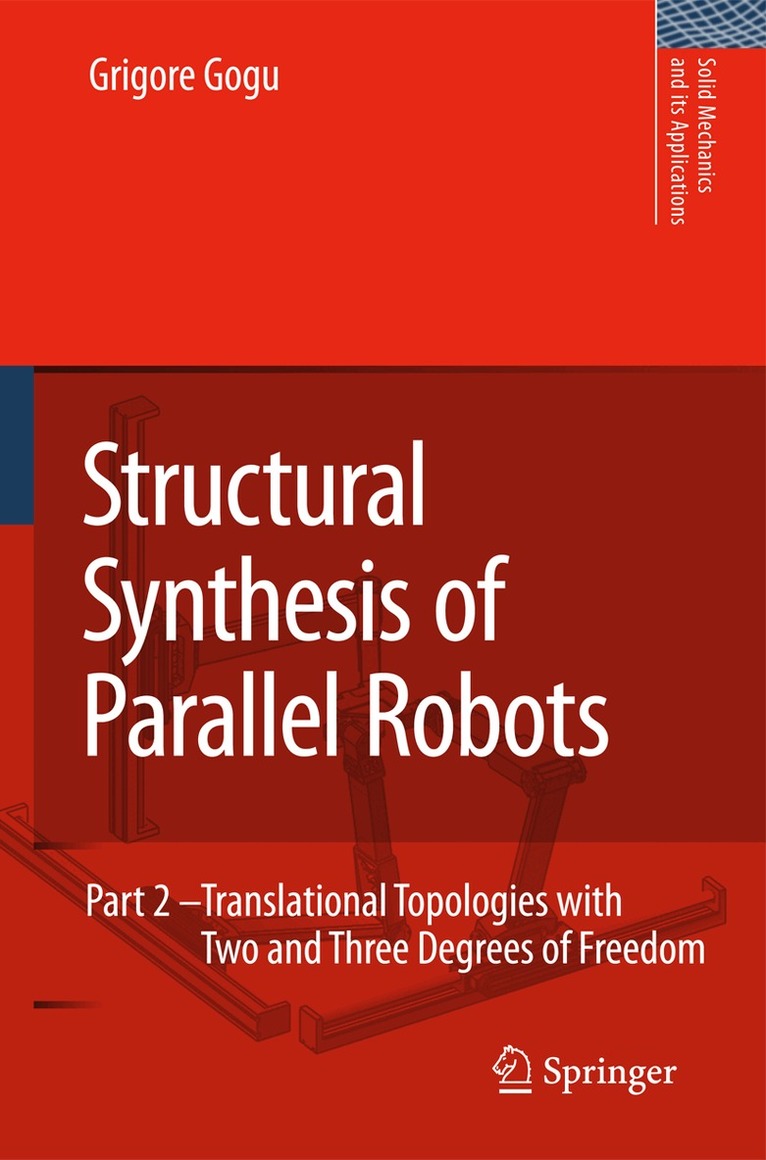
    Structural Synthesis of Parallel Robots

    Part 2: Translational Topologies with Two and Three Degrees of Freedom

    AvGrigore Gogu

    Inbunden, Engelska, 2009

    Del i serien Solid Mechanics and Its Applications

    1 623 kr

    Beställningsvara. Skickas inom 10-15 vardagar. Fri frakt över 249 kr.

    Fler format och utgåvor

    Inbunden

    1 623 kr

    E-bok

    2 044 kr

    E-bok

    2 051 kr

    Häftad

    1 623 kr

    Häftad

    1 623 kr

    Inbunden

    2 162 kr

    E-bok

    2 833 kr

    Inbunden

    1 623 kr

    E-bok

    2 044 kr

    Häftad

    2 162 kr

    Beskrivning

    “The mathematical investigations referred to bring the whole apparatus of a great science to the examination of the properties of a given mechanism, and have accumulated in this direction rich material, of enduring and increasing value. What is left unexamined is however the other, immensely deeper part of the problem, the question: How did the mechanism, or the elements of which it is composed, originate? What laws govern its building up? Is it indeed formed according to any laws whatever? Or have we simply to accept as data what invention gives us, the analysis of what is thus obtained being the only scientific problem left – as in the case of natural history?” Reuleaux, F., Theoretische Kinematik, Braunschweig: Vieweg, 1875 Reuleaux, F., The Kinematics of Machinery, London: Macmillan, 1876 and New York: Dover, 1963 (translated by A.B.W. Kennedy) This book represents the second part of a larger work dedicated to the structural synthesis of parallel robots. Part 1 already published in 2008 (Gogu 2008a) has presented the methodology proposed for structural synthesis. This book focuses on various topologies of translational parallel robots systematically generated by using the structural synthesis approach proposed in Part 1. The originality of this work resides in the fact that it combines the new formulae for mobility connectivity, redundancy and overconstraints, and the evolutionary morphology in a unified approach of structural synthesis giving interesting innovative solutions for parallel mechanisms.

    Produktinformation

    • Utgivningsdatum:2009-03-11
    • Mått:155 x 235 x 47 mm
    • Vikt:1 320 g
    • Format:Inbunden
    • Språk:Engelska
    • Serie:Solid Mechanics and Its Applications
    • Antal sidor:762
    • Förlag:Springer-Verlag New York Inc.
    • ISBN:9781402097935

    Utforska kategorier

    • Elektronik och kommunikationer inom Naturvetenskap och teknik
    • Teknik: allmänt inom Naturvetenskap och teknik
    • Klassisk mekanik inom Naturvetenskap och teknik

    Recensioner i media

    From the reviews: "Part 2 begins with a short summary of developed by the author new formulae for mobility, connectivity, redundancy, and over-constraint. ... Parallel robotic manipulators can be considered a well-established ... subject of many robotic research studies. ... the author has made a significant contribution towards establishing innovative and interesting solutions for parallel mechanisms. ... The presentation is at a level of a graduate textbook, and the book will be useful and enjoyed by serious graduate students and by scientists and engineers from academia and industry." (Franz Selig, Zentralblatt MATH, Vol. 1168, 2009)

    Innehållsförteckning

    • Preface; Acknowledgements; List of abbreviations and notations; 1 Introduction; 1.1 Terminology; 1.2 Methodology of structural synthesis; 1.2.1 New formulae for mobility, connectivity, redundancy and overconstraint of parallel robots; 1.2.2 Evolutionary morphology approach; 1.2.3 Types of parallel robots with respect to motion coupling; 1.3 Translational parallel robots; 2 Translational parallel robots with two degrees of freedom; 2.1 T2-type translational parallel robots with coupled motions; 2.1.1 Overconstrained solutions; 2.1.2 Non overconstrained solutions; 2.2 T2-type translational parallel robots with decoupled motions; 2.2.1 Overconstrained solutions; 2.2.2 Non overconstrained solutions; 2.3 T2-type translational parallel robots with uncoupled motions; 2.3.1 Overconstrained solutions; 2.3.2 Non overconstrained solutions; 2.4 Maximally regular T2-type translational parallel robots; 2.4.1 Overconstrained solutions; 2.4.2 Non overconstrained solutions; 2.5 Other T2-type translational parallel robots; 2.5.1 Overconstrained solution; 2.5.2 Non overconstrained solutions; 3 Overconstrained T3-type TPMs with coupled motions; 3.1 Basic solutions with linear actuators; 3.2 Derived solutions with linear actuators; 3.3 Basic solutions with rotating actuators; 3.4 Derived solutions with rotating actuators; 4 Non overconstrained T3-type TPMs with coupled motions; 4.1 Basic solutions with linear actuators; 4.2 Derived solutions with linear actuators; 4.3 Basic solutions with rotating actuators; 4.4 Derived solutions with rotating actuators; 5 Overconstrained T3-type TPMs with uncoupled motions; 5.1 Basic solutions with rotating actuators; 5.2 Derived solutions with rotating actuators; 6 Non overconstrained T3-type TPMs with uncoupled motions; 6.1 Basic solutions with rotating actuators; 6.2 Derived solutions with rotating actuators; 7 Maximally regular T3-type translational parallel robots; 7.1 Overconstrained solutions; 7.1.1 Basic solutions with no idle mobilities; 7.1.2 Derived solutions with idle mobilities; 7.2 Non overconstrained solutions; References; Index