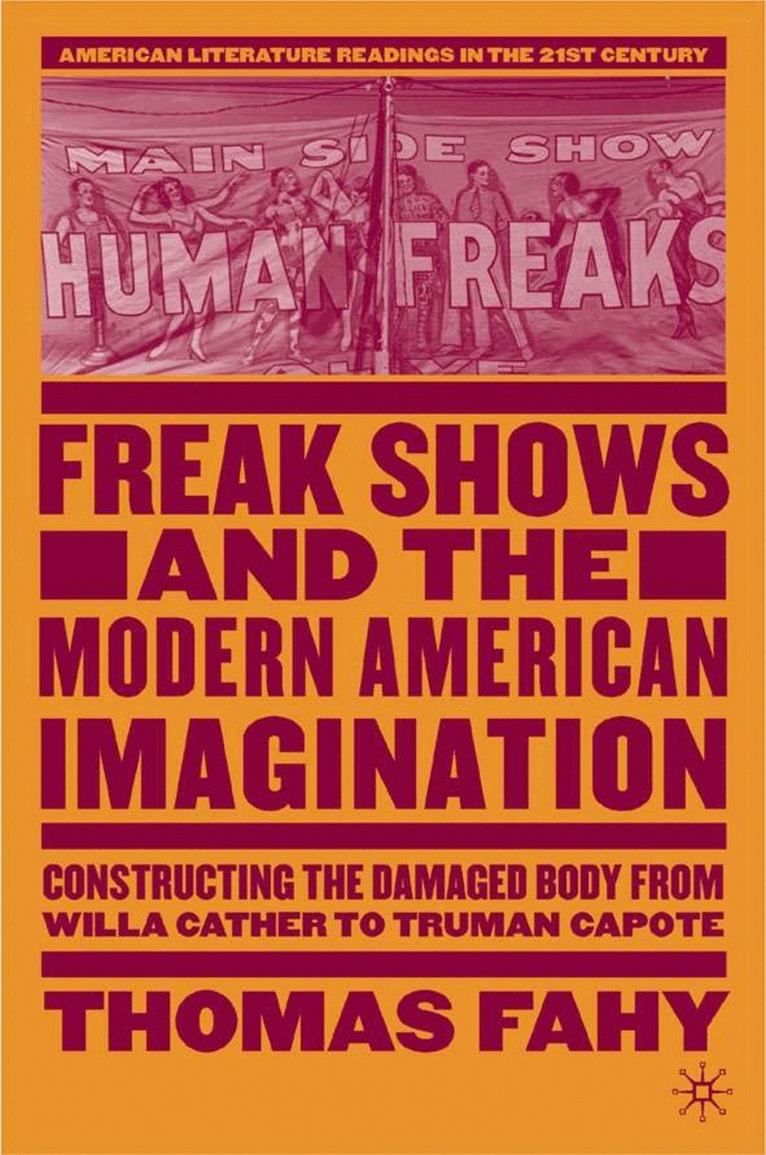
Freak Shows and the Modern American Imagination
Constructing the Damaged Body from Willa Cather to Truman Capote
639 kr
Beställningsvara. Skickas inom 10-15 vardagar. Fri frakt över 249 kr.
Du är på sajten för privatpersoner.
639 kr
Beställningsvara. Skickas inom 10-15 vardagar. Fri frakt över 249 kr.
THOMAS FAHY currently teaches for the English Department at Loyola Marymount University in Los Angeles, California, USA. He is the author of numerous articles, a monograph on Gabriel Garc?a M?rquez, and a novel, Night Visions (2004). He has also edited several collections, including Death, Sexuality, and the American Dream in the Works of Alan Ball (2006), Considering Aaron Sorkin (2005), and Peering Behind the Curtain: Disability, Illness and the Extraordinary Body in Contemporary Theater (2002).
"This eloquent and accessible book enhances our understanding of how and why our cultural imagination has given us the figure of 'the freak.' Fahy mines culture and literature with skill, excavating the often unnoticed and frequently misunderstood freaks for us to ponder. With great insight, he reveals the cultural work we ask these fellow humans to do on behalf of those of us who can somehow escape such a category." - Rosemarie Garland-Thomson, Emory University "This is a compelling and engaging book that makes a significant contribution to the field of literary studies. Fahy argues convincingly that the freak show imprinted itself on the artistic imagination of early twentieth-century American writers. Some of the most important figures in American literature (William Faulkner, Willa Cather, Ernest Hemingway, F. Scott Fitzgerald, Carson McCullers, John Steinbeck, and Truman Capote) used either freak shows or images of the freakish body (drawing on the conventions of this entertainment) to address issues of difference in American culture. For Fahy, the freak show in American literature functions as a metaphor for problematic constructions of race, gender, sexuality, and disability in modern society. By focusing his study on the last forty years of the freak-show's mainstream popularity (1900-1940), he maps out a trajectory of troubling social attitudes during one of the most important periods in American literary history-modernism." - Kristin Ringleberg, Elon University
Du är på sajten för privatpersoner.
639 kr
Beställningsvara. Skickas inom 10-15 vardagar. Fri frakt över 249 kr.
THOMAS FAHY currently teaches for the English Department at Loyola Marymount University in Los Angeles, California, USA. He is the author of numerous articles, a monograph on Gabriel Garc?a M?rquez, and a novel, Night Visions (2004). He has also edited several collections, including Death, Sexuality, and the American Dream in the Works of Alan Ball (2006), Considering Aaron Sorkin (2005), and Peering Behind the Curtain: Disability, Illness and the Extraordinary Body in Contemporary Theater (2002).
"This eloquent and accessible book enhances our understanding of how and why our cultural imagination has given us the figure of 'the freak.' Fahy mines culture and literature with skill, excavating the often unnoticed and frequently misunderstood freaks for us to ponder. With great insight, he reveals the cultural work we ask these fellow humans to do on behalf of those of us who can somehow escape such a category." - Rosemarie Garland-Thomson, Emory University "This is a compelling and engaging book that makes a significant contribution to the field of literary studies. Fahy argues convincingly that the freak show imprinted itself on the artistic imagination of early twentieth-century American writers. Some of the most important figures in American literature (William Faulkner, Willa Cather, Ernest Hemingway, F. Scott Fitzgerald, Carson McCullers, John Steinbeck, and Truman Capote) used either freak shows or images of the freakish body (drawing on the conventions of this entertainment) to address issues of difference in American culture. For Fahy, the freak show in American literature functions as a metaphor for problematic constructions of race, gender, sexuality, and disability in modern society. By focusing his study on the last forty years of the freak-show's mainstream popularity (1900-1940), he maps out a trajectory of troubling social attitudes during one of the most important periods in American literary history-modernism." - Kristin Ringleberg, Elon University