• Fri frakt över 249 kr
  • •
  • Snabba leveranser
  • •
  • Billiga böcker
Kundservice

Du är på sajten för privatpersoner.

Företag, bibliotek eller offentlig verksamhet?

Du handlar på classic.bokus.com, där alla dina funktioner finns intakta.
Till classic.bokus.com
Bokus logotyp. Gå till startsidan.
  • Erbjudanden
  • Nyheter
  • Student
  • Topplistor
  • Barn & ungdom
  • Bokus Play
  • E-böcker
  • Pocketböcker
  • Spel & pussel

10% rabatt på allt med kod NYSTART10 →

Sidfot

Mina sidor

    Hjälp

    • Kundservice
    • Vanliga frågor och svar
    • Frakt och leverans
    • Retur vid ångerrätt
    • Reklamera vara
    • Betalning
    • Köpvillkor
    • Allmänna villkor
    • Information om webbplatsens tillgänglighet

    Om Bokus

    • Om oss
    • Pressrum
    • För studenter
    • För företag
    • För bibliotek och offentlig verksamhet
    • För leverantörer
    • Hållbarhet

    Populärt

    • Aktuella erbjudanden
    • Presentkort
    • Studentlitteratur
    • Nya böcker
    • Topplistor
    • Signerade böcker
    • Engelska böcker

    Inspiration

    • Boktips
    • BookTok
    • Populära bokserier
    • Barnbokskaraktärer
    • Populära författare
    Logotyp för Bokus
    Följ oss på Facebook (extern länk)Följ oss på Instagram (extern länk)Följ oss på YouTube (extern länk)Följ oss på TikTok (extern länk)
    bokus @ CookiesAnpassa cookiesIntegritetspolicyKöpvillkor
    Till Citymail hemsida (extern länk)Till Budbee hemsida (extern länk)Till Postnord hemsida (extern länk)Till Schenker hemsida (extern länk)Till Early Bird hemsida (extern länk)Till Walleys hemsida (extern länk)
    1. Psykologi och pedagogik
    2. Psykologi
    3. Barnpsykologi och utvecklingspsykologi

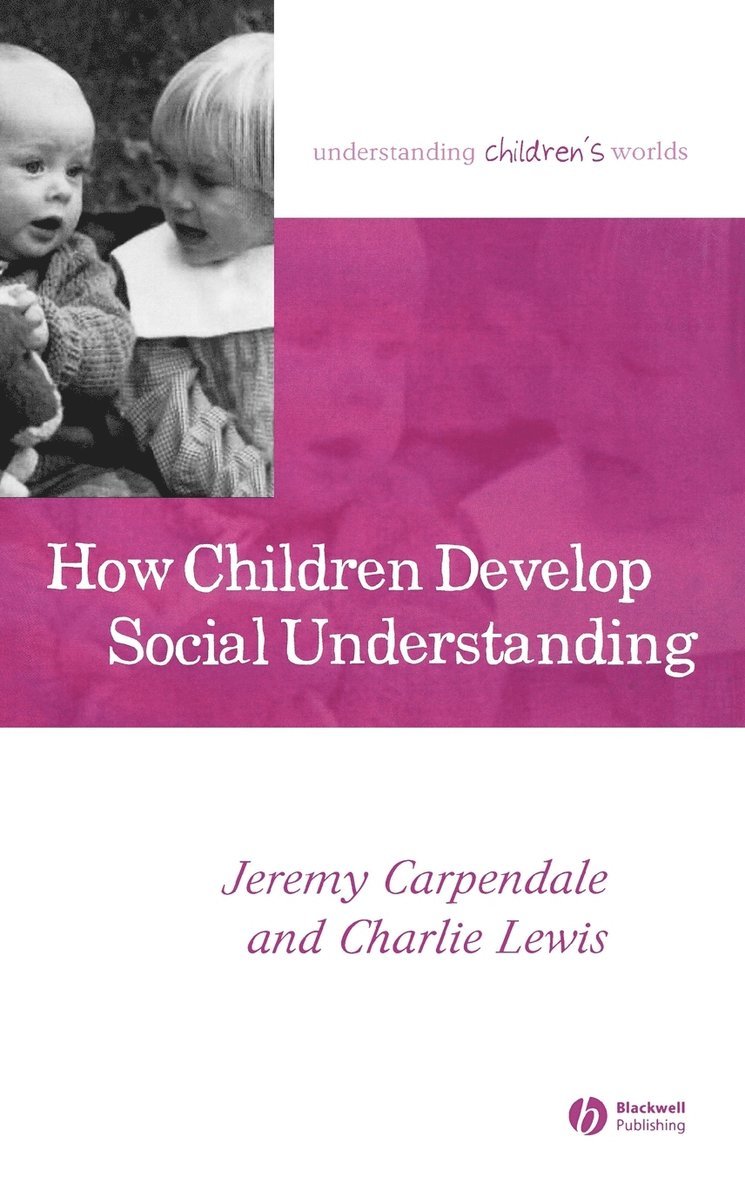
    How Children Develop Social Understanding

    AvJeremy Carpendale,Charlie Lewis

    Inbunden, Engelska, 2006

    Del i serien Understanding Children's Worlds

    1 309 kr

    Beställningsvara. Skickas inom 5-8 vardagar. Fri frakt över 249 kr.

    Fler format och utgåvor

    Häftad

    498 kr

    Beskrivning

    This book provides a critical review of research into how children come to understand the social world, an area often known as children's "theories of mind". Takes an integrated approach to the development of children's social understandingBrings out the connections between mental state understanding and children's understanding of language, social skills, morality and emotions.Sets research within a historical and theoretical contextContributes unique insights and perspectives, particularly in its discussions of Piaget and Vygotsky, and in its Wittgensteinian focus on the role of language.

    Produktinformation

    • Utgivningsdatum:2006-03-15
    • Mått:166 x 239 x 25 mm
    • Vikt:624 g
    • Format:Inbunden
    • Språk:Engelska
    • Serie:Understanding Children's Worlds
    • Antal sidor:336
    • Förlag:John Wiley and Sons Ltd
    • ISBN:9781405105491

    Utforska kategorier

    • Barnpsykologi och utvecklingspsykologi inom Psykologi och pedagogik

    Mer om författaren

    Jeremy Carpendale is Associate Professor of Psychology at Simon Fraser University, Canada.Charlie Lewis is Professor of Family and Developmental Psychology at Lancaster University, UK.

    Recensioner i media

    "The best book there is on children's social-cognitive development - full stop." Michael Tomasello, Max Planck Institute for Evolutionary Anthropology and Wolfgang Köhler Primate Research Center"This extraordinarily comprehensive book provides a lucid account of how children develop social understanding. The authors promise broad inquiry into social development and they consistently deliver pushing well beyond a thorough review of the enormous body of prior work on theory of mind. This book will awaken interest in key developmental questions by a new generation of students who become acquainted with the book in upper level seminars or graduate courses where it most certainly should be assigned." Nancy Budwig, Professor of Psychology, Clark University, USA "Carpendale and Lewis provide an exceptionally clear analysis of the prominent theoretical explanations of children’s understanding of beliefs. This work won’t end debate, but it may fundamentally revise the research agenda so that the steps along the way to social understanding are more fully revealed." Professor Hildy Ross, University of Waterloo, Canada "Professors searching for a theoretically rigorous and empirically accurate text to introduce students to the development of children’s social cognition will find what they seek in this text. So too will more advanced scholars and students who desire a comprehensive and incisive treatment of the increasingly vast literature on this topic, and the many lively debates it excites. Hats off to Carpendale and Lewis for a job well done." Jack Martin, Fraser University "How Children Develop Social Understanding is an appreciable piece of work, and I hope Carpendale and Lewis will continue in their successful effort to give us a thoughtful view of children's social-cognitive development. Furthermore, I hope that this book will attract new young researchers from all over the world to the study of a fabulous topic, the development of the child as a social human being." PsycCRITIQUES Volume 51, Issue 43 "This is an important book, and it succeeds on many levels. Most notably, the extensive literature on children's theory of mind is masterfully reviewed and critically assessed in relation to the accumulated findings, replications of findings, and failures to replicate." Human Development 2006; Issue 49

    Innehållsförteckning

    • Series Editor's Preface. Preface.1. Social Understanding and Social Interaction: An introduction to the issues.2. Contemporary Theories of Social Understanding.3. Understanding False Beliefs.4. The Development of Social Understanding in Infancy.5. Domain General Approaches to Reasoning about the Mind.6. Social Interaction and the Development of Social Understanding: The role of relationships in social cognitive development.7. Language and Social Understanding.8. Beyond (False) Belief: What do preschoolers still have to learn about the mind?.9. Social Understanding and Children's Social Lives.10. Constructing an Understanding of Mind.References.Author Index.Subject Index.