• Fri frakt över 249 kr
  • •
  • Snabba leveranser
  • •
  • Billiga böcker
Kundservice

Du är på sajten för privatpersoner.

Företag, bibliotek eller offentlig verksamhet?

Du handlar på classic.bokus.com, där alla dina funktioner finns intakta.
Till classic.bokus.com
Bokus logotyp. Gå till startsidan.
  • Erbjudanden
  • Nyheter
  • Student
  • Topplistor
  • Barn & ungdom
  • Bokus Play
  • E-böcker
  • Pocketböcker
  • Spel & pussel

10% studentrabatt med kod TERM26

Sidfot

Mina sidor

    Hjälp

    • Kundservice
    • Vanliga frågor och svar
    • Frakt och leverans
    • Retur vid ångerrätt
    • Reklamera vara
    • Betalning
    • Köpvillkor
    • Allmänna villkor
    • Information om webbplatsens tillgänglighet

    Om Bokus

    • Om oss
    • Pressrum
    • För studenter
    • För företag
    • För bibliotek och offentlig verksamhet
    • För leverantörer
    • Hållbarhet

    Populärt

    • Aktuella erbjudanden
    • Presentkort
    • Studentlitteratur
    • Nya böcker
    • Topplistor
    • Signerade böcker
    • Engelska böcker

    Inspiration

    • Boktips
    • BookTok
    • Populära bokserier
    • Barnbokskaraktärer
    • Populära författare
    Logotyp för Bokus
    Följ oss på Facebook (extern länk)Följ oss på Instagram (extern länk)Följ oss på YouTube (extern länk)Följ oss på TikTok (extern länk)
    bokus @ CookiesAnpassa cookiesIntegritetspolicyKöpvillkor
    Till Citymail hemsida (extern länk)Till Budbee hemsida (extern länk)Till Postnord hemsida (extern länk)Till Schenker hemsida (extern länk)Till Early Bird hemsida (extern länk)Till Walleys hemsida (extern länk)
    1. Mat och dryck
    2. Drycker
    3. Alkoholdrycker
    4. Vinböcker

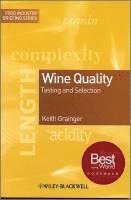
    Wine Quality

    Tasting and Selection

    AvKeith Grainger

    Häftad, Engelska, 2009

    1 097 kr

    Beställningsvara. Skickas inom 11-20 vardagar. Fri frakt över 249 kr.

    Fler format och utgåvor

    E-bok

    1 246 kr

    Beskrivning

    WINNER OF A GOURMAND WORLD COOKBOOK AWARD 2009!BEST WINE EDUCATION BOOK (THE BEST IN THE WORLD) "I really enjoyed this book … A constant feature of this book is how well Keith balances his mastery of the technicalities with a certain 'common touch', the ability to explain sometimes complex issues in easy-to-understand terms."—Association of Wine Educators "... an ideal book to accompany a WSET course."—Harpers Wine and SpiritThroughout the eight thousand years of vinous history wines have been tasted and their qualities examined in at least a basic way. Today producers can control the growing and winemaking processes, and the consumer may choose from a vast array of wines, both fine and ordinary. Tasting and evaluating these requires knowledge, skill and diligence.Part of the Wiley-Blackwell Food Industry Briefing Series, this book provides a concise, easy to use and clearly presented understanding of the techniques of wine tasting, quality assessment and evaluation. The reader is taken through the various stages of a structured and professional approach to tasting and the book examines the questions as to what constitutes quality in wines, how quality can be recognised and how it is achieved. Also discussed are the faults that can destroy wines at any quality level, and misconceptions as to quality and guarantees.Clearly presented and easily readable the book includes: DiagramsTablesTasting vocabulariesColour PlatesWritten by Keith Grainger, highly regarded international wine educator and wine consultant, this book provides a concise, quick reference for busy wine industry professionals, students or others who wish to gain a detailed knowledge of the concepts of wine tasting and quality assessment.The Wiley-Blackwell Food Industry Briefing SeriesDevised to increase the effectiveness and efficiency with which knowledge can be gained of the many subject areas that constitute the food industry, and on which the industry relies for its existence, this important series is intended expressly to benefit executives, managers and supervisors within the industry. Each book distils the subject matter of the topic, providing its essence for easy and speedy assimilation.

    Produktinformation

    • Utgivningsdatum:2009-01-16
    • Mått:152 x 231 x 13 mm
    • Vikt:354 g
    • Format:Häftad
    • Språk:Engelska
    • Antal sidor:192
    • Förlag:John Wiley and Sons Ltd
    • ISBN:9781405113663
    • Utmärkelser:Winner of A Gourmand World Cookbook Award 2009 (United States)

    Utforska kategorier

    • Vinböcker inom Mat och dryck
    • Tillverkningsteknik inom Naturvetenskap och teknik

    Mer om författaren

    Keith Grainger has been a wine educator and consultant for 20 years. In 1993, he was instrumental in founding the Association of Wine Educators and is a member of the Circle of Wine Writers. He has several international viticulture and winemaking consultancies and undertakes wine quality assessments. A lecturer for many wine education and training programmes, including those leading to the globally recognised qualifications of the Wine & Spirit Education Trust.

    Recensioner i media

    "A detailed consideration of tasting including a chapter on wine faults as well as looking at production and the notion of quality plus the sorts of criteria professional wine buyers use when selecting wine." (Circle Update, March 2009) "Keith Grainger's Wine Quality: Tasting and Selection is an ideal book to accompany a WSET course." (Harpers Wine and Spirit Weekly, February 2009)"I really enjoyed this book … .A constant feature of this book is how well Keith balances his mastery of the technicalities with a certain “common touch”, the ability to explain sometimes complex issues in easy-to-understand terms." (Association of Wine Educators, January 2009)

    Innehållsförteckning

    • Series Editor’s Foreword xiPreface xiiiAcknowledgements xvIntroduction xviiChapter 1 Wine Tasting 11.1 Wine tasting & laboratory analysis 11.2 What makes a good wine taster? 21.3 Where and when to taste – suitable conditions 41.4 Appropriate equipment 51.4.1 Tasting glasses 61.4.2 Water 101.4.3 Spittoons 101.4.4 Tasting sheets 101.4.5 Tasting mats 121.5 Tasting order 121.6 Temperature of wines for tasting 131.7 Tasting for specific purposes 141.8 Structured tasting technique 141.8.1 Appearance 141.8.2 Nose 161.8.3 Palate 161.8.4 Conclusions 181.9 The importance of keeping notes 18Chapter 2 Appearance 212.1 Clarity 212.2 Intensity 222.3 Colour 242.3.1 White wines 252.3.2 Ros´e wines 252.3.3 Red wines 262.3.4 Rim/core 262.4 Other observations 282.4.1 Bubbles 282.4.2 Legs 292.4.3 Deposits 33Chapter 3 Nose 353.1 Condition 363.2 Intensity 363.3 Development 373.3.1 Primary 373.3.2 Secondary 373.3.3 Tertiary 383.4 Aroma characteistics 39Chapter 4 Palate 434.1 Sweetness/bitterness/acidity/saltiness/umami 434.2 Dryness/sweetness 444.3 Acidity 464.4 Tannin 474.5 Alcohol 494.6 Body 504.7 Flavour intensity 514.8 Flavour characteristics 514.9 Other observations 544.10 Length 55Chapter 5 Tasting Conclusions 575.1 Quality 575.2 Reasons for quality 575.3 Readiness for drinking/potential for ageing 595.4 Price/value 605.5 Identification/true to type? 605.6 Grading wine – the award of points 605.6.1 Grading on a 20-point scale 615.6.2 Grading on a 100-point scale 625.7 Blind tasting 635.7.1 Why taste blind? 635.7.2 Blind or sighted? 645.7.3 Tasting for quality 645.7.4 Practicalities 645.7.5 Examination tastings 65Chapter 6 Wine Faults and Flaws 676.1 Chloroanisoles and bromoanisoles 676.2 Fermentation in the bottle and bacterial spoilage 706.3 Protein haze 706.4 Oxidation 706.5 Excessive volatile acidity 716.6 Excessive sulfur dioxide 726.7 Reductivity 736.8 Brettanomyces 746.9 Dekkera 756.10 Geraniol 756.11 Geosmin 756.12 Ethyl acetate 766.13 Excessive acetaldehyde 766.14 Candida acetaldehyde 766.15 Smoke taint 77Chapter 7 Quality – Assurances and Guarantees? 797.1 Compliance with ‘Quality Wine’ legislation as an assurance of quality? 797.1.1 The European Union and third Countries 797.1.2 Table Wine and QWpsr 807.1.3 The concept of Appellation Contrˆol´ee 817.2 Tasting competitions as an assessment of quality? 847.3 Classifications as an official assessment of quality? 867.4 ISO 9001 Certification as an assurance of quality? 877.5 Established brands as a guarantee of quality? 887.6 Price as an indication of quality? 91Chapter 8 Quality – The Natural Factors and a Sense of Place 938.1 Typicity and regionality 948.2 The impact of climate upon quality wine production 958.3 The role of soils 968.4 Terroir 978.5 The vintage factor 101Chapter 9 Constraints upon Quality Wine Production 1059.1 Financial 1059.1.1 Financial constraints upon the grower 1069.1.2 Financial constraints upon the winemaker 1079.2 Skills and diligence 1099.3 Legal 1109.4 Environmental 111Chapter 10 Production of Quality Wines 11310.1 Yield 11310.2 Density of planting 11410.3 Age of vines 11510.4 Winter pruning 11610.5 Stressing the vines 11610.6 Green harvesting 11710.7 Harvesting 11710.7.1 Mechanical harvesting 11810.7.2 Hand picking 11910.8 Delivery and processing of fruit 12010.9 Selection and sorting 12010.10 Use of pumps/gravity 12110.11 Control of fermentations 12110.12 Use of gasses 12410.13 Barrels 12410.14 Selection from vats or barrels 12510.15 Storage 126Chapter 11 Selection by Buyers 12911.1 Supermarket dominance 12911.2 Price point/margin 13111.3 Selecting for market and customer base 13211.4 Styles and individuality 13211.5 Continuity 13311.6 The place of individual wines in the range 13411.7 Exclusivity 13511.8 Specification 13511.9 Technical analysis 136Appendix 141Glossary 145Bibliography 149Useful Websites 151Wine Exhibitions 155Index 157A colour plate section appears between pages 28 and 29