• Fri frakt över 249 kr
  • •
  • Snabba leveranser
  • •
  • Billiga böcker
Kundservice

Du är på sajten för privatpersoner.

Företag, bibliotek eller offentlig verksamhet?

Du handlar på classic.bokus.com, där alla dina funktioner finns intakta.
Till classic.bokus.com
Bokus logotyp. Gå till startsidan.
  • Erbjudanden
  • Nyheter
  • Student
  • Topplistor
  • Barn & ungdom
  • Bokus Play
  • E-böcker
  • Pocketböcker
  • Spel & pussel

Må bättre, för mindre! Upp till 50% rabatt på hälsoböcker

Sidfot

Mina sidor

    Hjälp

    • Kundservice
    • Vanliga frågor och svar
    • Frakt och leverans
    • Retur vid ångerrätt
    • Reklamera vara
    • Betalning
    • Köpvillkor
    • Allmänna villkor
    • Information om webbplatsens tillgänglighet

    Om Bokus

    • Om oss
    • Pressrum
    • För studenter
    • För företag
    • För bibliotek och offentlig verksamhet
    • För leverantörer
    • Hållbarhet

    Populärt

    • Aktuella erbjudanden
    • Presentkort
    • Studentlitteratur
    • Nya böcker
    • Topplistor
    • Signerade böcker
    • Engelska böcker

    Inspiration

    • Boktips
    • BookTok
    • Populära bokserier
    • Barnbokskaraktärer
    • Populära författare
    Logotyp för Bokus
    Följ oss på Facebook (extern länk)Följ oss på Instagram (extern länk)Följ oss på YouTube (extern länk)Följ oss på TikTok (extern länk)
    bokus @ CookiesAnpassa cookiesIntegritetspolicyKöpvillkor
    Till Citymail hemsida (extern länk)Till Budbee hemsida (extern länk)Till Postnord hemsida (extern länk)Till Schenker hemsida (extern länk)Till Early Bird hemsida (extern länk)Till Walleys hemsida (extern länk)
    1. Samhälle och politik
    2. Samhälle och kultur
    3. Kultur och medier
    4. Kulturvetenskap

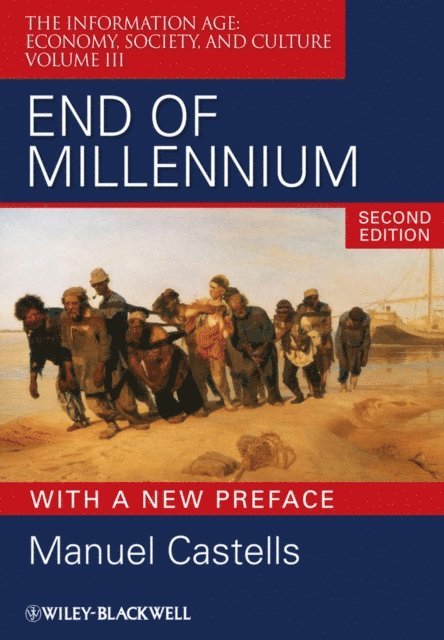
    End of Millennium

    AvManuel Castells

    Häftad, Engelska, 2010

    Del 10 i serien Information Age Series

    444 kr

    Beställningsvara. Skickas inom 5-8 vardagar. Fri frakt över 249 kr.

    Fler format och utgåvor

    E-bok

    505 kr

    Beskrivning

    END OF MILLENNIUM This final volume in Manuel Castells’ trilogy studies the key defining processes taking place in the last decade of the twentieth century as an expression of the crises resulting from the transition between the old industrial society and the emerging global network society. “Every now and then one reads a book of social science that is uplifting and mind expanding. These books are ambitious and lustrous, teaching us much about our world. Such is this work from the brilliant sociologist Manuel Castells. There is no other sociological work today that brings together in one panoramic expanse so many of the changes now occurring. This is a story not simply of global economic change, but of cultural upheavals. It is a tale not simply of the decline of sovereign states, but of the emergence of the new bases of power. And it is a narrative not merely about computer technology or the media, but of the very terms in which those agents work.”Anthony M. Orum, Contemporary Sociology “A magnum opus if ever there was one. In my view, the finest piece of contemporary social analysis for at least a generation.”Frank Webster, British Journal of Sociology “A truly stunning achievement. A scholar who, with remarkable mastery, has brought his experience over a lifetime to bear on astonishingly diversified data set, pulling them together into a compelling account of the complex relationship between the progressive and the reactionary, the globalizing and particularizing forces that are transforming our perplexing world.” Benjamin Barber, The Los Angeles Times Sunday Book Reviews

    Produktinformation

    • Utgivningsdatum:2010-03-05
    • Mått:150 x 229 x 25 mm
    • Vikt:658 g
    • Format:Häftad
    • Språk:Engelska
    • Serie:Information Age Series
    • Antal sidor:496
    • Upplaga:2
    • Förlag:John Wiley and Sons Ltd
    • ISBN:9781405196888

    Utforska kategorier

    • Kulturvetenskap inom Samhälle och politik
    • Naturvetenskap:allmänt inom Naturvetenskap och teknik

    Mer om författaren

    MANUEL CASTELLS is Professor Emeritus of Sociology and Planning at the University of California, Berkeley. He is also University Professor and the Wallis Annenberg Chair in Communication Technology and Society at the University of Southern California, Los Angeles, and Research Professor at the Open University of Catalonia in Barcelona. He is Distinguished Visiting Professor of Technology and Society at M.I.T., and Distinguished Visiting Professor of Internet Studies at Oxford University. He is the recipient of numerous academic awards, including the Guggenheim Fellowship, C. Wright Mills Award, the Robert and Helen Lynd Award from the American Sociological Association, and the Ithiel de Sola Pool Award from the American Political Science Association. He is a Fellow of the European Academy, a Fellow of the Spanish Royal Academy of Economics, and a Corresponding Fellow of the British Academy. He has received 16 honorary doctorates from universities around the world, and has been knighted by five countries. He has authored 23 books, among which is the trilogy The Information Age: Economy, Society, and Culture, first published by Blackwell in 1996–8, and translated into 22 languages.

    Innehållsförteckning

    • List of Tables xiList of Figures xiiList of Charts xiiiPreface to the 2010 Edition of End of Millennium xivAcknowledgments 1997 xxviiA Time of Change 11 The Crisis of Industrial Statism and the Collapse of the Soviet Union 5The Extensive Model of Economic Growth and the Limits of Hyperindustrialism 10The Technology Question 26The Abduction of Identity and the Crisis of Soviet Federalism 37The Last Perestroika 46Nationalism, Democracy, and the Disintegration of the Soviet State 56The Scars of History, the Lessons for Theory, the Legacy for Society 622 The Rise of the Fourth World: Informational Capitalism, Poverty, and Social Exclusion 69Toward a Polarized World? A Global Overview 74The De-humanization of Africa 85Marginalization and selective integration of Sub-Saharan Africa in the informational-global economy 85Africa’s technological apartheid at the dawn of the Information Age 93The predatory state 97Zaïre: the personal appropriation of the state 100Nigeria: oil, ethnicity, and military predation 103Ethnic identity, economic globalization, and state formation in Africa 106Africa’s plight 116Africa’s hope? The South African connection 123Out of Africa or back to Africa? The politics and economics of self-reliance 128The New American Dilemma: Inequality, Urban Poverty, and Social Exclusion in the Information Age 130Dual America 131The inner-city ghetto as a system of social exclusion 142When the underclass goes to hell 150Globalization, Over-exploitation, and Social Exclusion: the View from the Children 154The sexual exploitation of children 159The killing of children: war massacres and child soldiers 162Why children are wasted 164Conclusion: the Black Holes of Informational Capitalism 1663 The Perverse Connection: the Global Criminal Economy 171Organizational Globalization of Crime, Cultural Identification of Criminals 173The Pillage of Russia 185The structural perspective 189Identifying the actors 190Mechanisms of Accumulation 193Narcotrafico, Development, and Dependency in Latin America 198What are the economic consequences of the drugs industry for Latin America? 202Why Colombia? 204The Impact of Global Crime on Economy, Politics, and Culture 2094 Development and Crisis in the Asian Pacific: Globalization and the State 215The Changing Fortunes of the Asian Pacific 215Heisei’s Japan: Developmental State versus Information Society 223A social model of the Japanese developmental process 225Declining sun: the crisis of the Japanese model of development 236The end of ‘‘Nagatacho politics’’ 248Hatten Hokka and Johoka Shakai: a contradictory relationship 251Japan and the Pacific 258Beheading the Dragon? Four Asian Tigers with a Dragon Head, and their Civil Societies 259Understanding Asian development 261Singapore: state nation-building via multinational corporations 262South Korea: the state production of oligopolistic capitalism 266Taiwan: flexible capitalism under the guidance of an inflexible state 270Hong Kong model versus Hong Kong reality: small business in a world economy, and the colonial version of the welfare state 274The breeding of the tigers: commonalities and dissimilarities in their process of economic development 279The developmental state in East Asian industrialization: on the concept of the developmental state 286The rise of the developmental state: from the politics of survival to the process of nation-building 288The state and civil society in the restructuring of East Asia: how the developmental state succeeded in the development process 293Divergent paths: Asian ‘‘tigers’’ in the economic crisis 297Democracy, identity, and development in East Asia in the 1990s 303Chinese Developmental Nationalism with Socialist Characteristics 311The new Chinese revolution 312Guanxi capitalism? China in the global economy 317China’s regional developmental states and the bureaucratic (capitalist) entrepreneurs 321Weathering the storm? China in the Asian economic crisis 325Democracy, development, and nationalism in the new China 328Conclusion: Globalization and the State 3375 The Unification of Europe: Globalization, Identity, and the Network State 342European Unification as a Sequence of Defensive Reactions: a Half-century Perspective 344Globalization and European Integration 352Cultural Identity and European Unification 361The Institutionalization of Europe: the Network State 365European Identity or European Project? 368Conclusion: Making Sense of our World 371Genesis of a New World 372A New Society 376The New Avenues of Social Change 387Beyond this Millennium 389What is to be Done? 394Finale 395Summary of Contents of Volumes I and II 397References 399Index 433