• Fri frakt över 249 kr
  • •
  • Snabba leveranser
  • •
  • Billiga böcker
Kundservice

Du är på sajten för privatpersoner.

Företag, bibliotek eller offentlig verksamhet?

Du handlar på classic.bokus.com, där alla dina funktioner finns intakta.
Till classic.bokus.com
Bokus logotyp. Gå till startsidan.
  • Erbjudanden
  • Nyheter
  • Student
  • Topplistor
  • Barn & ungdom
  • Bokus Play
  • E-böcker
  • Pocketböcker
  • Spel & pussel

10% rabatt på allt med kod NYSTART10 →

Sidfot

Mina sidor

    Hjälp

    • Kundservice
    • Vanliga frågor och svar
    • Frakt och leverans
    • Retur vid ångerrätt
    • Reklamera vara
    • Betalning
    • Köpvillkor
    • Allmänna villkor
    • Information om webbplatsens tillgänglighet

    Om Bokus

    • Om oss
    • Pressrum
    • För studenter
    • För företag
    • För bibliotek och offentlig verksamhet
    • För leverantörer
    • Hållbarhet

    Populärt

    • Aktuella erbjudanden
    • Presentkort
    • Studentlitteratur
    • Nya böcker
    • Topplistor
    • Signerade böcker
    • Engelska böcker

    Inspiration

    • Boktips
    • BookTok
    • Populära bokserier
    • Barnbokskaraktärer
    • Populära författare
    Logotyp för Bokus
    Följ oss på Facebook (extern länk)Följ oss på Instagram (extern länk)Följ oss på YouTube (extern länk)Följ oss på TikTok (extern länk)
    bokus @ CookiesAnpassa cookiesIntegritetspolicyKöpvillkor
    Till Citymail hemsida (extern länk)Till Budbee hemsida (extern länk)Till Postnord hemsida (extern länk)Till Schenker hemsida (extern länk)Till Early Bird hemsida (extern länk)Till Walleys hemsida (extern länk)
    1. Samhälle och politik
    2. Samhälle och kultur
    3. Kultur och medier
    4. Kulturvetenskap

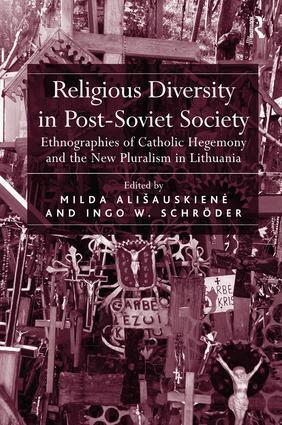
    Religious Diversity in Post-Soviet Society

    Ethnographies of Catholic Hegemony and the New Pluralism in Lithuania

    AvMilda Ališauskiene,Ingo W. Schröder

    Inbunden, Engelska, 2012

    3 175 kr

    Beställningsvara. Skickas inom 5-8 vardagar. Fri frakt över 249 kr.

    Fler format och utgåvor

    Häftad

    737 kr

    Beskrivning

    Since the end of state repression against religion, two major processes have taken place in the formerly socialist countries: historically dominant churches strive to reassert their position in society, while new religious groups and ideas from various parts of the world are proliferating. This generates pluralism of religious communities and individual religious attitudes. Religious Diversity in Post-Soviet Society presents the first collection of ethnographies of this new religious diversity for Lithuania, a country that has a long history of a dominant Catholic Church. The authors reveal how Catholicism has become increasingly diversified and other religions (Charismatic Protestantism, Baltic Paganism, Eastern religions and other alternative spiritualities) are claiming their space in the religious field.

    Produktinformation

    • Utgivningsdatum:2012-01-28
    • Mått:156 x 234 x 14 mm
    • Vikt:580 g
    • Format:Inbunden
    • Språk:Engelska
    • Antal sidor:226
    • Förlag:Taylor & Francis Ltd
    • ISBN:9781409409120

    Utforska kategorier

    • Kulturvetenskap inom Samhälle och politik
    • Religion: allmänt inom Filosofi och religion
    • Kristendom inom Filosofi och religion

    Mer om författaren

    Milda Ališauskiene is a Postdoctoral Fellow at the Centre for Oriental Studies at Vilnius University and a Lecturer in Sociology at Vytautas Magnus University, Kaunas, where she teaches courses on religion and society, contemporary processes of religious group formation and religion and politics. Her 2009 dissertation was entitled "Manifestation and Peculiarities of New Religions in Lithuania: the Case of the Art of Living Foundation". She has published several articles on contemporary religiosity in Lithuania, focusing on New Age, the Art of Living Foundation, and Satanism, which are based on the material collected during her fieldwork. Her research interests include secularization, religious pluralism, religious fundamentalism, new religious movements, New Age and Neo-Hinduism. Ingo W. Schröder is a Senior Researcher at the Social Anthropology Centre, Vytautas Magnus University, Kaunas, and an Adjunct Professor (Privatdozent) of Social Anthropology at Philipps University, Marburg. He was a Senior Research Fellow from 2007-10 at the Max Planck Institute for Social Anthropology in Halle/Saale in the research project "The Catholic Church and Religious Pluralism in Lithuania and Poland". His main geographical fields of expertise are Eastern Europe and Native North America, and his research has focused on Catholicism, Neopaganism, socialism and postsocialism, the politics of identity, heritage and culture, as well as urban anthropology. His most recent publication is the edited volume (with Asta Vonderau) Changing Economies and Changing Identities in Postsocialist Eastern Europe (2008). In 2008/2009 he spent a year of fieldwork on urban religiosity in Lithuania.

    Recensioner i media

    'Lithuania is normally, and correctly, thought of as a majority Catholic country, but this volume reveals the hitherto unacknowledged richness of its religious landscape. The Catholic Church is having to come to terms not only with its Soviet past but also with the contemporary scene in which it has to co-exist with Lithuania's minority traditional religions (Greek Catholics; Russian Orthodox; Old Believers; Judaism; Karaism; Islam; Lutheran and Reformed Churches) but also with new (to Lithuania) religions including Baptists; Buddhists, ISKCON; Unificationists; New Agers, Pagans and, perhaps most challenging of all, the Word of Life and Jehovah's Witnesses. This interesting, informative and invaluable volume not only charts the religious scene in this small Baltic country, but also provides a template with which we can compare the situation in which other Central and Eastern European countries find themselves two decades after the collapse of atheistic socialism. It is a book that should be on the shelves of all those with an interest in religion, social change and, particularly, but by no means only, the New Europe.' Eileen Barker, Professor Emeritus, London School of Economics, UK 'Poised between the low levels of religiosity which characterise its Baltic, ex-Soviet neighbours and the high levels of Catholic Poland, Lithuania provides a fascinating window through which to examine processes of religious reconfiguration after socialism. The "birthright" Roman Catholic Church exercises a diffuse hegemony, especially in rural areas, but the contributors document an astonishing variety of beliefs and practices. This volume will be read with pleasure and profit by all concerned with the complex interdependence of the religious and the secular in modern Europe.' Chris Hann, Max Planck Institute for Social Anthropology, Germany '... an in-depth look at the relation of the once-predominant Roman Catholicism in Lithuania to the new pluralism that has emerged in the small Baltic nation since the fall of communism.' Religion Watch 'Lithuania finds itself positioned between rather different neighbours and it certainly requires some effort to penetrate cultural codes and local traditions before the local within the global becomes approachable. Reading the book one is reminded that a careful ethnography is the best outset for any exploration of local religion or religions... The past two decades have fundamentally changed Lithuania, a change mirrored in the new multi-religious reality of the country. In terms of scholarship pertaining to religion, the emerging change is reflected in the rising scientific expertise. The present volume is a fine example of this.' Journal of Contemporary Religion 'There is much here to fascinate...' Catholic Library World '... Religious Diversity in Post-Soviet Society, jointly edited by a sociologist specializing in new religious movements, AlisauskienA-, and an anthropologist well-known for his studies on the Catholic Church, Schroder, is an important addition to the growing body of literature on religion in the former Soviet Bloc countries. What is also original in the volume is the use, as a meeting ground for anthropologists and sociologists, of cognitive tools derived from Italian Marxist political theorist Antonio Gramsci (1891-1937), which have been studied in Lithuania before and after the fall of the Soviet regime.' International Journal for the Study of New Religions 'All in all, this is a good collection of studies looking at contemporary religious life in Lithuania outside the dominant Catholic Church.' Slavonic and East European Review 'This collection of ethnographic essays represents an excellent introduction to the religious field, but also raises a number of interesting questions for the reader to reflect on. ...the authors certainly help to fill the current gap in ethnographic research on religion in post-Soviet societies. They cover a wide range of religious groups and research topics and tell intriguing stories that provide us with a rich understanding.' Europe-Asia Studies

    Innehållsförteckning

    • Introduction, Milda Ališauskien?, Ingo W. Schröder; Chapter 1 Catholic Majority Societies and Religious Hegemony: Concepts and Comparisons, Ingo W. Schröder; Chapter 2 The History of Religion in Lithuania since the Nineteenth Century, Ar?nas Streikus; Chapter 3 “We Are All in Exile Here”: Perceptions of Death, the Soul, and the Afterlife in Rural Lithuania, Lina Pranaityt? Wergin; Chapter 4 The Elusive Religious Field in Lithuania, Ingo W. Schröder; Chapter 5 From Confrontation to Conciliation: On Syncretic Rapprochement between Catholics and Charismatic Evangelists in Lithuania, Gediminas Lankauskas; Chapter 6 Romuva Looks East: Indian Inspiration in Lithuanian Paganism, Michael F. Strmiska; Chapter 7 The New Age Milieu in Lithuania: Popular Catholicism or Religious Alternative?, Milda Ališauskien?; Chapter 8 Muslims in Catholic Lithuania: Divergent Strategies in Dealing with the Marginality Status, Egd?nas Ra?ius; Chapter 9 The Neo-Buddhist White Lotus Movement in Search for Legitimacy, Donatas Glodenis; conclusion Concluding Thoughts, Ingo W. Schröder;