• Fri frakt över 249 kr
  • •
  • Snabba leveranser
  • •
  • Billiga böcker
Kundservice

Du är på sajten för privatpersoner.

Företag, bibliotek eller offentlig verksamhet?

Du handlar på classic.bokus.com, där alla dina funktioner finns intakta.
Till classic.bokus.com
Bokus logotyp. Gå till startsidan.
  • Erbjudanden
  • Nyheter
  • Student
  • Topplistor
  • Barn & ungdom
  • Bokus Play
  • E-böcker
  • Pocketböcker
  • Spel & pussel

10% rabatt på allt med kod NYSTART10 →

Sidfot

Mina sidor

    Hjälp

    • Kundservice
    • Vanliga frågor och svar
    • Frakt och leverans
    • Retur vid ångerrätt
    • Reklamera vara
    • Betalning
    • Köpvillkor
    • Allmänna villkor
    • Information om webbplatsens tillgänglighet

    Om Bokus

    • Om oss
    • Pressrum
    • För studenter
    • För företag
    • För bibliotek och offentlig verksamhet
    • För leverantörer
    • Hållbarhet

    Populärt

    • Aktuella erbjudanden
    • Presentkort
    • Studentlitteratur
    • Nya böcker
    • Topplistor
    • Signerade böcker
    • Engelska böcker

    Inspiration

    • Boktips
    • BookTok
    • Populära bokserier
    • Barnbokskaraktärer
    • Populära författare
    Logotyp för Bokus
    Följ oss på Facebook (extern länk)Följ oss på Instagram (extern länk)Följ oss på YouTube (extern länk)Följ oss på TikTok (extern länk)
    bokus @ CookiesAnpassa cookiesIntegritetspolicyKöpvillkor
    Till Citymail hemsida (extern länk)Till Budbee hemsida (extern länk)Till Postnord hemsida (extern länk)Till Schenker hemsida (extern länk)Till Early Bird hemsida (extern länk)Till Walleys hemsida (extern länk)
    1. Samhälle och politik
    2. Sociologi och antropologi
    3. Sociologi

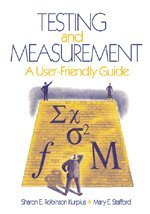
    Testing and Measurement

    A User-Friendly Guide

    AvSharon E. Robinson Kurpius,Mary E. Stafford

    Häftad, Engelska, 2005

    1 747 kr

    Beställningsvara. Skickas inom 3-6 vardagar. Fri frakt över 249 kr.

    Beskrivning

    This step-by-step approach allows students to master testing and measurement concepts through practical exercises and feedback. Using humor, cartoons and real-world examples, Sharon E. Robinson Kurpius and Mary E. Stafford guide the reader through the essential components of measurement, starting with measurement scales and ending with reliability and validity. The authors show that everyone can learn testing and measurement concepts, and they make the learning process fun and non-threatening. For those who want to challenge themselves beyond the self-instructional exercises included throughout each chapter, data sets are provided as an aid to further learning. The book is invaluable for all introductory courses in measurement and testing at undergraduate and lower-level graduate level in the social and behavioral sciences.

    Produktinformation

    • Utgivningsdatum:2005-10-20
    • Mått:177 x 254 x 11 mm
    • Vikt:340 g
    • Format:Häftad
    • Språk:Engelska
    • Antal sidor:200
    • Upplaga:1
    • Förlag:SAGE Publications
    • ISBN:9781412910026

    Utforska kategorier

    • Sociologi inom Samhälle och politik

    Mer om författaren

    Since I was a small child, I have always been a nurturer, someone who helps others. I patiently listen to their concerns, let them express their feelings, and, when appropriate, help them look at ways to feel better or behave differently. In its simplest form, I think of mentoring as a process of nurturing others. For me, it is using who I am and what I know to foster the personal and professional growth of graduate students. This is what I find most fulfilling about being a professor-the opportunity to develop meaningful individual relationships with my students with the primary goal being their academic and career success and fulfillment.As I reflected on my almost 29-year tenure as a faculty member at Arizona State University, I realized that I have had the privilege of fostering the development of 50 doctoral graduates, as well as numerous master degree graduates. Currently, I am directing the dissertations of nine students. The students who enter our doctoral program in counseling psychology are amazing. They are unbelievably bright, articulate, and curious, and invariably kind-hearted. To be able to work with them is a privilege. I have never viewed being a teacher and mentor as a task or as "a job." Instead, I believe that these students have been gifts to me. As I have tried to enrich their lives and careers, they have enriched mine both personally and professionally. Mentoring is a reciprocal process, occurring in stages. Dr. Mary E. Stafford is a faculty member and internship coordinator in the School Psychology Program at University of Houston Clear Lake, where she is an Associate Professor. Dr. Stafford is editor of the International School Psychology Association’s (ISPA) newsletter, the World*Go*Round. She teaches courses in personality assessment, child psychopathology, counseling children, and biological basis of behavior. Her research interests focus on at-risk children (especially, on influences on resilience among youth, on the effects of mobility among school-age children, and on socioeconomic, cultural, and language issues related to children’s achievement and adjustment in schools), on practice issues in schools internationally, and on ethics.Dr. Stafford has a Ph.D. degree in Educational Psychology, with concentration in School Psychology, from the University of Texas at Austin. Prior to coming to UHCL in 2005, she was the Training Director in the School Psychology Program in the Division of Psychology in Education at Arizona State University. In her early career, she worked with children in public school and residential treatment center for emotionally handicapped settings as teacher, counselor, diagnostician, and school principal.

    Recensioner i media

    It is a good textbook for beginning students.

    Innehållsförteckning

    • List of FiguresList of TablesA Note to StudentsAcknowledgments1. What Is a Number? Is a Rose Always a Rose?Numbers and ScalesSome Final Thoughts About Scales of MeasurementNumbers and Response FormatsSome Final Thoughts About Response FormatsNumbers and Test Scores--How Do They Relate?Some Final Thoughts About Measurement Scales and Response FormatsKey TermsModels and Self-instructional ExercisesWords of Encouragement2. Frequencies: One Potato, Two Potato, Three Potato, FourUngrouped Frequency DistributionsGrouped Frequency DistributionsCumulative Frequency DistributionSome Final Thoughts About Frequency DistributionsKey TermsModels and Self-instructional ExercisesWords of Encouragement3. The Distribution of Test Scores--The Perfect Body?KurtosisSkewnessSome Final Thoughts About Distribution of Test ScoresKey TermsModels and Self-instructional ExercisesWords of Encouragement4. Central Tendencies and Dispersion--Coming Together or Growing ApartCentral Tendencies--The Inner Core of the Normal CurveThe ModeThe MedianMedians and Modes for Grouped Frequency DataThe MeanSome Final Points About Central TendencyDispersion--Not All Bodies Are the SameRangeDeviation ScoresVarianceStandard DeviationMeans and Standard Deviations in the Real WorldKey TermsModels and Self-instructional ExercisesYour New Best Friend--SPSSWords of Encouragement5. Standardized Scores--Do You Measure Up?Percentiles--What They Mean in MeasurementPercentile Ranks for Grouped DataSome Final Thoughts About Percentile RanksZ ScoresWhy Transform a Raw Score to a Z Score?Other Standard ScoresKey TermsModels and Self-instructional ExercisesYour New Best Friend–SPSSWords of Encouragement6. Norms and Criterion Scores--Keeping Up With the Joneses or NotCriterion-Referenced Tests--Do You Know as Much as You Should?Norm-Referenced Tests--Dying to Fit InKey TermsModels and Self-instructional ExercisesWords of Encouragement7. Error Scores--The Truth, the Whole Truth, and Nothing but the Truth?Test TheoryTest-Theory AssumptionsKey TermsModels and Self-instructional ExercisesWords of Encouragement8. Building a Strong Test--One the Big Bad Wolf Can’t Blow DownItem DifficultySome Final Thoughts About Item DifficultyItem DiscriminationKey TermsModels and Self-instructional ExercisesWords of Encouragement9. Reliability--The Same Yesterday, Today, and TomorrowThe Mathematical Foundation of ReliabilityTypes of Reliability EstimatesStandard Error of MeasurementCorrelation Coefficients as Measures of ReliabilitySome Final Thoughts About ReliabilityKey TermsModels and Self-instructional ExercisesWords of Encouragement10. Validity--What You See Is Not Always What You GetHelping You Get What You SeeSources of Validity EvidenceThe Marriage of Reliability and Validity--Wedded BlissInterpreting the Validity of Tests--Intended and Unintended ConsequencesSome Final Thoughts About ValidityKey TermsModels and Self-instructional ExercisesWords of Encouragement11. The Perils and Pitfalls of Testing--Being EthicalYour Own CompetenceRights of Those Being TestedPotential DangersRyan′s RightsAppendixReferencesIndexAbout the Authors