• Fri frakt över 249 kr
  • •
  • Snabba leveranser
  • •
  • Billiga böcker
Kundservice

Du är på sajten för privatpersoner.

Företag, bibliotek eller offentlig verksamhet?

Du handlar på classic.bokus.com, där alla dina funktioner finns intakta.
Till classic.bokus.com
Bokus logotyp. Gå till startsidan.
  • Erbjudanden
  • Nyheter
  • Student
  • Topplistor
  • Barn & ungdom
  • Bokus Play
  • E-böcker
  • Pocketböcker
  • Spel & pussel

10% rabatt på allt med kod: NYSTART10 →

Sidfot

Mina sidor

    Hjälp

    • Kundservice
    • Vanliga frågor och svar
    • Frakt och leverans
    • Retur vid ångerrätt
    • Reklamera vara
    • Betalning
    • Köpvillkor
    • Allmänna villkor
    • Information om webbplatsens tillgänglighet

    Om Bokus

    • Om oss
    • Pressrum
    • För studenter
    • För företag
    • För bibliotek och offentlig verksamhet
    • För leverantörer
    • Hållbarhet

    Populärt

    • Aktuella erbjudanden
    • Presentkort
    • Studentlitteratur
    • Nya böcker
    • Topplistor
    • Signerade böcker
    • Engelska böcker

    Inspiration

    • Boktips
    • BookTok
    • Populära bokserier
    • Barnbokskaraktärer
    • Populära författare
    Logotyp för Bokus
    Följ oss på Facebook (extern länk)Följ oss på Instagram (extern länk)Följ oss på YouTube (extern länk)Följ oss på TikTok (extern länk)
    bokus @ CookiesAnpassa cookiesIntegritetspolicyKöpvillkor
    Till Citymail hemsida (extern länk)Till Budbee hemsida (extern länk)Till Postnord hemsida (extern länk)Till Schenker hemsida (extern länk)Till Early Bird hemsida (extern länk)Till Walleys hemsida (extern länk)
    1. Samhälle och politik
    2. Social välfärd och brottslighet
    3. Brottslighet och kriminologi

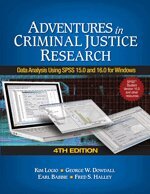
    Adventures in Criminal Justice Research

    Data Analysis Using SPSS 15.0 and 16.0 for Windows

    AvKim A. Logio,George W. Dowdall

    Häftad, Engelska, 2008

    1 892 kr

    Tillfälligt slut

    Beskrivning

    The only book of its kind, this text guides students through the process of conducting criminological data analysis. Used primarily in lab settings, the Fourth Edition of Adventures in Criminal Justice Research, derived from the popular Adventures in Social Research (Babbie et al, Pine Forge Press/SAGE), systematically takes students through a series of investigative adventures. More than 150 screenshots in the text offer clear visual step-by-step instructions to solidify student understanding.


    New to This Edition

    • Incorporates even more criminal justice exercises, policy-related exercises, and hot criminal justice–related issues throughout the book
    • Includes analysis of criminal justice and other social issues using data from GSS sets, the 2000 Census, the Harvard School of Public Health College Alcohol Survey, and other data sets available to the public through the Internet
    • Offers increased coverage of Web-based surveys and survey software

    Accompanied by High-Quality Ancillaries!

    • A new Student study site a features numerous data sets along with online appendices - Appendix A: Sample Journal Article and "How to Read a Research Article", Appendix B: College Alcohol Study Questionnaire, and Appendix C: Chapter Review Quizzes with Answers.
    Intended Audience

    This practical textbook is a valuable supplement for courses in Research Methods and/or Statistics in departments of criminal justice or criminology. The only book of its kind, this text guides students through the process of conducting criminological data analysis. Used primarily in lab settings, the of , derived from the popular (Babbie et al, Pine Forge Press/SAGE), systematically takes students through a series of investigative adventures.

    Produktinformation

    • Utgivningsdatum:2008-06-04
    • Mått:215 x 279 x undefined mm
    • Vikt:510 g
    • Format:Häftad
    • Språk:Engelska
    • Antal sidor:216
    • Upplaga:4
    • Förlag:SAGE Publications
    • ISBN:9781412963510

    Utforska kategorier

    • Brottslighet och kriminologi inom Samhälle och politik

    Mer om författaren

    Kim A. Logio is an Assistant Professor of Sociology at Saint Joseph′s University in Philadelphia. She teaches research methods for sociology and criminal justice students. She is actively involved in research on victims of juvenile crime and adolescent body image. George Dowdall teaches undergraduate and graduate Criminal Justice and Sociology at St. Joseph′s University in Philadelphia. He is chair-elect of the American Sociological Association’s Section on Communication and Information Technologies. He has taught methods, statistics, and data analysis courses at St. Joseph′s University, the Harvard School of Public Health, and the Brown University School of Medicine. Earl Babbie was born in Detroit, Michigan, in 1938, but his family chose to return to Vermont 3 months later, and he grew up there and in New Hampshire. In 1956, he set off for Harvard Yard, where he spent the next 4 years learning more than he initially planned. After 3 years with the US Marine Corps, mostly in Asia, he began graduate studies at the University of California—Berkeley. He received his PhD from Berkeley in 1969. He taught sociology at the University of Hawaii from 1968 through 1979, took time off from teaching and research to write full-time for 8 years, and then joined the faculty at Chapman University in Southern California in 1987. Although he is the author of several research articles and monographs, he is best known for the many textbooks he has written, which have been widely adopted in colleges throughout the United States and the world. He also has been active in the American Sociological Association for 25 years and currently serves on the ASA’s executive committee. He is also past president of the Pacific Sociological Association and California Sociological Association.Fred Halley, Associate Professor Emeritus, SUNY-Brockport, received his bachelor’s degree in sociology and philosophy from Ashland College and his master’s and doctorate degrees from Case Western Reserve University and the University of Missouri, respectively. Since 1970, he has worked to bring both instructional and research computer applications into the undergraduate sociology curriculum. Halley has been recognized for his leadership in the instructional computing sections of the Eastern and Midwest Sociological Societies and the American Sociological Association. At Brockport, he served as a collegewide social science computing consultant and directed Brockport’s Institute for Social Science Research and the College’s Data Analysis Laboratory. Off campus, Halley directed and consulted on diverse community research projects that were used to establish urban magnet schools, evaluate a Head Start family service center, locate an expressway, and design a public transportation system for a rural county. Now residing in Rochester, New York, he plays an active role in a faith-based mentoring program for ex-offenders, and he volunteers for Micrecycle, an organization that refurbishes computers used by those on the other side of the computer divide in schools, daycares, youth centers, and other community organizations.

    Recensioner i media

    I am happy with the current text. I will continue to use it as long as it is viable.

    Innehållsförteckning

    • About the AuthorsPreface for InstructorsPart I: Preparing for Criminal Justice ResearchChapter 1: Theory, Measurement, and Research Development1.1 Research in Criminal Justice1.2 Theory in Criminal Justice: Routine Activity Theory1.3 Hypotheses in Criminal Justice Research1.4 Should Abortion Be Legal?1.5 Crime, Punishment, and Violence1.6 The Logic of Measurement1.7 Validity Problems1.8 Reliability Problems1.9 Multiple Indicators1.10 Level of Measurement1.11 Units of Analysis1.12 SummaryChapter 2: Criminal Justice Data Sets2.1 Primary and Secondary Data Analysis2.2 Description of a Data Set: The General Social Survey2.3 Sampling: How Representative Are Your Data?2.4 Data Collection2.5 General Social Survey Variables2.6 Harvard School of Public Health College Alcohol Study2.7 Other Criminal Justice Data Sets Available on the Web2.8 Downloading Data from the Internet2.9 Your Own Criminal Justice Survey2.10 SummaryChapter 3: Using SPSS3.1 Using SPSS to Open Existing Data Sets3.2 Learning More: The Windows Tutorial3.3 Creating Your Own Data Set3.4 Coding Your Data3.5 Entering Your Data3.6 Using Published Criminal Justice Data3.7 SummaryPart II: Univariate AnalysisChapter 4: Describing a Variable4.1 A Graphic View4.2 Measuring Central Tendency and Dispersion4.3 Modifying Variables With Recode4.4 Practicing Recodes4.5 Saving Your Work4.6 SummaryChapter 5: Working With Variables5.1 Political Views: Liberalism Versus Conservatism5.2 Political Policy Affiliation5.3 Gun Laws and Capital Punishment5.4 Understanding Binge Drinking5.5 Other Survey Items About Crime and Justice5.6 Crime and Justice Data for the American States5.7 SummaryChapter 6: Creating Composite Measures6.1 Using Crosstabs6.2 Combining Two Items in an Index6.3 Checking to See How the Index Works6.4 Creating a More Complex Index With Count6.5 Creating the FBI Crime Index6.6 "Secondhand Binge Effects": Creating an Index6.7 SummaryPart III: Bivariate AnalysisChapter 7: Investigating the Correlates of Binge Drinking and Attitudes Toward Gun Control and Capital Punishment: Independent Versus Dependent Variables7.1 Moving Beyond Description: Comparing Two Variables7.2 Comparing Binge Drinking and Gender7.3 Examining Binge Drinking and Race7.4 Continuing the Analysis: Binge Drinking and Religiosity7.5 The Impact of the Minimum Purchase Law: Bingeing and Age7.6 Political Orientation, Guns, and Capital Punishment: Independent Versus Dependent Variables7.7 The Relationship Between POLVIEWS and PARTYID7.8 Age and Politics7.9 Religion and Politics7.10 Gender and Politics7.11 Race, Class, and Politics7.12 Education and Politics7.13 Martial Status and Politics7.14 Gun Laws and Capital Punishment7.15 SummaryChapter 8: Measures of Association8.1 Lambda8.2 Gamma8.3 Pearson′s r, the Correlation Coefficient8.4 Regression8.5 SummaryChapter 9: The Existence, Strength, and Direction of an Association9.1 Chi-Square9.2 t-Tests9.3 Analysis of Variance9.4 SummaryPart IV: Multivariate AnalysisChapter 10: Examining Several Independent Variables10.1 Age, Sex, and Religiosity10.2 Family Status and Religiosity10.3 Social Class and Religiosity10.4 Other Variables to Explore10.5 Multiple Linear Regression10.6 SummaryChapter 11: Exploring What Shapes Attitudes About Guns and Capital Punishment11.1 Political Philosophy and Party Identification11.2 The Mystery of Politics and Marital Status11.3 Guns and Capital Punishment11.4 SummaryChapter 12: Logistic Regression: Understanding College Student Drug and Alcohol Abuse12.1 Binge Drinking: A Dichotomous Dependent Variable12.2 The Odds Ratio: Gender and Binge Drinking12.3 Using SPSS for Windows Student Version for the Odds Ratio12.4 Logistic Regression in SPSS for Windows12.5 Multiple Logistic Regression12.6 SummaryAppendix A: How to Read a Research ArticleAppendix B: College Alcohol Study Questionnaire (on the Student Study Site)Appendix C: Chapter Review Quizzes and Independent Projects (on the Student Study Site)Appendix D: Answers to Chapter Review Quizzes (on the Student Study Site)References and Suggested ReadingsGlossary/Index