• Fri frakt över 249 kr
  • •
  • Snabba leveranser
  • •
  • Billiga böcker
Kundservice

Du är på sajten för privatpersoner.

Företag, bibliotek eller offentlig verksamhet?

Du handlar på classic.bokus.com, där alla dina funktioner finns intakta.
Till classic.bokus.com
Bokus logotyp. Gå till startsidan.
  • Erbjudanden
  • Nyheter
  • Student
  • Topplistor
  • Barn & ungdom
  • Bokus Play
  • E-böcker
  • Pocketböcker
  • Spel & pussel

10% rabatt på allt med kod NYSTART10 →

Sidfot

Mina sidor

    Hjälp

    • Kundservice
    • Vanliga frågor och svar
    • Frakt och leverans
    • Retur vid ångerrätt
    • Reklamera vara
    • Betalning
    • Köpvillkor
    • Allmänna villkor
    • Information om webbplatsens tillgänglighet

    Om Bokus

    • Om oss
    • Pressrum
    • För studenter
    • För företag
    • För bibliotek och offentlig verksamhet
    • För leverantörer
    • Hållbarhet

    Populärt

    • Aktuella erbjudanden
    • Presentkort
    • Studentlitteratur
    • Nya böcker
    • Topplistor
    • Signerade böcker
    • Engelska böcker

    Inspiration

    • Boktips
    • BookTok
    • Populära bokserier
    • Barnbokskaraktärer
    • Populära författare
    Logotyp för Bokus
    Följ oss på Facebook (extern länk)Följ oss på Instagram (extern länk)Följ oss på YouTube (extern länk)Följ oss på TikTok (extern länk)
    bokus @ CookiesAnpassa cookiesIntegritetspolicyKöpvillkor
    Till Citymail hemsida (extern länk)Till Budbee hemsida (extern länk)Till Postnord hemsida (extern länk)Till Schenker hemsida (extern länk)Till Early Bird hemsida (extern länk)Till Walleys hemsida (extern länk)
    1. Psykologi och pedagogik
    2. Pedagogik
    3. Utbildningsstrategier och utbildningspolitik

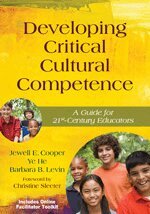
    Developing Critical Cultural Competence

    A Guide for 21st-Century Educators

    AvJewell Cooper,Ye He

    Häftad, Engelska, 2011

    467 kr

    Skickas . Fri frakt över 249 kr.

    Beskrivning

    "Developing Critical Cultural Competence provides educators with the inspiration, knowledge, and tools to move from theory to action in seeking to eliminate the achievement gap."—Bess Scott, Director of Elementary EducationLincoln Public Schools, NE"As I read this book, it became clear that my long-held belief about the meaning of cultural competence needed a makeover. I am now convinced that my personal definition of diversity should embrace a much deeper appreciation of differences and transformative action."—Denise Carlson, Curriculum ConsultantHeartland Area Education Agency, Johnston, IACultural competence is key to improved student achievementThe increasingly diverse nature of today′s schools and the need to increase the achievement of all students, no matter their background, requires 21st-century teachers to develop critical cultural competence. Looking at data is not enough. We have to know who our students are! This book shows you how to provide professional development that deepens teachers′ cultural understanding. Developing Critical Cultural Competence helps educators translate new knowledge into action with activities that focus on the three inseparable insights required for developing teachers′ critical cultural competency: Understanding themselvesUnderstanding their studentsUnderstanding their students′ families and communitiesIn addition to the activities are reflection questions, group discussion questions, online extensions for facilitators, and a sample professional development plan. A companion website provides reproducible resource lists and handouts as well as examples that can serve as models for some of the activities.

    Produktinformation

    • Utgivningsdatum:2011-11-03
    • Mått:177 x 254 x 15 mm
    • Vikt:480 g
    • Format:Häftad
    • Språk:Engelska
    • Antal sidor:232
    • Förlag:SAGE Publications Inc
    • ISBN:9781412996259

    Utforska kategorier

    • Utbildningsstrategier och utbildningspolitik inom Psykologi och pedagogik
    • Lärarutbildning inom Psykologi och pedagogik

    Mer om författaren

    Dr. Ye He is an Associate Professor in the Teacher Education and Higher Education Department at the University of North Carolina at Greensboro. Her research focuses on the promotion of strength-based, community-engaged culturally responsive practices in education.Barbara Levin has been a Professor in the Department of Teacher Education and Higher Education at the University of North Carolina at Greensboro (UNCG) since 1993. She was an elementary school teacher for 17 years before earning her Ph.D. at the University of California-Berkeley. Dr. Levin served as the Director of the Teachers Academy at UNCG, assistant department chair, and director of graduate studies. She was awarded the first Mentoring-Advising-Supervising (MAS) Award in the School of Education at UNCG. Dr. Levin also served as an Associate Editor for Teacher Education Quarterly for 8 years, and was co-PI on a 5-year, $1.4 million National Professional Development grant from the Dept. of Education called TESOL for ALL. Her research interests include: understanding how teachers’ pedagogical beliefs develop across their careers; case-based teaching; problem-based learning (PBL); universal design for learning (UDL); and leading, teaching, and learning with technology. Dr. Levin has published eight books and over 40 articles in well-respected research journals.

    Recensioner i media

    “This book offers a coherent collection of theories and practices for a strong multicultural teacher education. It would act as a useful text or starting place for an entire course.”

    Innehållsförteckning

    • List of ResourcesForeword by Christine SleeterPrefaceWhy do we need this book?What is critical cultural competence?Who is this book for?How is this book different from other books about diversity and multicultural education?Organization and Special Features of This BookConclusionAcknowledgmentsAbout the AuthorsIntroduction: What Do We Need to Do to Prepare Teachers for Today′s Diverse Classrooms?Why do we need educators with critical cultural competence in today′s schools?How can we move professional development about diversity beyond knowledge?Who are we in this thing called diversity?How do we leverage assets of students, families and communities?Bringing It All TogetherSummary of Key PointsReflection and Extension1. Common Practices: How Are We Currently Preparing Educators for Diverse Classrooms?IntroductionCommon Goals for Multicultural EducationFoundational Understandings About DiversityMilner′s Five Conceptual Repertoires of DiversityEmpathy Versus SympathyStrength-Based ApproachMaterials and ResourcesTextbooksHistoric and Contemporary VideosOnline Learning ResourcesGuest SpeakersOther Commonly Used Activities and ApproachesDiscussions and ReflectionCase Studies and Case DiscussionsBook ClubsActivity 1.1 Book Club Jigsaw ActivityThe Game of MonopolyEmpathy ActivitiesSummary of Key PointsReflection and ExtensionOnline Extensions2. Who I Am: How Can We Understand Ourselves as Cultural Beings?IntroductionExploring Personal Characteristics and BeliefsActivity 2.1 AutobiographiesActivity 2.2 Educational PhilosophyActivity 2.3 All About Me ActivitiesActivity 2.4 All in a Picture and Snapshot of Me ActivitiesRevealing Beliefs and Identities to OthersActivity 2.5 Intercultural Autograph HuntActivity 2.6 Bio-PoemsActivity 2.7 the Privilege WalkSummary of Key PointsReflection and ExtensionAdditional ResourcesOnline ExtensionsFocus for Professional Learning Communities (PLCs)3. Moving From Beliefs and Visions to Action: How Can We Link Our Personal and Professional Identities?IntroductionActivity 3.1 VisioningActivity 3.2 Personal Practical Theories (PPTs)Activity 3.3 Action ResearchSummary of Key PointsReflection and ExtensionAdditional ResourcesOnline ExtensionsFocus for Professional Learning Communities (PLCs)4. How Do We Prepare Educators to Understand and Appreciate Student Diversity?IntroductionFrom Understanding Diversity to Appreciating DiversityActivity 4.1 Diversity Fact SheetsActivity 4.2 Website ReviewsActivity 4.3 Interactive SurveyActivity 4.4 Description, Interpretation, and EvaluationSummary of Key PointsReflection and ExtensionOnline ExtensionsFocus for Professional Learning Communities (PLCs)5. From Critical Awareness to Transformative Action: How Do We Prepare Educators to Become Cultural Brokers for Student Success?IntroductionFrom Critical Awareness to Transformative ActionCross-Cultural Competence and Critical Self-ReflectionActivity 5.1 Active ListeningActivity 5.2 Classroom Observation AnalysisActivity 5.3 ABCs ProjectSummary of Key PointsReflection and ExtensionOnline ExtensionsFocus for Professional Learning Communities (PLCs)6. Learning About the Community: How Can We Learn More About Parents and Families?IntroductionStandards-Based ReformBenefits of Invoving Parents and Families in SchoolsTraditional Ways of Involving Parents in SchoolsNontraditional Approaches to Parents and InvolvementBarriers and Facilitators to InvolvementExtending Traditional Approaches to Parent and Family InvolvementActivity 6.1 Touring the Neighborhood--The Do′s and Don′tsActivity 6.2 Home Visits at the Beginning of the School YearActivity 6.3 Preparing for the First Parent ConferenceSummary of Key PointsReflection and ExtensionOnline ExtensionsFocus for Professional Learning Communities (PLCs)7. Community-Based Learning: How Can We Learn From Parents, Families, and Communities?IntroductionHow diverse are families and our communities?Partnering with Parents, Families, and CommunitiesWhat is community-based learning?Community-Based Learning ActivitiesActivity 7.1 Home-Community Camera AdventureActivity 7.2 Walking a Mile in Another′s ShoesTransformative Effects of Community AdventuresSummary of Key PointsReflection and ExtensionOnline ExtensionsFocus for Professional Learning Communities (PLCs)8. Bringing It All Together: How Do We Maximize Teaching and Learning Opportunities?IntroductionConnecting Culturally Responsive Pedagogy and Critical Cultural CompetenceTaking Risks to Develop Critical Cultural CompetenceInspiring Critical Reflection and AwarenessTransforming Professional PracticeUsing Rogers′s Adoption of Innovation TheoryUsing the Concerns-Based Adoption Model (CBAM)Planning for Professional DevelopmentBefore We StartPre- and PostassessmentFollow-UpSummary of Key PointsFinal WordsAdditional ResourcesReflection and ExtensionOnline ExtensionsReferencesIndex