• Fri frakt över 249 kr
  • •
  • Snabba leveranser
  • •
  • Billiga böcker
Kundservice

Du är på sajten för privatpersoner.

Företag, bibliotek eller offentlig verksamhet?

Du handlar på classic.bokus.com, där alla dina funktioner finns intakta.
Till classic.bokus.com
Bokus logotyp. Gå till startsidan.
  • Erbjudanden
  • Nyheter
  • Student
  • Topplistor
  • Barn & ungdom
  • Bokus Play
  • E-böcker
  • Pocketböcker
  • Spel & pussel

10% rabatt på allt med kod: NYSTART10 →

Sidfot

Mina sidor

    Hjälp

    • Kundservice
    • Vanliga frågor och svar
    • Frakt och leverans
    • Retur vid ångerrätt
    • Reklamera vara
    • Betalning
    • Köpvillkor
    • Allmänna villkor
    • Information om webbplatsens tillgänglighet

    Om Bokus

    • Om oss
    • Pressrum
    • För studenter
    • För företag
    • För bibliotek och offentlig verksamhet
    • För leverantörer
    • Hållbarhet

    Populärt

    • Aktuella erbjudanden
    • Presentkort
    • Studentlitteratur
    • Nya böcker
    • Topplistor
    • Signerade böcker
    • Engelska böcker

    Inspiration

    • Boktips
    • BookTok
    • Populära bokserier
    • Barnbokskaraktärer
    • Populära författare
    Logotyp för Bokus
    Följ oss på Facebook (extern länk)Följ oss på Instagram (extern länk)Följ oss på YouTube (extern länk)Följ oss på TikTok (extern länk)
    bokus @ CookiesAnpassa cookiesIntegritetspolicyKöpvillkor
    Till Citymail hemsida (extern länk)Till Budbee hemsida (extern länk)Till Postnord hemsida (extern länk)Till Schenker hemsida (extern länk)Till Early Bird hemsida (extern länk)Till Walleys hemsida (extern länk)
    1. Skönlitteratur
    2. Litteraturvetenskap

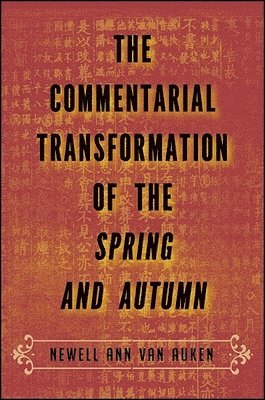
    Commentarial Transformation of the Spring and Autumn

    AvNewell Ann van Auken

    Häftad, Engelska, 2017

    Del i serien SUNY series in Chinese Philosophy and Culture

    543 kr

    Beställningsvara. Skickas inom 5-8 vardagar. Fri frakt över 249 kr.

    Fler format och utgåvor

    Inbunden

    Tillf. slut

    Beskrivning

    Shows how the text evolved from a non-narrative historical record into a Confucian classic.The Spring and Autumn is among the earliest surviving Chinese historical records, covering the period 722–479 BCE. It is a curious text: the canonical interpretation claims that it was composed by Confucius and embodies his moral judgments, but this view appears to be contradicted by the brief and dispassionate records themselves. Newell Ann Van Auken addresses this puzzling discrepancy through an examination of early interpretations of the Spring and Autumn, and uncovers a crucial missing link in two sets of commentarial remarks embedded in the Zuǒ Tradition. These embedded commentaries do not seek moral judgments in the Spring and Autumn, but instead interpret its records as produced by a historiographical tradition that was governed by rules related to hierarchy and ritual practice. Van Auken's exploration of the Zuǒ Tradition and other early commentaries sheds light on the transformation of the Spring and Autumn from a simple, non-narrative historical record into a Confucian classic.

    Produktinformation

    • Utgivningsdatum:2017-07-02
    • Mått:152 x 229 x 21 mm
    • Vikt:481 g
    • Format:Häftad
    • Språk:Engelska
    • Serie:SUNY series in Chinese Philosophy and Culture
    • Antal sidor:352
    • Förlag:State University of New York Press
    • ISBN:9781438463001

    Utforska kategorier

    • Litteraturvetenskap inom Skönlitteratur
    • Historia: teori och metod inom Historia och arkeologi
    • Asiens historia inom Historia och arkeologi

    Mer om författaren

    Newell Ann Van Auken teaches in the Department of Asian and Slavic Languages and Literatures at the University of Iowa.

    Recensioner i media

    "…this book is a finely illuminating piece of research and exposition, executed with great care and precision." — Dao

    Innehållsförteckning

    • AcknowledgmentsScholarly ConventionsIntroductionText, Commentary, and AuthorityThe Spring and Autumn: An Overview and Brief Reception HistoryThe Zuô Tradition and Spring and Autumn CommentaryOverview of the Book1. Orthodoxy and Transformation: Two Categories of CommentaryDù Yù's "Preface": Zhōu Gōng and ConfuciusAfter Dù Yù: Reception and Rejection of the Direct Commentary PassagesPerceptions of the Direct Commentary's Place in Zuô Tradition Composition HistoryGeneral and Specific Remarks: NomenclatureFormal Description of the Direct Commentary Passages2. The Ritual Filter and the Centrality of LǔReporting and RecordingThe Centrality of the Lǔ RulerTardiness"Avoiding the ugly"The Ritual Filter: Rules, Ritual Deficiencies, and Criticism3. Hierarchy, Criticism, and Commendation: Recognizing Merit and Assigning FaultRank, Hierarchy, and PrestigeCriticism and Assignment of FaultCommendation and Honor"Subtle words conveying praise and blame" Revisited4. Two Ways of Teaching the Spring and Autumn: The Sources of the Direct CommentariesBefore Interlinear CommentariesThematic Clustering and the Source of the Specific RemarksThe "Fifty Generalizations"Teaching and Commentary: Texts for Teaching Texts5. Other Approaches to Commentary in the Zuô Tradition: The Gentleman and ConfuciusThe Remarks of the "Gentleman" and "Confucius" versus the Direct CommentaryIntroducing Ambiguity: Composite Passages and ConflationsA Commentarial Essay: Merging Approaches to History"Only the Sage could have revised it"From Ritual Prescriptions to Praise and Blame6. Incomplete Correspondences and the Likelihood of MediatedContact: The Relation of the Direct Commentaries to Gōngyáng and GǔliángThe Direct Commentaries as Later Interpolations?Comparison of Corresponding Gōngyáng and Gǔliáng, and Direct Commentary RemarksFormulaic Expressions, Complexity, and SpecificityApproaches to Commentary: Teaching Texts and Teaching about Texts7. From Recording Rules to Written Text: Conceptual Antecedents to Gōngyáng and Gǔliáng in the Direct CommentariesRules of Exclusion Pertaining to Records: Omitted Events and Exceptional RecordsRules of Exclusion and Omission of Details: Names, Dates, and LocationsThe Special Status of Lǔ: Implicit Assumptions versus Overt RecognitionHidden Messages and the Language of Praise and BlameConclusions: The Commentarial Transformation of the Spring and AutumnEpilogueFrom Zhōu Gōng to Confucius: Textual Creation Myths Forgotten and ReplacedAppendixSummaries and Topical Lists of the Direct Commentary PassagesSummaries: Specific RemarksSummaries: General RemarksTopical Lists of Direct Commentary PassagesNotesBibliographyIndex