• Fri frakt över 249 kr
  • •
  • Snabba leveranser
  • •
  • Billiga böcker
Kundservice

Du är på sajten för privatpersoner.

Företag, bibliotek eller offentlig verksamhet?

Du handlar på classic.bokus.com, där alla dina funktioner finns intakta.
Till classic.bokus.com
Bokus logotyp. Gå till startsidan.
  • Erbjudanden
  • Nyheter
  • Student
  • Topplistor
  • Barn & ungdom
  • Bokus Play
  • E-böcker
  • Pocketböcker
  • Spel & pussel

10% rabatt på allt med kod: NYSTART10 →

Sidfot

Mina sidor

    Hjälp

    • Kundservice
    • Vanliga frågor och svar
    • Frakt och leverans
    • Retur vid ångerrätt
    • Reklamera vara
    • Betalning
    • Köpvillkor
    • Allmänna villkor
    • Information om webbplatsens tillgänglighet

    Om Bokus

    • Om oss
    • Pressrum
    • För studenter
    • För företag
    • För bibliotek och offentlig verksamhet
    • För leverantörer
    • Hållbarhet

    Populärt

    • Aktuella erbjudanden
    • Presentkort
    • Studentlitteratur
    • Nya böcker
    • Topplistor
    • Signerade böcker
    • Engelska böcker

    Inspiration

    • Boktips
    • BookTok
    • Populära bokserier
    • Barnbokskaraktärer
    • Populära författare
    Logotyp för Bokus
    Följ oss på Facebook (extern länk)Följ oss på Instagram (extern länk)Följ oss på YouTube (extern länk)Följ oss på TikTok (extern länk)
    bokus @ CookiesAnpassa cookiesIntegritetspolicyKöpvillkor
    Till Citymail hemsida (extern länk)Till Budbee hemsida (extern länk)Till Postnord hemsida (extern länk)Till Schenker hemsida (extern länk)Till Early Bird hemsida (extern länk)Till Walleys hemsida (extern länk)
    1. Kultur
    2. Konstböcker
    3. Konsthistoria

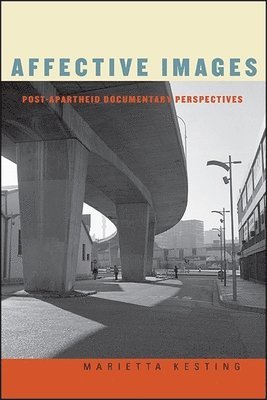
    Affective Images

    Post-apartheid Documentary Perspectives

    AvMarietta Kesting

    Häftad, Engelska, 2018

    Del i serien SUNY Press Open Access

    401 kr

    Tillfälligt slut

    Fler format och utgåvor

    Inbunden

    Tillf. slut

    Beskrivning

    Explores intervisual case studies in relation to migration, xenophobia, and gender.Affective Images examines both canonical and lesser-known photographs and films that address the struggle against apartheid and the new struggles that came into being in post-apartheid times. Marietta Kesting argues for a way of embodied seeing and complements this with feminist and queer film studies, history of photography, media theory, and cultural studies. Featuring in-depth discussions of photographs, films, and other visual documents, Kesting then situates them in broader historical contexts, such as cultural history and the history of black subjectivity and revolves the images around the intersection of race and gender. In its interdisciplinary approach, this book explores the recurrence of affective images of the past in a different way, including flashbacks, trauma, "white noise," and the return of the repressed. It draws its materials from photographers, filmmakers, and artists such as Ernest Cole, Simphiwe Nkwali, Terry Kurgan, Thenjiwe Niki Nkosi, Adze Ugah, and the Center for Historical Reenactments.This book is freely available in an open access edition thanks to Knowledge Unlatched-an initiative that provides libraries and institutions with a centralized platform to support OA collections and from leading publishing houses and OA initiatives. Learn more at the Knowledge Unlatched website at https://www.knowledgeunlatched.org/.

    Produktinformation

    • Utgivningsdatum:2018-07-02
    • Mått:152 x 229 x undefined mm
    • Vikt:431 g
    • Format:Häftad
    • Språk:Engelska
    • Serie:SUNY Press Open Access
    • Antal sidor:292
    • Förlag:State University of New York Press
    • ISBN:9781438467849

    Utforska kategorier

    • Konsthistoria inom Kultur
    • Afrikas historia inom Historia och arkeologi
    • Film inom Kultur

    Mer om författaren

    Marietta Kesting is Junior Professor for Media Theory at the CX Centre for Interdisciplinary Studies at the Academy of Fine Arts, Munich, Germany.

    Recensioner i media

    "Kesting has done much in her circumspect, thoughtful account of South African images of social conflict, encompassing the human rights issues of economic abjection, political resistance, gender-based violence, immigration, national and ethnic identity, and the fomenting of attacks by the dispossessed upon the dispossessed … Kesting's important study makes the South African situation both accessible and exemplary, and should be of significant value to scholars and students surveying a wider range of contrasting but comparable geographical and political landscapes." — Journal of the Royal Anthropological Institute"Throughout the book, the rich and detailed descriptions of photographs and films are a strong asset, speaking of Kesting's sensitivity towards images … Kesting takes an innovative approach to analyse the country's visual culture and to rearrange its established orders … Kesting therefore offers readers a new understanding of South Africa's visual culture and opens up the field to also examine the more recent use of images (for instance on social media) while relating them to historic examples of the twentieth century." — Sehepunkte"In its focus on lens-based media, the book not only tackles some of the questions around the visuality of migration and xenophobia, but also does so using the media (photography and film) that are probably the most complicit in the visual witnessing and translation within this field." — Rory Bester, coeditor of Rise and Fall of Apartheid: Photography and the Bureaucracy of Everyday Life

    Innehållsförteckning

    • List of IllustrationsAcknowledgmentsIntroduction1. Mapping Context and Place2. Affective Images2.1. Photographs of Black Suffering and Violence2.2. Affective Images in the "New" South Africa3. Burning Questions3.1. The "Burning Man"3.2. The Afterlife of Nhamuave’s Photographphoto gallery follows page 1184. Photographic Speech Acts4.1. Migrant Life and the Image4.2. Documentary Participatory Photography and Politics5. In/Visibilities and Reenactments5.1. De-identification and Multiplication?5.2. From Documentary to Fiction—and Back: District 9 6. Conclusion: Affective Images of BelongingNotesGlossaryBibliographyFilmographyIndex