• Fri frakt över 249 kr
  • •
  • Snabba leveranser
  • •
  • Billiga böcker
Kundservice

Du är på sajten för privatpersoner.

Företag, bibliotek eller offentlig verksamhet?

Du handlar på classic.bokus.com, där alla dina funktioner finns intakta.
Till classic.bokus.com
Bokus logotyp. Gå till startsidan.
  • Erbjudanden
  • Nyheter
  • Student
  • Topplistor
  • Barn & ungdom
  • Bokus Play
  • E-böcker
  • Pocketböcker
  • Spel & pussel

10% rabatt på allt med kod NYSTART10 →

Sidfot

Mina sidor

    Hjälp

    • Kundservice
    • Vanliga frågor och svar
    • Frakt och leverans
    • Retur vid ångerrätt
    • Reklamera vara
    • Betalning
    • Köpvillkor
    • Allmänna villkor
    • Information om webbplatsens tillgänglighet

    Om Bokus

    • Om oss
    • Pressrum
    • För studenter
    • För företag
    • För bibliotek och offentlig verksamhet
    • För leverantörer
    • Hållbarhet

    Populärt

    • Aktuella erbjudanden
    • Presentkort
    • Studentlitteratur
    • Nya böcker
    • Topplistor
    • Signerade böcker
    • Engelska böcker

    Inspiration

    • Boktips
    • BookTok
    • Populära bokserier
    • Barnbokskaraktärer
    • Populära författare
    Logotyp för Bokus
    Följ oss på Facebook (extern länk)Följ oss på Instagram (extern länk)Följ oss på YouTube (extern länk)Följ oss på TikTok (extern länk)
    bokus @ CookiesAnpassa cookiesIntegritetspolicyKöpvillkor
    Till Citymail hemsida (extern länk)Till Budbee hemsida (extern länk)Till Postnord hemsida (extern länk)Till Schenker hemsida (extern länk)Till Early Bird hemsida (extern länk)Till Walleys hemsida (extern länk)
    1. Samhälle och politik
    2. Politik och statsskick
    3. Centralt styre och förvaltning

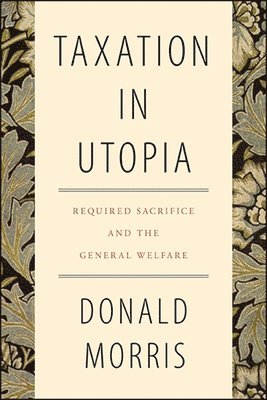
    Taxation in Utopia

    Required Sacrifice and the General Welfare

    AvDonald Morris

    Häftad, Engelska, 2021

    624 kr

    Beställningsvara. Skickas inom 3-6 vardagar. Fri frakt över 249 kr.

    Fler format och utgåvor

    Inbunden

    1 532 kr

    Beskrivning

    An interdisciplinary exploration of utopian political philosophy from the neglected perspective of taxation.Taxation in Utopia explores utopian political philosophy from the neglected perspective of taxation. At its core, taxation is an ethical question. It requires people to sacrifice for the benefit of others, whether or not they also benefit themselves. Donald Morris refers to this broader, nonmonetary context as constructive taxation, which includes restrictions on privacy and access to information, constraints on marriage and child-rearing, and conventions restricting the proprietorship of land. Morris examines this in the context of various utopian writings, such as More's Utopia, as well as literary treatments of these issues, such as Bellamy's Looking Backward. This interdisciplinary exploration of utopian taxation provides a novel approach to examining relations between a state's view of the general welfare and the sacrifices this view requires of its citizens.

    Produktinformation

    • Utgivningsdatum:2021-07-02
    • Mått:152 x 229 x 25 mm
    • Vikt:426 g
    • Format:Häftad
    • Språk:Engelska
    • Antal sidor:336
    • Förlag:State University of New York Press
    • ISBN:9781438479484

    Utforska kategorier

    • Centralt styre och förvaltning inom Samhälle och politik
    • Statsvetenskap och politisk teori inom Samhälle och politik

    Mer om författaren

    Donald Morris is Professor Emeritus of Accounting at the University of Illinois, Springfield. He is the author of several books, including Tax Cheating: Illegal—But Is It Immoral?, also published by SUNY Press.

    Recensioner i media

    "This is an extremely well researched and thorough exploration of utopian literature, effectively back to the beginning of the written word. Morris covers every major work of literature with a utopian element, and works through the tax (both pecuniary and constructive) present in all of these works. His explanation and analysis of economics and doctrine of tax laws is of the highest order." — Jennifer Bird-Pollan, University of Kentucky J. David Rosenberg College of Law

    Innehållsförteckning

    • AcknowledgmentsIntroductionChapter One: Taxation as a Moral Quest Part One: Taxation: The Tail Wags the DogAn Experiment in Shared SacrificeEnds and MeansPracticalityTaxation as a Moral Question of SacrificePart Two: The Construal of Taxation and of UtopiaThe Sinews of TaxationBeyond Revenue: Defining a TaxDefining UtopiaChapter Two: Privacy Deprivation as Taxation The Nature and Role of PrivacyThomas More (1478–1535): No Spots for Secret MeetingsBig Brother's Eyes in Nineteen Eighty-FourH. G. Wells (1866–1946): Indexing HumanityZamyatin (1884–1937): Who Are "They" and Who Are "We"?Expectations of PrivacyChapter Three: Taxing Access to Truth Part One: Plato and BaconOpaque GovernmentPlato (c. 428–c. 348 BCE): The Republic of LiesFrancis Bacon (1561–1626): The Sacrifice to SciencePart Two: Orwell and GodwinTotalitarian Methodologies: Orwell (1903–1950)William Godwin (1756–1836): Anarchist Tax PolicyChapter Four: Taxation by Required Work or Occupation Part One: Plato and MoreWork and InequalityMatching Specialized Abilities to Society's NeedsPlato (c. 428–c. 348 BCE): The Ideal Job in the RepublicThomas More (1478–1535): The Common Obligation of Common Daily ToilPart Two: Bellamy, Gilman, Wells, and SkinnerEdward Bellamy (1850–1898): The Industrial ArmyCharlotte Perkins Gilman (1860–1935): Half the Human Race Is Denied Free Productive ExpressionH. G. Wells (1866–1946): Labor Laws and the Insult of CharityB. F. Skinner (1904–1990): We Have Created Leisure Without SlaveryPart Three: Saint-Simon and CampanellaHenri Saint-Simon (1760–1825): The Human Spirit Follows a Predetermined CourseTommaso Campanella (1568–1639): Assigned Labor in The City of the SunChapter Five: Taxing the Family: Marriage, Childrearing, and Eugenics Part One: Plato, More, Bacon, Wells, and Le GuinMarriage RestrictionsFrancis Bacon (1561–1626): Marriage Except for the WiseH. G. Wells (1866–1946): Motherhood as a Service to the StateLe Guin (1929–2018): Anarchism and the Tax-Free Family in The DispossessedPart Two: Owen and GilmanRobert Owen (1771–1858): The Tax on ChildrearingCharlotte Perkins Gilman (1860–1935): Motherhood and Eugenics in HerlandPart Three: Skinner, Eugenic Tax ProceduresB. F. Skinner (1904–1990): Eliminating the Meaner Emotions in Walden TwoEugenic Tax Procedures: Campanella, Bellamy, Zamyatin, HuxleyChapter Six: Taxation and Land Proprietorship Part One: Harrington, Godwin, and OwenThe Land QuestionJames Harrington (1611–1677): Inheritance Tax in OceanaWilliam Godwin (1756–1836): Anarchy and Private PropertyRobert Owen (1771–1858): Peaceful RevolutionPart Two: George, Tolstoy, Wells, and NozickHenry George (1839–1897): Progress, Land, and PovertyTolstoy (1828–1910): A Landowner's Struggle with the Land ProblemWells (1866–1946): The Land Question in A Modern UtopiaRobert Nozick (1938–2002): Entitlement TheoryChapter Seven: Taxation Purged from Utopia Part One: Ayn Rand (1905–1982): Atlas ShruggedDisparate Social SystemsRand's Four UtopiasRand's "Tax" SystemPart Two: Robert Nozick (1938–2002): Utopia of UtopiasThe Most Extensive State that Can Be JustifiedThe Developing State: The First Four StagesThe Fifth StageTaxes, Forced Labor, and the Minimal State Utopia: The Minimal State FrameworkTaxation in Nozick's Utopia of UtopiasIn ClosingBibliographyIndex