• Fri frakt över 249 kr
  • •
  • Snabba leveranser
  • •
  • Billiga böcker
Kundservice

Du är på sajten för privatpersoner.

Företag, bibliotek eller offentlig verksamhet?

Du handlar på classic.bokus.com, där alla dina funktioner finns intakta.
Till classic.bokus.com
Bokus logotyp. Gå till startsidan.
  • Erbjudanden
  • Nyheter
  • Student
  • Topplistor
  • Barn & ungdom
  • Bokus Play
  • E-böcker
  • Pocketböcker
  • Spel & pussel

10% rabatt på allt med kod NYSTART10 →

Sidfot

Mina sidor

    Hjälp

    • Kundservice
    • Vanliga frågor och svar
    • Frakt och leverans
    • Retur vid ångerrätt
    • Reklamera vara
    • Betalning
    • Köpvillkor
    • Allmänna villkor
    • Information om webbplatsens tillgänglighet

    Om Bokus

    • Om oss
    • Pressrum
    • För studenter
    • För företag
    • För bibliotek och offentlig verksamhet
    • För leverantörer
    • Hållbarhet

    Populärt

    • Aktuella erbjudanden
    • Presentkort
    • Studentlitteratur
    • Nya böcker
    • Topplistor
    • Signerade böcker
    • Engelska böcker

    Inspiration

    • Boktips
    • BookTok
    • Populära bokserier
    • Barnbokskaraktärer
    • Populära författare
    Logotyp för Bokus
    Följ oss på Facebook (extern länk)Följ oss på Instagram (extern länk)Följ oss på YouTube (extern länk)Följ oss på TikTok (extern länk)
    bokus @ CookiesAnpassa cookiesIntegritetspolicyKöpvillkor
    Till Citymail hemsida (extern länk)Till Budbee hemsida (extern länk)Till Postnord hemsida (extern länk)Till Schenker hemsida (extern länk)Till Early Bird hemsida (extern länk)Till Walleys hemsida (extern länk)
    1. Samhälle och politik
    2. Politik och statsskick
    3. Centralt styre och förvaltning

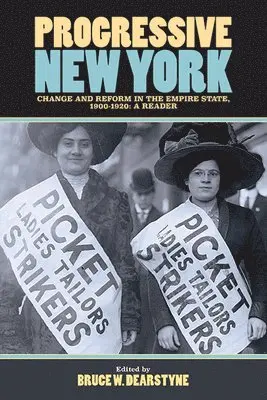
    Progressive New York

    Change and Reform in the Empire State, 1900-1920: A Reader

    AvBruce W. Dearstyne

    Häftad, Engelska, 2024

    441 kr

    Beställningsvara. Skickas inom 3-6 vardagar. Fri frakt över 249 kr.

    Fler format och utgåvor

    Inbunden

    1 283 kr

    Beskrivning

    The exciting story of New York in the progressive era told by the reformers and visionaries who shaped its history.Progressive New York provides a firsthand portrait of one of the most exciting times in New York's and the nation's history: the progressive era, 1900–1920. This was a time of vast uncertainty and change-with major social and economic developments, including large-scale immigration, industrialization, and urbanization-roiling the nation. New Yorkers were among the first to confront and develop policies to deal with these issues. Political reformers made government more accountable; workers achieved shorter hours and better working conditions; social workers fought poverty and urban overcrowding; women achieved the right to vote; Black citizens advanced the cause of opportunity and equality; and, millions of immigrants enriched New York's culture. Drawing on accounts from contemporary newspapers, periodicals, books, and other sources, this collection introduces readers to the foundational ideas of the modern era. Among the authors are such influential figures as Emma Goldman, Alain Locke, Jacob Riis, Mary Beard, Abraham Cahan, W.E.B. Du Bois, and many others.

    Produktinformation

    • Utgivningsdatum:2024-10-02
    • Mått:152 x 229 x 22 mm
    • Vikt:499 g
    • Format:Häftad
    • Språk:Engelska
    • Antal sidor:372
    • Förlag:State University of New York Press
    • ISBN:9781438497389

    Utforska kategorier

    • Centralt styre och förvaltning inom Samhälle och politik
    • Statsvetenskap och politisk teori inom Samhälle och politik
    • Amerikas historia inom Historia och arkeologi

    Mer om författaren

    Bruce Dearstyne is the author of several books, including The Spirit of New York: Defining Events in the Empire State's History) and The Crucible of Public Policy: New York Courts in the Progressive Era, both published by SUNY Press.

    Recensioner i media

    "Offers a trusted reading of one of American history's most important chapters … set inside the state in which many of the most important moments of the era played out." — Lisa Krissoff Boehm, Bridgewater State University"Makes a good argument for using New York as a lens through which to view many of the important issues of the Progressive Era." — William B. Murphy, SUNY Oswego

    Innehållsförteckning

    • AcknowledgmentsIntroductionChapter 1. Gauging the Tenor of the Times Extreme Wealth on DisplayFrom The Reign of Gilt (1905) by David Graham PhillipsFrom "Drift" to "Mastery"From Drift and Mastery (1914) by Walter LippmannMaking Systematic, Incremental ProgressFrom The New Democracy (1912) by Walter E. WeylThe Rising Standard of LivingFrom The City Worker's World in America (1917) by Mary K. SimkhovitchThe "Social Gospel" Fuels ProgressivismFrom Christianity and the Social Crisis (1907) by Walter RauschenbuschA Skeptical View of Modern TrendsFrom "A Layman's Views of an Art Exhibition," Outlook (1913) by Theodore RooseveltA Plea for Rural ValuesFrom The Country Life Movement in the United States (1915) by Liberty Hyde BaileyThe Anarchist's PleaFrom What I Believe (1908) by Emma GoldmanChapter 2. Building Grand Enterprises A Grand Expo in BuffaloFrom Official Catalogue and Guide Book to the Pan-American Exposition (1901)A New Cross-State CanalFrom The Thousand-Ton Barge Improvement (1903) by Canal Improvement State CommitteeNew York City Opens Its SubwayFrom "Our Subway Open, 150,000 Try It," New York Times (October 28, 1904)An Outstanding New Venue for BaseballFrom "Ebbets Field Has No Rival in Baseball," New York Tribune (April 6, 1913)Pioneering in AviationFrom "Flight Down the Hudson River from Albany to New York City," The Curtiss Aviation Book (1912) by Glenn Hammond CurtissA Grand New Train StationFrom "New Grand Central Terminal Opens Its Doors," New York Times (February 2, 1913)Technology and InnovationFrom Book of the Kodak Exhibition (1912) by Eastman Kodak CompanyChapter 3. Reforming Politics and Government Politics, Government, and "Honest Graft"From Plunkett of Tammany Hall (1905) by George Washington Plunkett and William L. Riordon"Muckrakers" Help Propel ProgressivismFrom "Concerning Three Articles in this Number of McClure's and a Coincidence That May Set Us Thinking," McClure's (1903) by S. S. McClureNewspapers Expose Political CorruptionFrom New York Evening Post (January 18, 1910)The "Treason of the Senate"From "The Treason of the Senate: New York's Misrepresentatives," Cosmopolitan Magazine (March 1906) by David Graham PhillipsDirect PrimariesFrom "Message to the Legislature" (January 6, 1909) in Public Papers of Charles E. Hughes, Governor by Governor Charles Evans HughesA Day of Reform TriumphFrom "Message to the Legislature" (December 8, 1913) in Public Papers of Martin H. Glynn, Governor by Governor Martin H. GlynnFrom "All Glynn Bills to Pass This Week," New York Times (December 10, 1913)New York's Progressive Party Presents an Aspirational AgendaFrom State Platform, National Progressive Party of the State of New York Adopted by the State Convention, Syracuse, N.Y. Sept. 5, 1912 (1912) by National Progressive Party of the State of New YorkVeering Away from ProgressivismFrom Revolutionary Radicalism (1920) by the Joint Legislative Committee Investigating Seditious ActivitiesChapter 4. Improving People's Lives Educating Young New YorkersFrom American Education (1909) by Andrew S. DraperRevealing How Poor New Yorkers LiveFrom How the Other Half Lives: Studies Among the Tenements of New York (1901) by Jacob RiisThe Benefits of Tenement House ReformFrom The Tenement House Problem (1908) edited by Robert W. DeForest and Lawrence VeillerCharitable Assistance for New York's PoorFrom Twenty-Sixth Annual Report for the Year Ending September 30, 1908 (1908) by the Charity Organization Society of the City of New YorkHelping People Take Care of ThemselvesFrom For You: It is Hard to Get Money, It is Harder to Spend it Right, Health is Wealth (1910) by Charity Organization Society of New York and New York City Tenement House DepartmentSettlement Houses and Visiting Nurses Ease City LifeFrom The House on Henry Street (1915) by Lillian D. WaldRestricting Alcoholic BeveragesFrom "New York" in Proceedings of the Nineteenth National Convention of the Anti-Saloon League of America (1919) by William H. AndersonCensorship Impacts LivesFrom Anthony Comstock: Roundsman of the Lord (1927) by Haywood Broun and Margaret LeechStrengthening Public HealthFrom Thirty Sixth Annual Report of the State Department of Health for the Year Ending December 31, 1915 (1915) by New York State Department of HealthProtecting Rural New YorkFrom Powers and Territory of the New York State Troopers (1918) by Committee for State PoliceChapter 5. Strengthening Women's Status Women Struggle for Equality in the WorkplaceFrom A Woman of Fifty (1924) by Rheta Childe DorrWomen Already Influence Public Policy; They Should Be Able to VoteFrom "The Legislative Influence of Unenfranchised Women" (1914) by Mary Ritter BeardMaking the Case for Woman SuffrageFrom "What Woman Suffrage Stands For" (1917) booklet by New York State Woman Suffrage PartyFrom "Twelve Reasons Why Women Should Vote" (1917) booklet by New York State Woman Suffrage PartyFrom "Modern Representative Government" (1917) booklet by New York State Woman Suffrage PartyFrom "Suffrage as a War Measure" (1917) booklet by New York State Woman Suffrage PartySecuring the Right to VoteFrom Woman Suffrage and Politics: The Inner Story of the Suffrage Movement (1923), by Carrie Chapman Catt and Nettie Rogers SchulerWomen Can Vote, What Comes Next?From "Now We Can Begin," The Liberator (1920) by Crystal EastmanPublic Support Encourages Women's Labor ActivismFrom "The Working Girls and Women of Rochester," The Common Good: An Independent Magazine of Civic and Social Rochester (1913) by Edwin and Catherine RumballAdvocating for "Voluntary Womanhood"From Woman and the New Race (1921) by Margaret SangerChapter 6. Welcoming Newcomers Immigrants Encounter New YorkFrom The Rise of David Levinsky (1917) by Abraham CahanAdjusting to American WaysFrom "The Making of an American," Outlook (1903) by David BlausteinAiding ImmigrantsFrom "Solving the Immigration Problem," Outlook (1904) by Gino Carlo SperanzaExplaining the Immigrant ExperienceFrom An American in the Making: The Life Story of an Immigrant (1917) by Marcus Eli RavageDocumenting Immigrants' Challenges in New YorkFrom Report of the Commission on Immigration of the State of New York (1909)Asserting That Some Newcomers Are a ThreatFrom The Passing of the Great Race (1916) by Madison GrantDefining New York's "Cultural Pluralism"From "Democracy Versus the Melting Pot," The Nation (1915) by Horace M. KallenChapter 7. Reckoning with Race Probing Black New Yorkers' BurdensFrom Half a Man: The Status of the Negro in New York (1911) by Mary White OvingtonAn Outburst of Cultural AchievementFrom The New Negro: An Interpretation (1925) by Allain LockeHarlem Becomes a Center of Black CultureFrom "Harlem: The Cultural Center," in Alain Locke, ed., The New Negro (1925) by James Weldon JohnsonNew York's Racial AmbivalenceFrom "The Paradox of Color" in Alain Locke, ed., The New Negro (1925) by Walter WhiteBlack Women Cope with RacismFrom "T