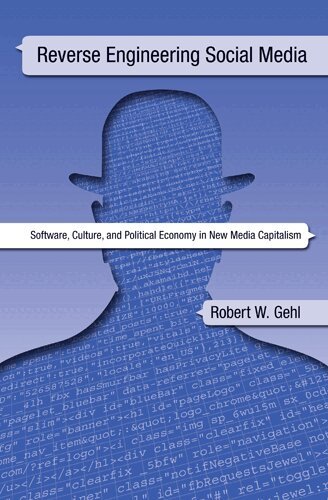
Häftad, Engelska, 2014
Reverse Engineering Social Media
Software, Culture, and Political Economy in New Media Capitalism
342 kr
Tillfälligt slut
Beskrivning
Produktinformation
- Utgivningsdatum: 2014-06-27
- Mått: 140 x 210 x 25 mm
- Vikt: 295 g
- Format: Häftad
- Språk: Engelska
- Antal sidor: 236
- Förlag: Temple University Press,U.S.
- ISBN: 9781439910351
Utforska kategorier
Mer om författaren
Robert W. Gehl is an Assistant Professor in the Department of Communication at the University of Utah. He is the co-editor (with Victoria Watts) of The Politics of Cultural Programming in Public Spaces.
Recensioner i media
"Reverse Engineering Social Media is a smart book on a hot topic. Gehl presents original and substantive advances in theoretical approaches that are unique and fruitful and that enable the development of software studies in a useful critical direction. His close reading of the software architecture of social networking sites is distinctive and insightful, as is his combination of critique and solution. This book is an important contribution to the field of digital media studies." —Mark Andrejevic, University of Queensland "In a world dominated by graphic interfaces and slim screens, Robert Gehl implores us to dig deeper into software platforms to rethink the values embedded in their underlying code. Drawing on the work of software designers and engineers, Reverse Engineering Social Media rejects the default settings of software criticism, summoning us to reengineer the past into a more politically engaged future." —Greg Elmer, Ryerson University, author of Profiling Machines: Mapping the Personal Information Economy "Bored with Vice, the Daily Dot, and Reddit? Finally there is a study that leaves aside the depressed user cultures and positions social media as an integral part of computer science instead. Gehl successfully connects cybernetics and European thinking with contemporary Internet culture. Using the theory of abstraction failure, he explains how socialbots emerged, how the rough Myspace was wiped out by the standardized templates of Facebook, and how Wikipedia eventually became a nonprofit. Instead of moralizing about usage or preaching offline romanticism, Gehl concludes that we must team up with emerging social media alternative platforms."—Geert Lovink, media theorist, Internet critic, and director of the Institute of Network Cultures, Amsterdam
Betyg & recensioner
0 recensioner
Inga recensioner tillgängliga.