• Fri frakt över 249 kr
  • •
  • Snabba leveranser
  • •
  • Billiga böcker
Kundservice

Du är på sajten för privatpersoner.

Företag, bibliotek eller offentlig verksamhet?

Du handlar på classic.bokus.com, där alla dina funktioner finns intakta.
Till classic.bokus.com
Bokus logotyp. Gå till startsidan.
  • Erbjudanden
  • Nyheter
  • Student
  • Topplistor
  • Barn & ungdom
  • Bokus Play
  • E-böcker
  • Pocketböcker
  • Spel & pussel

10% rabatt på allt med kod: NYSTART10 →

Sidfot

Mina sidor

    Hjälp

    • Kundservice
    • Vanliga frågor och svar
    • Frakt och leverans
    • Retur vid ångerrätt
    • Reklamera vara
    • Betalning
    • Köpvillkor
    • Allmänna villkor
    • Information om webbplatsens tillgänglighet

    Om Bokus

    • Om oss
    • Pressrum
    • För studenter
    • För företag
    • För bibliotek och offentlig verksamhet
    • För leverantörer
    • Hållbarhet

    Populärt

    • Aktuella erbjudanden
    • Presentkort
    • Studentlitteratur
    • Nya böcker
    • Topplistor
    • Signerade böcker
    • Engelska böcker

    Inspiration

    • Boktips
    • BookTok
    • Populära bokserier
    • Barnbokskaraktärer
    • Populära författare
    Logotyp för Bokus
    Följ oss på Facebook (extern länk)Följ oss på Instagram (extern länk)Följ oss på YouTube (extern länk)Följ oss på TikTok (extern länk)
    bokus @ CookiesAnpassa cookiesIntegritetspolicyKöpvillkor
    Till Citymail hemsida (extern länk)Till Budbee hemsida (extern länk)Till Postnord hemsida (extern länk)Till Schenker hemsida (extern länk)Till Early Bird hemsida (extern länk)Till Walleys hemsida (extern länk)
    1. Samhälle och politik
    2. Politik och statsskick
    3. Statsvetenskap och politisk teori

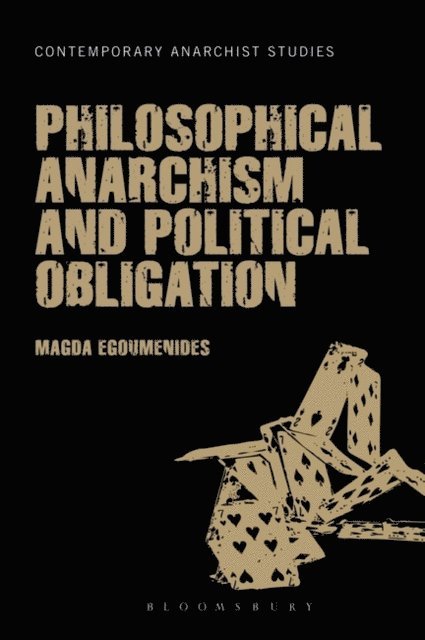
    Philosophical Anarchism and Political Obligation

    AvMagda Egoumenides

    E-bok
    Engelska, 2014

    Del i serien Contemporary Anarchist Studies

    543 kr

    Läs direkt i Bokus Reader – eller ladda ned till din enhet

    Fler format och utgåvor

    Häftad

    506 kr

    E-bok

    543 kr

    Inbunden

    2 088 kr

    Beskrivning

    Political obligation refers to the moral obligation of citizens to obey the law of their state and to the existence, nature, and justification of a special relationship between a government and its constituents. This volume in the Contemporary Anarchist Studies series challenges this relationship, seeking to define and defend the position of critical philosophical anarchism against alternative approaches to the issue of justification of political institutions. The book sets out to demonstrate the value of taking an anarchist approach to the problem of political authority, looking at theories of natural duty, state justification, natural duty of justice, fairness, political institutions, and more. It argues that the anarchist perspective is in fact indispensable to theorists of political obligation and can improve our views of political authority and social relations.This accessible book builds on the works of philosophical anarchists such as John Simmons and Leslie Green, and discusses key theorists, including Rousseau, Rawls, and Horton. This key resource will make an important contribution to anarchist political theory and to anarchist studies more generally.

    Produktinformation

    • Utgivningsdatum:2014-08-28
    • Språk:Engelska
    • Antal sidor:288
    • Filformat:EPUB
    • Kopieringsskydd:LCP
    • ISBN:9781441124456
    • Förlag:Bloomsbury Publishing PLC (Digital)
    • Serie:Contemporary Anarchist Studies

    Utforska kategorier

    • Statsvetenskap och politisk teori inom Samhälle och politik
    • Anarkism inom Samhälle och politik
    • Filosofiska discipliner inom Filosofi och religion

    Mer om författaren

    Magda Egoumenides is Visiting Lecturer at the University of Cyprus. She has published articles in the Review Journal of Political Philosophy, Isopolitia, and the book Critical Philosophical Anarchism.

    Recensioner i media

    In this thoughtful and passionately argued book Magda Egoumenides advances a distinctive approach to the problem of justifying political institutions that she calls 'critical philosophical anarchism'. After critically assessing a variety of justifications of state authority, Egoumenides distinguishes her own view from other forms of philosophical anarchism by locating it firmly within a more comprehensive anarchist theory. The result is a book that raises serious questions about the existing literature on political obligation, while also offering a controversial and challenging alternative; and in the process Egoumenides does much to revive the vitality of anarchist thinking.

    Innehållsförteckning

    • TABLE OF CONTENTSINTRODUCTION1. THE VARIETY OF ANARCHISMS. DEFINING CRITICAL PHILOSOPHICAL ANARCHISM WITHIN THE CURRENT DEBATE ON ANARCHISM2. THE MAIN PARTS AND UNDERLYING IDEAS OF MY ARGUMENTCHAPTER ONE: WHAT THE PROBLEM IS1.1. THE PROBLEM OF POLITICAL OBLIGATION1.1.i. The Correlativity Thesi1.1.ii. The Two Main Aspects of the Problem of Political Obligation1.1.iii. Quality-Based and Interaction-Based Evaluations of Political Institutions1.1.iv. The Conditions of Political Obligation1.2. THE PARADOX OF AUTHORITY1.3. DISSOLVING THE PARADOX: ROUSSEAU AS A PARADIGM OF STATE JUSTIFICATION1.4. RAZ'S THEORY AS AN ILLUSTRATION1.5. THE ARGUMENT FOR CRITICAL PHILOSOPHICAL ANARCHISM1.5.1. An Alternative to Prominent Positions on the State1.5.2. Improving the Way Critical Philosophical Anarchists See Their Position. Simmons' Theory as an Illustration1.5.2.i. Simmons' Theory1.5.2.ii. Specific Arguments against Simmons1.5.2.iii. A More General Departure from Simmons' Approach1.6. CONCLUSIONCHAPTER TWO.: THE LIMITS OF VOLUNTARISM2.1. AN ANARCHIST CRITICISM OF VOLUNTARIST THEORIES OF POLITICAL OBLIGATION2.1.1. Actual Consent2.1.2. Tacit Consent2.1.3. Hypothetical Consent2.1.4. Raz on Consent2.1.5. Social Contract Theories2.1.6. A Defense of Hypothetical Contractualism2.2. DISMISSING THE CONCEPTUAL ARGUMENT FOR POLITICAL OBLIGATION2.3. THE IMPLICATIONS OF THE ANARCHIST CRITICISM OF CONSENTCHAPTER THREE: AN ANARCHIST CRITIQUE OF THE RAWLSIAN IDEA OF A NATURAL DUTY OF JUSTICE3.1. RAWLS' THEORY AND THE NATURAL DUTY OF JUSTICE3.2. AN ANARCHIST CRITICISM OF THE NATURAL DUTY OF JUSTICE3.2.1. Against the Justice of Political Institutions as a Ground of Political Obligation3.2.2. The Argument Arising from Particularity3.2.3. Rawls and Particularity3.2.4. Self-Governance, Equality, and the Role of General Moral Principles3.3. THE IMPLICATIONS OF THE ANARCHIST CRITICISM OF NATURAL DUTYCHAPTER FOUR: THE FAILURE OF THE PRINCIPLE OF FAIRNESS AS AN ACCOUNT OF POLITICAL OBLIGATION4.1. THE PRINCIPLE OF FAIRNESS4.2. "TRIVIALITY," "SUCCESS," AND "JUSTICE"4.3. THE ANARCHIST CRITICISM OF THE PRINCIPLE OF FAIRNESS4.3.1. "Receipt" versus "Acceptance"4.3.1.i. Objections to Understanding Fairness Obligations in Terms of "Receipt"4.3.1.ii. Klosko's Defense of "Receipt"4.3.1.iii. Simmons on "Acceptance"4.3.1.iv. The Significance of "Acceptance”4.3.2. Fairness, Political Obligation, and the Idea of Societies as "Schemes of Social Cooperation"4.4. THE IMPLICATIONS OF THE ANARCHIST CRITICISM OF THE PRINCIPLE OF FAIRNESSCHAPTER FIVE: HORTON REVISITED5.1.HORTON'S PRELIMINARY ARGUMENTS FOR ASSOCIATIVE POLITICAL OBLIGATIONS5.1.1. About a Non-Voluntarist Contract Theory5.1.2. On the Communitarian Approach5.1.3. Against Associative Political Obligations5.2. HORTON'S CONSTRUCTIVE ACCOUNT OF ASSOCIATIVE POLITICAL OBLIGATIONS AND THE ANARCHIST CHALLENGE5.2.1. The Significance of Membership Argument5.2.2. The Hobbesian, or Value, Argument5.2.3. The Associative Argument5.2.4. The Anarchist Challenge5.3. THE CHALLENGE FROM MORAL UNIVERSALISM5.4. CONCLUDING REMARKS: THE VALUE OF HORTON'S ASSOCIATIVE THEORYCHAPTER SIX: WHERE FRIENDS OF POLITICAL INSTITUTIONS AND ANARCHISTS ARE IN THE SAME BOAT6.1. NEGATIVE AND POSITIVE POINTS RESULTING FROM THE ANARCHIST CRITICISMS6.1.1. The Negative Conclusions6.1.2. The Positive Conclusions6.1.3. The Implications of the Anarchist Challenge for Political Thought and Practice6.2. THE CONTRIBUTION OF CRITICAL PHILOSOPHICAL ANARCHISM6.2.1. The Anarchist Perspective6.2.2. The Significance of the Question of Obligation6.2.3. Justification as an Endless Process6.2.4. The Anarchist Ideal of Legitimacy6.3. CONCLUSIONCHAPTER SEVEN: ANARCHISM: PHILOSOPHICAL AND POLITICAL7.1. THE TASKS OF POLITICAL ANARCHISTS7.2. A CRITICAL PHILOSOPHICAL ANARCHIST CRITIQUE OF BOOKCHIN'S ANARCHIST POLITICAL PROGRAM7.2.1. Bookchin Revisited7.2.2. A Poststructuralist Intervention7.2.3. The Gordonian "Anarchy Alive!"7.3. ANARCHIST APPROACHES TO CONCRETE DILEMMASCONCLUSIONOVERVIEW OF THE RESULTS OF THE STUDYCONCLUSIONBIBLIOGRAPHY