• Fri frakt över 249 kr
  • •
  • Snabba leveranser
  • •
  • Billiga böcker
Kundservice

Du är på sajten för privatpersoner.

Företag, bibliotek eller offentlig verksamhet?

Du handlar på classic.bokus.com, där alla dina funktioner finns intakta.
Till classic.bokus.com
Bokus logotyp. Gå till startsidan.
  • Erbjudanden
  • Nyheter
  • Student
  • Topplistor
  • Barn & ungdom
  • Bokus Play
  • E-böcker
  • Pocketböcker
  • Spel & pussel

10% rabatt på allt med kod: NYSTART10 →

Sidfot

Mina sidor

    Hjälp

    • Kundservice
    • Vanliga frågor och svar
    • Frakt och leverans
    • Retur vid ångerrätt
    • Reklamera vara
    • Betalning
    • Köpvillkor
    • Allmänna villkor
    • Information om webbplatsens tillgänglighet

    Om Bokus

    • Om oss
    • Pressrum
    • För studenter
    • För företag
    • För bibliotek och offentlig verksamhet
    • För leverantörer
    • Hållbarhet

    Populärt

    • Aktuella erbjudanden
    • Presentkort
    • Studentlitteratur
    • Nya böcker
    • Topplistor
    • Signerade böcker
    • Engelska böcker

    Inspiration

    • Boktips
    • BookTok
    • Populära bokserier
    • Barnbokskaraktärer
    • Populära författare
    Logotyp för Bokus
    Följ oss på Facebook (extern länk)Följ oss på Instagram (extern länk)Följ oss på YouTube (extern länk)Följ oss på TikTok (extern länk)
    bokus @ CookiesAnpassa cookiesIntegritetspolicyKöpvillkor
    Till Citymail hemsida (extern länk)Till Budbee hemsida (extern länk)Till Postnord hemsida (extern länk)Till Schenker hemsida (extern länk)Till Early Bird hemsida (extern länk)Till Walleys hemsida (extern länk)
    1. Psykologi och pedagogik
    2. Pedagogik
    3. Skolan och förskolan

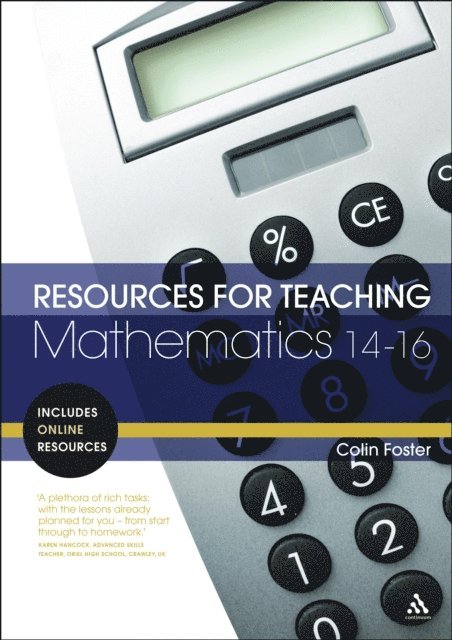
    Resources for Teaching Mathematics: 14-16

    AvColin Foster

    E-bok
    PDF, Engelska, 2010

    Del i serien Resources for Teaching

    483 kr

    Läs direkt i Bokus Reader – eller ladda ned till din enhet (PDF kräver ofta zoom och scroll på små skärmar).

    Beskrivning

    This book contains 70 ready-to-use mathematics lessons suitable for students aged 14-16. Some lessons offer alternative routes through the curriculum, such as practising indices by solving radical equations, while others concentrate on difficult ideas, like appreciating that not all mathematical relationships are linear. Each plan consists of a teacher's sheet, providing: • the aims and objectives of the lesson • a lesson starter, main phase, plenary and homework ideas, each with suggested timeframes • guidance on how to adapt the activities to cater for students working at different levels; and • online resources, including links to useful websites, material to display on the whiteboard and additional ideas. Each plan also includes a photocopiable or downloadable student task sheet that corresponds to the teacher's sheet. The lessons focus on problem solving and putting mathematics into context, and are an essential resource for any busy teacher of mathematics.

    Produktinformation

    • Utgivningsdatum:2010-08-05
    • Språk:Engelska
    • Antal sidor:320
    • Filformat:PDF
    • Kopieringsskydd:LCP
    • ISBN:9781441137241
    • Förlag:Continuum Publishing Corporation
    • Serie:Resources for Teaching

    Utforska kategorier

    • Skolan och förskolan inom Psykologi och pedagogik
    • Undervisning i specifika ämnen inom Psykologi och pedagogik
    • Matematik inom Naturvetenskap och teknik

    Mer om författaren

    Colin Foster teaches mathematics at a secondary school in Coventry, UK. Colin is author of 50 Mathematics Lessons, also published by Continuum.

    Recensioner i media

    'This is an essential resource book for all secondary mathematics teachers. There are so many lovely ideas to access students to concepts through investigative approaches to learning. Colin offers an approach which teachers can adopt and adapt to existing schemes of work and which takes on board key issues of differentiated learning and teaching without a textbook. I shall definitely recommend this book to friends and acquaintances who teach mathematics... in fact I already have done.' Mike Ollerton, experienced teacher, teacher trainer and consultant, UK

    Innehållsförteckning

    • Introduction \ 1. A Tale of Two Numbers: Finding factors and using ratio \ 2. Acting Your Age?: Solving simultaneous equations and drawing straight-line graphs \ 3. Arc Drawings: Finding the area and perimeter of sectors of circles \ 4. Area of a Triangle: Using the sine rule and the equation 'area = ½ absinC' \ 5. Bearings: Calculating and measuring bearings and back-bearings \ 6. Beat the Calculator!: Using calculators and simplifying algebraic expressions \ 7. Being Human: Estimating quantities and working with given data \ 8. Being Irrational: Understanding and manipulating irrational numbers \ 9. Building a Wall: Moving the centre of enlargement and investigating what happens \ 10. Cake-Cutting Contest: Finding areas of sectors of circles and using circle theorems \ 11. Circle Theorems: Understanding circle theorems \ 12. Circular Argument: Finding the circumference of a circle \ 13. Congruence: Understanding the conditions for congruence of two triangles \ 14. Connect Four: Practising algebraic substitution and looking for connections \ 15. Constructions: Constructing triangles given side-side-side \ 16. Counting Squares: Estimating and calculating with large numbers \ 17. Cutting a Square: Investigating angles on parallel lines \ 18. Equable Sectors: Finding the area and perimeter of sectors of circles and using scatter-graphs \ 19. Equivalent Fractions: Using equivalence of fractions to solve problems \ 20. Factorizing Quadratics: Understanding when monic quadratics will factorize \ 21. Fill it Up!: Generating and describing quadratic (and other) sequences \ 22. Fly on the Wall: Exploring Pythagoras' Theorem in three dimensions \ 23. Functions: Understanding the concept and notation of mathematical functions \ 24. Golden Rectangles: Designing a questionnaire involving ratio calculations \ 25. Graphical Linear Inequalities: Shading inequalities in two variables \ 26. Graphical Solutions of Equations: Solving equations by drawing a suitable line on a curve \ 27. Histograms: Understanding why grouped bar charts can be misleading \ 28. Identities: Manipulating algebra and solving quadratic equations \ 29. Indices: Simplifying quantities with integer indices \ 30. Inverse Functions: Understanding inverse functions by drawing 'function-machine' diagrams \ 31. Kim's Game: Adding and subtracting directed numbers and collecting terms \ 32. Many Faces: Finding equivalent algebraic expressions \ 33. Maximum Product: Estimating products and multiplying integers \ 34. Monkeying Around: Estimating values and using standard form \ 35. Odd Ones Out: Exploring the properties of numbers, shapes and so on \ 36. Ordering Fractions: Adding and subtracting fractions \ 37. Percentage Increases and Decreases: Working with repeated percentage changes \ 38. Pint Cone: Finding the surface area and volume of a cone \ 39. Polygon Areas: Using the area of a triangle to find the area of other polygons \ 40. Prime Numbers: Using the sieve of Eratosthenes 41. Prime-Generating Formulae: Practising algebraic substitution and looking for primes \ 42. Probability Pi: Investigating digit frequency and drawing pie charts \ 43. Properties of Circles: Establishing and working with circle theorems \ 44. Proportionality: Examining direct and inverse proportion \ 45. Pythagoras' Theorem: Proving Pythagoras' Theorem by dissection \ 46. Quadratic Probabilities: Using the quadratic formula and understanding the role of the discriminant \ 47. Quadratics in Disguise: Rearranging and factorizing quadratic equations \ 48. Radical Equations: Manipulating indices to solve equations \ 49. Randomness: Exploring patterns of heads and tails when throwing a fair coin \ 50. Rationalizing Denominators: Manipulating surds \ 51. Recurring Decimals: Converting recurring decimals to simplified fractions \ 52. Reverse Percentages: Finding the 'old' amount before a specified percentage change \ 53. Rounding: Introducing the 'floor' and 'ceiling' functions \ 54. Set Theory: Making sense of set notation \ 55. Similarity: Proving similarity and using it to solve problems \ 56. Simpson's Paradox: Handling data and exploring ratio \ 57. Solving Quadratic Equations: Critiquing learners' work and comparing different methods \ 58. Straight-Line Graphs: Understanding the effects of m and c in y = mx + c and of k in x = k on the graphs \ 59. Surds: Manipulating surds and understanding irrational numbers \ 60. Surface Area and Volume of a Cuboid: Maximizing the number of cubes that can be wrapped with one sheet of paper \ 61. Surface Area and Volume of a Sphere: Proving the formulae without using calculus \ 62. Tetraphobia: Exploring linear sequences with 'missing' terms \ 63. The Cosine Rule: Proving the cosine rule \ 64. The Sine Rule: Proving the sine rule \ 65. Throwing a Coin: Designing an experiment to estimate a probability \ 66. Trial and Improvement: Investigating exponential equations \ 67. Trigonometry: Introducing sin, cos and tan via measurement \ 68. Twenty Questions: Developing a strategy to find a missing number \ 69. Vectors: Adding and subtracting vectors \ 70. Winner Takes All!: Understanding and using conditional probability \ Other Resources \ Index