• Fri frakt över 249 kr
  • •
  • Snabba leveranser
  • •
  • Billiga böcker
Kundservice

Du är på sajten för privatpersoner.

Företag, bibliotek eller offentlig verksamhet?

Du handlar på classic.bokus.com, där alla dina funktioner finns intakta.
Till classic.bokus.com
Bokus logotyp. Gå till startsidan.
  • Erbjudanden
  • Student
  • Topplistor
  • Barn & ungdom
  • Bokus Play
  • E-böcker
  • Ljudböcker
  • Pocketböcker
  • Spel och pussel

Pocketfynda! Hundratals böcker för 49 kr/st →

Sidfot

Mina sidor

    Hjälp

    • Kundservice
    • Vanliga frågor och svar
    • Frakt och leverans
    • Retur vid ångerrätt
    • Reklamera vara
    • Betalning
    • Köpvillkor
    • Allmänna villkor
    • Information om webbplatsens tillgänglighet

    Om Bokus

    • Om oss
    • Pressrum
    • För studenter
    • För företag
    • För bibliotek och offentlig verksamhet
    • För leverantörer
    • Hållbarhet

    Populärt

    • Aktuella erbjudanden
    • Presentkort
    • Studentlitteratur
    • Nya böcker
    • Topplistor
    • Signerade böcker
    • Engelska böcker

    Inspiration

    • Boktips
    • BookTok
    • Barnbokskaraktärer
    • Populära författare
    Logotyp för Bokus
    Följ oss på Facebook (extern länk)Följ oss på Instagram (extern länk)Följ oss på YouTube (extern länk)Följ oss på TikTok (extern länk)
    bokus @ CookiesAnpassa cookiesIntegritetspolicyKöpvillkor
    Till Citymail hemsida (extern länk)Till Budbee hemsida (extern länk)Till Postnord hemsida (extern länk)Till Schenker hemsida (extern länk)Till Early Bird hemsida (extern länk)Till Walleys hemsida (extern länk)
    1. Psykologi och pedagogik
    2. Pedagogik
    3. Skolan och förskolan

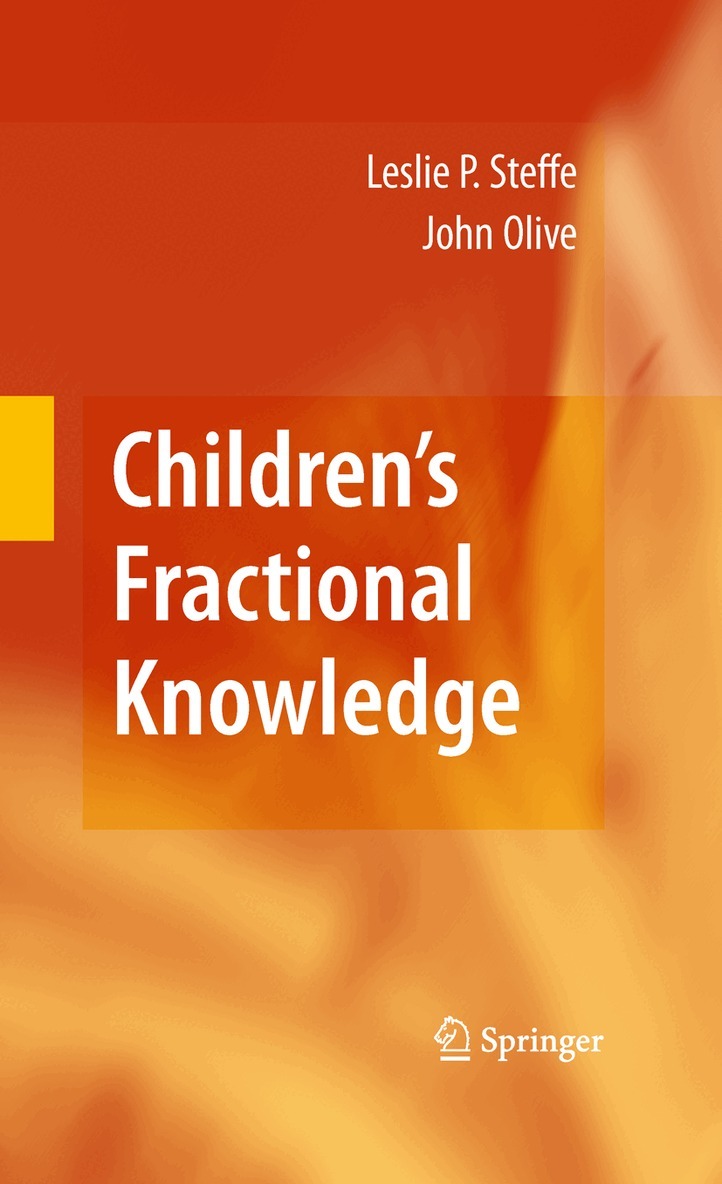
    Children's Fractional Knowledge

    AvLeslie P. Steffe,John Olive

    Inbunden, Engelska, 2009

    1 048 kr

    Beställningsvara. Skickas inom 10-15 vardagar. Fri frakt över 249 kr.

    Fler format och utgåvor

    Häftad

    1 078 kr

    Beskrivning

    Children’s Fractional Knowledge elegantly tracks the construction of knowledge, both by children learning new methods of reasoning and by the researchers studying their methods. The book challenges the widely held belief that children’s whole number knowledge is a distraction from their learning of fractions by positing that their fractional learning involves reorganizing—not simply using or building upon—their whole number knowledge. This hypothesis is explained in detail using examples of actual grade-schoolers approaching problems in fractions including the schemes they construct to relate parts to a whole, to produce a fraction as a multiple of a unit part, to transform a fraction into a commensurate fraction, or to combine two fractions multiplicatively or additively.These case studies provide a singular journey into children’s mathematics experience, which often varies greatly from that of adults. Moreover, the authors’ descriptive terms reflect children’s quantitative operations, as opposed to adult mathematical phrases rooted in concepts that do not reflect—and which in the classroom may even suppress—youngsters’ learning experiences.Highlights of the coverage:Toward a formulation of a mathematics of living instead of beingOperations that produce numerical counting schemesCase studies: children’s part-whole, partitive, iterative, and other fraction schemesUsing the generalized number sequence to produce fraction schemesRedefining school mathematicsThis fresh perspective is of immediate importance to researchers in mathematics education. With the up-close lens onto mathematical development found in Children’s Fractional Knowledge, readers can work toward creating more effective methods for improving young learners’ quantitative reasoning skills.

    Produktinformation

    • Utgivningsdatum:2009-12-04
    • Mått:155 x 235 x 30 mm
    • Vikt:706 g
    • Format:Inbunden
    • Språk:Engelska
    • Antal sidor:364
    • Upplaga:2010
    • Förlag:Springer-Verlag New York Inc.
    • ISBN:9781441905901

    Utforska kategorier

    • Skolan och förskolan inom Psykologi och pedagogik
    • Undervisning i specifika ämnen inom Psykologi och pedagogik

    Innehållsförteckning

    • A New Hypothesis Concerning Children’s Fractional Knowledge.- Perspectives on Children’s Fraction Knowledge.- Operations That Produce Numerical Counting Schemes.- Articulation of the Reorganization Hypothesis.- The Partitive and the Part-Whole Schemes.- The Unit Composition and the Commensurate Schemes.- The Partitive, the Iterative, and the Unit Composition Schemes.- Equipartitioning Operations for Connected Numbers: Their Use and Interiorization.- The Construction of Fraction Schemes Using the Generalized Number Sequence.- The Partitioning and Fraction Schemes.- Continuing Research on Students’ Fraction Schemes.