• Fri frakt över 249 kr
  • •
  • Snabba leveranser
  • •
  • Billiga böcker
Kundservice

Du är på sajten för privatpersoner.

Företag, bibliotek eller offentlig verksamhet?

Du handlar på classic.bokus.com, där alla dina funktioner finns intakta.
Till classic.bokus.com
Bokus logotyp. Gå till startsidan.
  • Erbjudanden
  • Student
  • Topplistor
  • Barn & ungdom
  • Bokus Play
  • E-böcker
  • Ljudböcker
  • Pocketböcker
  • Spel & pussel

10% rabatt på allt med kod NYSTART10 →

Sidfot

Mina sidor

    Hjälp

    • Kundservice
    • Vanliga frågor och svar
    • Frakt och leverans
    • Retur vid ångerrätt
    • Reklamera vara
    • Betalning
    • Köpvillkor
    • Allmänna villkor
    • Information om webbplatsens tillgänglighet

    Om Bokus

    • Om oss
    • Pressrum
    • För studenter
    • För företag
    • För bibliotek och offentlig verksamhet
    • För leverantörer
    • Hållbarhet

    Populärt

    • Aktuella erbjudanden
    • Presentkort
    • Studentlitteratur
    • Nya böcker
    • Topplistor
    • Signerade böcker
    • Engelska böcker

    Inspiration

    • Boktips
    • BookTok
    • Populära bokserier
    • Barnbokskaraktärer
    • Populära författare
    Logotyp för Bokus
    Följ oss på Facebook (extern länk)Följ oss på Instagram (extern länk)Följ oss på YouTube (extern länk)Följ oss på TikTok (extern länk)
    bokus @ CookiesAnpassa cookiesIntegritetspolicyKöpvillkor
    Till Citymail hemsida (extern länk)Till Budbee hemsida (extern länk)Till Postnord hemsida (extern länk)Till Schenker hemsida (extern länk)Till Early Bird hemsida (extern länk)Till Walleys hemsida (extern länk)
    1. Naturvetenskap och teknik
    2. Matematik och naturvetenskap
    3. Biologi
    4. Biovetenskap

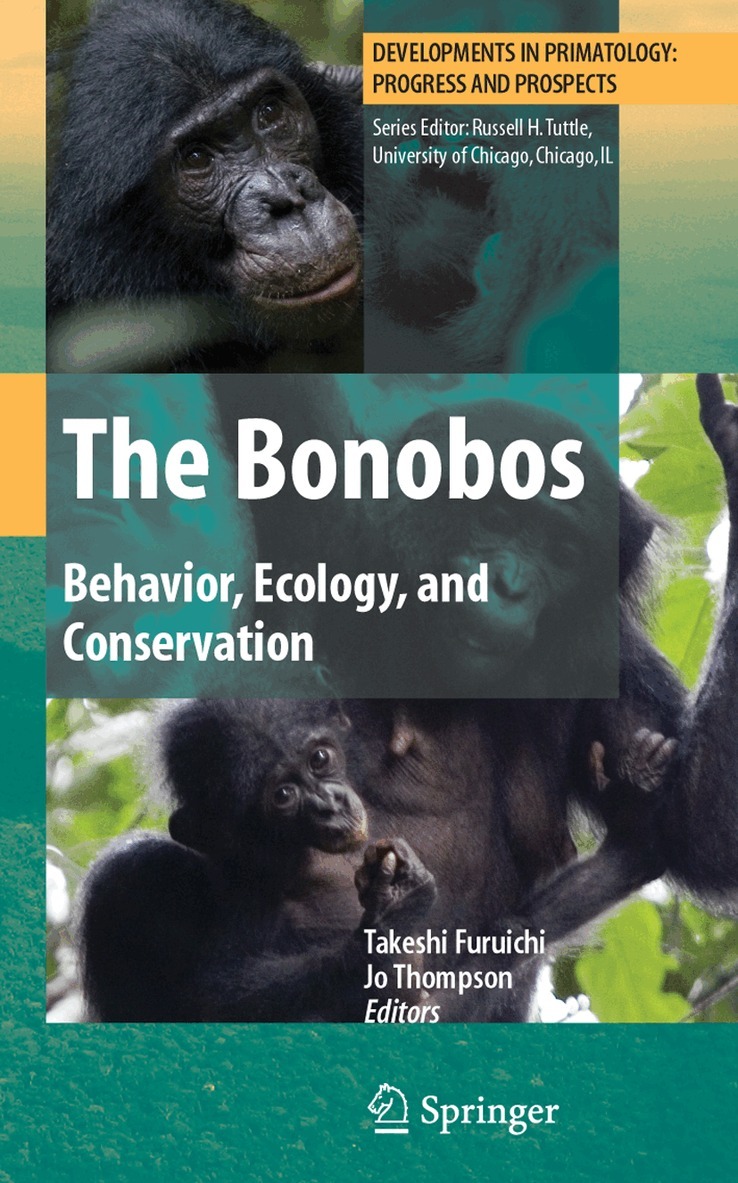
    Bonobos

    Behavior, Ecology, and Conservation

    AvTakeshi Furuichi,Jo Thompson

    Häftad, Engelska, 2010

    Del i serien Developments in Primatology: Progress and Prospects

    1 623 kr

    Beställningsvara. Skickas inom 10-15 vardagar. Fri frakt över 249 kr.

    Beskrivning

    Among all great ape species, the bonobo is still the least studied in both captivity and the wild. Nevertheless we have observed a considerable increase in knowledge across various fields of bonobo research in recent years. In part due to the ongoing peace process in the Democratic Republic of Congo, research and conservation activities on the bonobo have resumed and multiplied since 2001. Part One of The Bonobos: Behavior, Ecology, and Conservation focuses on scientific research. Behavioral studies in captivity propose to answer why bonobos have some unique characteristics such as high social status of females and flexible social relationships. The outcomes present important aspects to be investigated in running field studies. In the wild, analysis of population genetics across the bonobo's distribution range illuminates the species' evolutionary path and contributes to a global management plan. Site specific analysis reveals how genetics are used to re-identify individuals after an extended interruption of long-term research. Ecological studies at three independent sites, two in Salonga National Park, as well as one in the Luo Scientific Reserve, provide valuable information for the comprehension of ecological adaptation of bonobos. With the application of recent methods of mammalian feeding ecology as well as comparative approaches in other great ape species, these studies allow us to draw conclusions on ape ecological adaptation and evolution. Part Two of The Bonobos: Behavior, Ecology, and Conservation focuses on conservation. In overview, local and global aspects of the factors threatening the wild bonobo population are reviewed. Here the outcomes of large-scale efforts within the functioning ecosystem conservation paradigm focus on three landscapes within the range of the bonobo: the Salonga-Lukenie-Sankuru Landscape, the Maringa-Lopori-Wamba Landscape, and the Lac Télé-Lac Tumba Swamp Forest Landscape, are presented. Papers in thispart include the different aspects of various stakeholders and discuss the unique threats and actions taken to ensure bonobo survival. Pioneering the way, details from the first comprehensive assessment of bonobos in the Salonga National Park reveal a baseline from which to monitor future trends. Concerned about the indigenous' peoples aspects of conservation, an ethnographic study documents cultural, social, and economic practices for the purpose of reviving the local traditional knowledge to exemplify possible applications at the national level. To be inclusive of all aspects of range country concerns, the contributions of Kinshasa's bonobo sanctuary to national conservation efforts are presented. The outcome of these contributions taken together not only illuminate the current status of the bonobo but allow for critically designing the next steps for the continuation of its future.

    Produktinformation

    • Utgivningsdatum:2010-11-29
    • Mått:155 x 235 x 19 mm
    • Vikt:522 g
    • Format:Häftad
    • Språk:Engelska
    • Serie:Developments in Primatology: Progress and Prospects
    • Antal sidor:327
    • Förlag:Springer-Verlag New York Inc.
    • ISBN:9781441925725

    Utforska kategorier

    • Biovetenskap inom Naturvetenskap och teknik
    • Biologi inom Naturvetenskap och teknik
    • Zoologi inom Naturvetenskap och teknik

    Recensioner i media

    From the reviews: "This volume ... focuses on the lesser-known species of chimpanzee, Pan paniscus, commonly known as the bonobo or the pygmy chimpanzee. ... provides a comprehensive, current perspective on the behavior and ecology of both captive and wild bonobos, as well as the major threats facing their survival. ... This work is thus a welcome and important contribution to the primate literature. Summing Up: Highly recommended. Upper-division undergraduates through researchers/faculty." (L. Swedell, Choice, Vol. 46 (2), October, 2008) "Highlights of this book are the number of Congolese scientists and researchers ... recognise that many people interested in the results might not have English as their first (second or even third) language. ... The papers are excellent and interesting ... . to those working with counting apes elsewhere. ... All in all, the book has vital data, good use of analytical techniques and novel discussions of the conservation prospects of the 'last chimpanzee', all of which make it well worth owning ... ." (P. C. Lee, Primate Eye, August, 2009) "The Bonobos, edited by Takeshi Furuichi and Jo Thompson, consists of information presented in two symposia held at the 2006 International Primatological Society Congress in Uganda. ... The main thrust of the book is the updating of field studies and new data on conservation. ... The Bonobos is a welcome update on the state of bonobo research, particularly in the post-war environment of Central Congo." (Randall L. Susman, Primates, Vol. 50, 2009)

    Innehållsförteckning

    • Behavioral Study Section.- The Bonobo’s Adaptive Potential: Social Relations under Captive Conditions.- What Does Agonistic Dominance Imply in Bonobos?.- Social Play in Bonobos: Not Only an Immature Matter.- Gestures and Multimodal Signaling in Bonobos.- Ecological Study Section.- Longitudinal Structure of a Unit-group of Bonobos: Male Philopatry and Possible Fusion of Unit-groups.- Seasonal Changes in Fruit Production and Party Size of Bonobos at Wamba.- Relationships among Fruit Abundance, Ranging Rate, and Party Size and Composition of Bonobos at Wamba.- Bonobo (Pan paniscus) Density Estimation in the SW-Salonga National Park, Democratic Republic of Congo: Common Methodology Revisited.- Ecological Factors Influencing Bonobo Density and Distribution in the Salonga National Park: Applications for Population Assessment.- Range Occupation and Population Estimates of Bonobos in the Salonga National Park: Application to Large-scale Surveys of Bonobos in the Democratic Republic of Congo.- Conservation Study Section.- Traditional Land-use Practices for Bonobo Conservation.- Human Hunting and its Impact on Bonobos in the Salonga National Park, Democratic Republic of Congo.- The Bonobos of the Lake Tumba – Lake Maindombe Hinterland: Threats and Opportunities for Population Conservation.- Changes in the Status of Bonobos, their Habitat, and the Situation of Humans at Wamba in the Luo Scientific Reserve, Democratic Republic of Congo.- The Conservation Value of Lola ya Bonobo Sanctuary.