• Fri frakt över 249 kr
  • •
  • Snabba leveranser
  • •
  • Billiga böcker
Kundservice

Du är på sajten för privatpersoner.

Företag, bibliotek eller offentlig verksamhet?

Du handlar på classic.bokus.com, där alla dina funktioner finns intakta.
Till classic.bokus.com
Bokus logotyp. Gå till startsidan.
  • Erbjudanden
  • Nyheter
  • Student
  • Topplistor
  • Barn & ungdom
  • Bokus Play
  • E-böcker
  • Pocketböcker
  • Spel & pussel

10% rabatt på allt med kod: NYSTART10 →

Sidfot

Mina sidor

    Hjälp

    • Kundservice
    • Vanliga frågor och svar
    • Frakt och leverans
    • Retur vid ångerrätt
    • Reklamera vara
    • Betalning
    • Köpvillkor
    • Allmänna villkor
    • Information om webbplatsens tillgänglighet

    Om Bokus

    • Om oss
    • Pressrum
    • För studenter
    • För företag
    • För bibliotek och offentlig verksamhet
    • För leverantörer
    • Hållbarhet

    Populärt

    • Aktuella erbjudanden
    • Presentkort
    • Studentlitteratur
    • Nya böcker
    • Topplistor
    • Signerade böcker
    • Engelska böcker

    Inspiration

    • Boktips
    • BookTok
    • Populära bokserier
    • Barnbokskaraktärer
    • Populära författare
    Logotyp för Bokus
    Följ oss på Facebook (extern länk)Följ oss på Instagram (extern länk)Följ oss på YouTube (extern länk)Följ oss på TikTok (extern länk)
    bokus @ CookiesAnpassa cookiesIntegritetspolicyKöpvillkor
    Till Citymail hemsida (extern länk)Till Budbee hemsida (extern länk)Till Postnord hemsida (extern länk)Till Schenker hemsida (extern länk)Till Early Bird hemsida (extern länk)Till Walleys hemsida (extern länk)
    1. Samhälle och politik
    2. Samhälle och kultur
    3. Kultur och medier
    4. Referensverk och tvärvetenskap

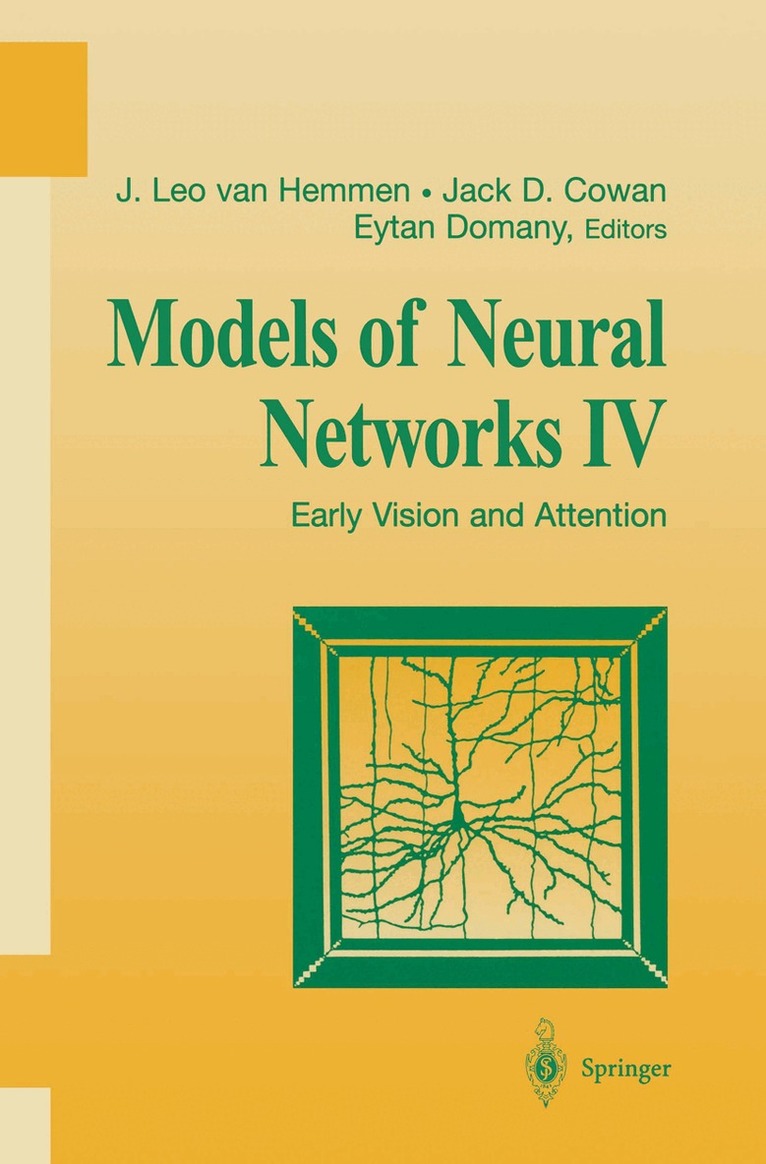
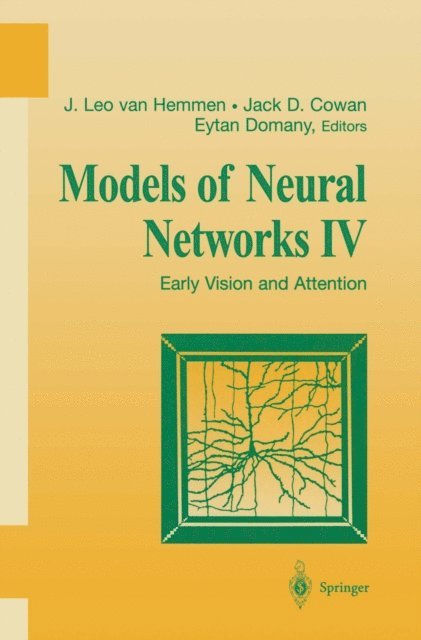
    Models of Neural Networks IV

    Early Vision and Attention

    AvJ. Leo van Hemmen,Jack D. Cowan

    Häftad, Engelska, 2011

    Del i serien Physics of Neural Networks

    547 kr

    Beställningsvara. Skickas inom 10-15 vardagar. Fri frakt över 249 kr.

    Beskrivning

    Close this book for a moment and look around you. You scan the scene by directing your attention, and gaze, at certain specific objects. Despite the background, you discern them. The process is partially intentional and partially preattentive. How all this can be done is described in the fourth volume of Models of Neural Networks devoted to Early Vision and Atten­ tion that you are holding in your hands. Early vision comprises the first stages of visual information processing. It is as such a scientific challenge whose clarification calls for a penetrating review. Here you see the result. The Heraeus Foundation (Hanau) is to be thanked for its support during the initial phase of this project. John Hertz, who has extensive experience in both computational and ex­ perimental neuroscience, provides in "Neurons, Networks, and Cognition" to neural modeling. John Van Opstal explains in a theoretical introduction "The Gaze Control System" how the eye's gaze control is performed and presents a novel theoretical description incorporating recent experimental results. We then turn to the relay stations thereafter, the lateral genicu­ late nucleus (LGN) and the primary visual cortex. Their anatomy, phys­ iology, functional relations, and ensuing response properties are carefully analyzed by Klaus Funke et al. in "Integrating Anatomy and Physiology of the Primary Visual Pathway: From LGN to Cortex", one of the most comprehensive reviews that is available at the moment.
    Produktinformation

    • Utgivningsdatum:2011-12-14
    • Mått:155 x 235 x 24 mm
    • Vikt:645 g
    • Format:Häftad
    • Språk:Engelska
    • Serie:Physics of Neural Networks
    • Antal sidor:413
    • Förlag:Springer-Verlag New York Inc.
    • ISBN:9781441928757

    Utforska kategorier

    • Referensverk och tvärvetenskap inom Samhälle och politik
    • Teknik: allmänt inom Naturvetenskap och teknik
    • Artificiell intelligens inom Data och IT

    Innehållsförteckning

    • 1 Neurons, Networks, and Cognition: An Introduction to Neural Modeling.- 1.1 Introduction.- 1.2 Neurons.- 1.3 Local Cortical Network Dynamics.- 1.4 Collective Computation: Associative Memory.- 1.5 Concluding Remarks.- 1.6 Acknowledgments.- 1.7 References.- 2 The Gaze Control System.- 2.1 Introduction.- 2.2 The Gaze Control System in One and Two Dimensions.- 2.3 New Aspects for Eye Rotations in 3D.- 2.4 Mathematics of 3D Rotational Kinematics.- 2.5 Donders’ Law and Listing’s Law.- 2.6 Head-free Saccadic Gaze Shifts in 3D.- 2.7 Conclusion.- 2.8 References.- 3 Integrating Anatomy and Physiology of the Primary Visual Pathway: From LGN to Cortex.- 3.1 Introduction.- 3.2 The LGN.- 3.3 Models of the LGN.- 3.4 The Visual Cortex.- 3.5 Models of the Visual Cortex.- 3.6 References.- 4 Neural Principles of Preattentive Scene Segmentation: Hints from Cortical Recordings, Related Models, and Perception.- 4.1 Introduction.- 4.2 Properties of Synchronized Fast Cortical Oscillations (FCOs).- 4.3 Coding Contour Continuity.- 4.4 Coding Region Continuity.- 4.5 Coding the Separation of Adjacent Regions.- 4.6 Spatially Restricted Synchronization Among FCOs.- 4.7 Additional Properties of FCOs.- 4.8 Stimulus-Locked Scene Segmentation.- 4.9 Early Labeling of Visual Objects by FCO- or Rate-Coherence?.- 4.10 Appendix.- 4.11 References.- 5 Figure-Ground Segregation and Brightness Perception at Illusory Contours: A Neuronal Model.- 5.1 Introduction.- 5.2 Methods.- 5.3 Results.- 5.4 Discussion.- 5.5 Acknowledgment.- 5.6 References.- 6 Controlling the Focus of Visual Selective Attention.- 6.1 Introduction.- 6.2 A Computational Model of The Dorsal Pathway.- 6.3 Simulation Results.- 6.4 Discussion.- 6.5 References.- 7 Activity-Gating Attentional Networks.- 7.1 Introduction.- 7.2 Activity-GatingNetworks.- 7.3 Results.- 7.4 Discussion.- 7.5 References.- 8 Timing and Counting Precision in the Blowfly Visual System.- 8.1 Introduction.- 8.2 Signal, Noise and Information Transmission in a Modulated Poisson Process.- 8.3 The Early Stages of Fly Vision.- 8.4 Coding in a Blowfly Motion Sensitive Neuron.- 8.5 Discussion and Conclusions.- 8.6 References.- 9 Paradigms for Computing with Spiking Neurons.- 9.1 Introduction.- 9.2 A Formal Computational Model for a Network of Spiking Neurons.- 9.3 McCulloch-Pitts Neurons versus Spiking Neurons.- 9.4 Computing with Temporal Patterns.- 9.5 Computing with a Space-Rate Code.- 9.6 Analog Computation on Time Series in a Space-Rate Code.- 9.7 Computing with Firing Rates.- 9.8 Firing Rates and Temporal Correlations.- 9.9 Networks of Spiking Neurons for Storing and Retrieving Information.- 9.10 Computing on Spike Trains.- 9.11 Conclusions.- 9.12 References.