E-bok, Engelska, 2012
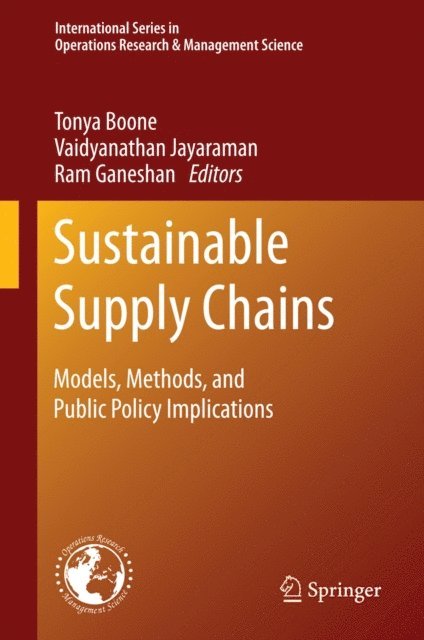
Sustainable Supply Chains
Av Ram Ganeshan, Vaidyanathan Jayaraman, Tonya Boone
2111 kr
Läs direkt i Bokus Reader – eller ladda ned till din enhet (PDF kräver ofta zoom och scroll på små skärmar).
Beskrivning
A sustainable enterprise is one that contributes to sustainable development by simultaneously delivering economic, social and environmental benefits or what has been termed "the triple bottom line." While pursuing profit, socially responsible companies should be sensitive to the environment and uphold the rights of all the firm''s stakeholders. This edited volume explores leading-edge ideas — both by academics and forward-thinking companies — to (re)design and market products, source, manufacture, and eventually distribute and recover or dispose of them in an environmentally, ecologically, and socially responsible way.
This edited volume is made up of fifteen chapters loosely grouped into clusters. After an introduction, chapter 2 shows the greenhouse emissions at various levels, from countries all the way to individual products. Chapters 3-7 each focus on an industrial sector and address issues specific to that industry, with chapter 7 presenting a case study on LEED certification of Miller Hall, home of the Mason School of Business where two of the authors (Tonya and Ram) work. Chapters 8-10 address product take back in the supply chain. Chapter 8 introduces e-waste and surveys what firms are doing to combat it. Chapter 9 provides an overview of existing take-back legislation and academic papers that have studied various research questions associated with them. Chapter 10 is a tutorial that addresses the problem of product disposition on a closed-loop supply chain: what should a firm do with a product return?
Chapters 11-15 address measurement, monitoring, decision-making, and reporting regarding environmental issues in a firm. Chapter 11 provides an academic survey of eco-labeling and the consumer’s willingness to pay for them. Chapter 12 discusses how firms can measure the total carbon footprint in their supply chains and some of the strategies they can use to mitigate carbon emissions. Using the price of call options, chapter 13illustrates how managers can quantify the savings attributed to sustainability-related investment. Chapter 14 develops a non-linear optimization model that addresses the complex trade-offs involved in making joint operational and environmental decisions. Finally, chapter 15 develops a Data Envelopment Analysis-based method for supplier evaluation incorporating environmental and business factors.
Produktinformation
- Utgivningsdatum: 2012-06-07
- Språk: Engelska
- Filformat: PDF
- Kopieringsskydd: LCP
- ISBN: 9781441961051
- Förlag: Springer New York
Utforska kategorier
Betyg & recensioner
0 recensioner
Inga recensioner tillgängliga.