• Fri frakt över 249 kr
  • •
  • Snabba leveranser
  • •
  • Billiga böcker
Kundservice

Du är på sajten för privatpersoner.

Företag, bibliotek eller offentlig verksamhet?

Du handlar på classic.bokus.com, där alla dina funktioner finns intakta.
Till classic.bokus.com
Bokus logotyp. Gå till startsidan.
  • Erbjudanden
  • Nyheter
  • Student
  • Topplistor
  • Barn & ungdom
  • Bokus Play
  • E-böcker
  • Pocketböcker
  • Spel & pussel

10% rabatt på allt med kod: NYSTART10 →

Sidfot

Mina sidor

    Hjälp

    • Kundservice
    • Vanliga frågor och svar
    • Frakt och leverans
    • Retur vid ångerrätt
    • Reklamera vara
    • Betalning
    • Köpvillkor
    • Allmänna villkor
    • Information om webbplatsens tillgänglighet

    Om Bokus

    • Om oss
    • Pressrum
    • För studenter
    • För företag
    • För bibliotek och offentlig verksamhet
    • För leverantörer
    • Hållbarhet

    Populärt

    • Aktuella erbjudanden
    • Presentkort
    • Studentlitteratur
    • Nya böcker
    • Topplistor
    • Signerade böcker
    • Engelska böcker

    Inspiration

    • Boktips
    • BookTok
    • Populära bokserier
    • Barnbokskaraktärer
    • Populära författare
    Logotyp för Bokus
    Följ oss på Facebook (extern länk)Följ oss på Instagram (extern länk)Följ oss på YouTube (extern länk)Följ oss på TikTok (extern länk)
    bokus @ CookiesAnpassa cookiesIntegritetspolicyKöpvillkor
    Till Citymail hemsida (extern länk)Till Budbee hemsida (extern länk)Till Postnord hemsida (extern länk)Till Schenker hemsida (extern länk)Till Early Bird hemsida (extern länk)Till Walleys hemsida (extern länk)
    1. Samhälle och politik
    2. Politik och statsskick
    3. Politiska partier

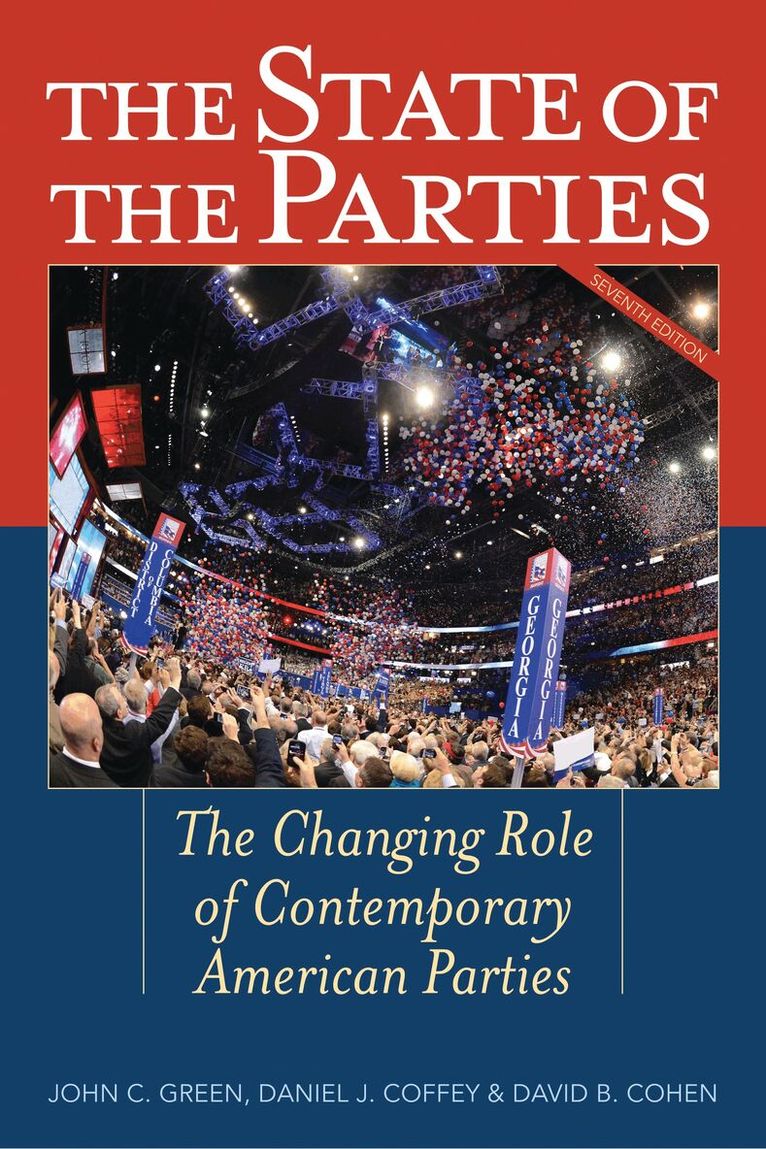
    State of the Parties

    The Changing Role of Contemporary American Parties

    AvJohn J. Green,Daniel J. Coffey

    Inbunden, Engelska, 2014

    1 674 kr

    Beställningsvara. Skickas inom 10-15 vardagar. Fri frakt över 249 kr.

    Beskrivning

    Continuing a three-decade tradition, The State of the Parties 7th edition brings together leading experts to evaluate change and continuity in American electoral politics. Political parties in America have never been more contentious and divided than they are right now. Even splits within the parties themselves have the power to elevate relatively unknown candidates to power and topple established incumbents. With sections devoted to polarization and the electorate, polarization and political elites, tea party politics, super PACS, and partisan resources and partisan activities, the contributors survey the American political landscape. They pay special attention to polarization between and within the parties in the aftermath of the 2012 election, demographic changes to America’s political parties, the effects of new media and campaign finance laws on national and local electoral results, the Tea Party’s rise and, as always, the implications of all these factors on future policymaking and electoral prospects. The State of the Parties 7th edition offers an indispensable guide to American politics for scholars, students, and practitioners. Contributions by: Alan Abramowitz, Paul A. Beck, Michael John Burton, Edward G. Carmines, Daniel J. Coffey, William F. Connelly, Jr., Meredith Dost, Diana Dwyre, Michael J. Ensley, Peter L. Francia, Erik Heidemann,,Shannon Jenkins, Caitlin E. Jewitt, David C. Kimball, Robin Kolodny, Thad Kousser, David B. Magleby, Seth Masket, William G. Mayer, Eric McGhee, William J. Miller, Jonathan S. Morris, Ronald Rapoport, Douglas D. Roscoe, Dante Scala, Daniel M. Shea, Boris Shor, Walter Stone, Jeffrey M. Stonecash, Eric C. Vorst, Michael W. Wagner

    Produktinformation

    • Utgivningsdatum:2014-08-21
    • Mått:161 x 234 x 33 mm
    • Vikt:730 g
    • Format:Inbunden
    • Språk:Engelska
    • Antal sidor:410
    • Upplaga:7
    • Förlag:Bloomsbury Publishing Plc
    • ISBN:9781442225596

    Utforska kategorier

    • Politiska partier inom Samhälle och politik
    • Statsskick och politiska processer inom Samhälle och politik

    Mer om författaren

    John C. Green is Distinguished Professor of Political Science and director of the Ray C. Bliss Institute of Applied Politics at The University of Akron. Daniel J. Coffey is assistant professor of political science at The University of Akron and a fellow in the Ray C. Bliss Institute of Applied Politics. He has published in State Politics and Policy Quarterly. He studies political parties, public opinion, state and local politics, campaigns and elections, and research methods. David B. Cohen is professor of political science and fellow in the Ray C. Bliss Institute of Applied Politics at The University of Akron.

    Recensioner i media

    Polarization in U.S. politics is typically characterized as red versus blue states, yet political parties in the U.S. have never been more divided and contentious. The aftermath of the 2012 presidential election speaks to the chasm that separates the two parties. The State of the Parties, edited by Green, Coffey, and Cohen, highlights that those divisions are only part of the dynamic shaping the American political landscape. Identifying both party change and continuity, this edition’s prominent and emerging scholars examine the 'state of parties,' polarization of the electorate, polarization of the political elites, Tea Party politics, Super PACs and partisan resources, and partisan activities. The contributors' well-documented analyses persuasively illustrate that polarization between the parties is rooted deep within the electorate, polarization is intense among the party elites, the Republican Party has serious internal divisions, and the Tea Party will remain a force within the GOP. The research confirms that American political parties, central to all aspects of politics in a functioning democracy, are vibrant and dynamic institutions. Summing Up: Recommended. Upper-division undergraduate, graduate, research, and professional collections.

    Innehållsförteckning

    • IntroductionCoffey, Green and Cohen IWhy So Polarized? Why American Political Parties Can’t Get Beyond the Left-Right Divide (Edward G. Carmines, Indiana University, Michael J. Ensley, Kent State University, Michael W. Wagner, University of Wisconsin). American Electorate: Explaining Polarization in Feeling Thermometer Ratings of the Parties (Alan Abramowitz, Emory University) Political Identity and Party Polarization in the American Electorate (David C. Kimball, Bryce Summary, and Eric C. Vorst, University of Missouri-St. Louis) The End of the Two-Tiered Electoral System (William G. Mayer, Northeastern University) IIElite PolarizationCongressional Polarization and Presidential-House Election Results (Jeffrey M. Stonecash, Syracuse University) Congress: Partisan, Polarized, Yet Not Dysfunctional? William F. Connelly, Jr., Washington and Lee University Two Parties Divided by a Common Language? Regional Sources of Partisan Disagreement (Daniel J. Coffey, University of Akron) Party Polarization in America’s State Legislatures (Boris Shor, University of Chicago, Harris School) IIIThe 2012 Presidential ElectionThe Role of Rules in the 2012 Presidential Nominations (Caitlin E. Jewitt, Indiana University-Purdue University Indianapolis)Kingmakers or Cheerleaders? Party Power and the Causal Effects of Endorsements (Thad Kousser, University of California, San Diego, Seth Masket, University of Denver, and Eric McGhee, Public Policy Institute of California)The Ground Game from the Voter’s Perspective: 2012 and Before (Paul A. Beck, The Ohio State University and Erik Heidemann, Kent State University) IVThe Tea Party and the 2012 Election The Tea Party and the 2012 Election Ronald Rapoport, College of William and Mary, Meredith Dost, College of William and Mary, and Walter Stone, University of California, Davis) The Divided Republicans: Tea Party Supporters, Establishment Republicans, and the Role of Social Networking Media in Driving Polarization (Peter L. Francia and Jonathan S. Morris, East Carolina University) Who Needs Enemies? The Tea Party Impact on the Republican Party (William J. Miller, Flagler College and Michael John Burton, Ohio University) VCampaign Finance The Changing Role of Hill Committees in the Age of Super PACS (Diana Dwyre, California State University, Chico and Robin Kolodny, Temple University) Towards a Typology of Super PACs: Candidate, Party or Group Centered? (David B. Magleby, Brigham Young University) The Importance of Building a Donor Network in the Presidential Primary: Lessons Learned by the 2012 Republicans (Dante Scala, University of New Hampshire) VIState and Local PartiesChanges in Local Party Structure and Activity, 1980-2010 (Douglas D. Roscoe and Shannon Jenkins, University of Massachusetts, Dartmouth)Separated We Stand? The Impact of Ideological Sorting on Local Party Dynamics (Daniel M. Shea, Colby College) Mahoning Democrats