Inbunden, Engelska, 2015
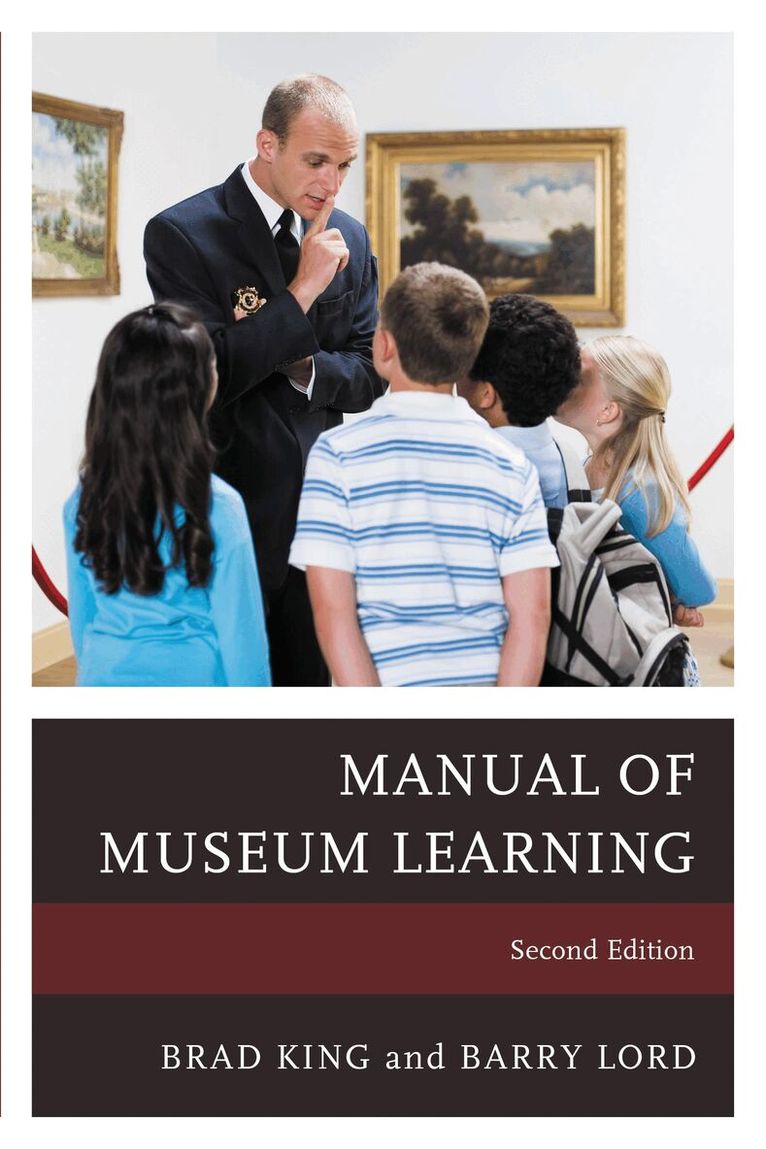
Manual of Museum Learning
Av Brad King, Barry Lord
1747 kr
Beställningsvara. Skickas inom 10-15 vardagar. Fri frakt över 249 kr.
Beskrivning
Produktinformation
- Utgivningsdatum: 2015-12-24
- Mått: 182 x 262 x 23 mm
- Vikt: 780 g
- Format: Inbunden
- Språk: Engelska
- Antal sidor: 286
- Upplaga: 2
- Förlag: Bloomsbury Publishing Plc
- ISBN: 9781442258464
Utforska kategorier
Mer om författaren
Brad King is a Vice President with Lord Cultural Resources in Toronto. He holds a PhD in History from the University of Toronto where he was a Doctoral Fellow of the Social Sciences and Humanities Research Council of Canada. Since joining Lord in 2000, Brad has led or contributed to a wide variety of museum and cultural planning projects and has been involved in some of the most interesting and ambitious projects of our time. He brings a wealth of international experience to his work, being recently active in the Arabian Gulf, South Asian and the Caribbean regions as well as in the United States and Canada. He is the author of chapters on collections analysis (The Manual of Museum Planning, 3rd ed.), on evolving museum-school relationships (The Manual of Museum Learning, 1st ed.) and is a frequent speaker at museum and academic conferences. The recently deceased Barry Lord, Co-President of Lord Cultural Resources, was internationally known as one of the world's leading museum planners. Based in Toronto but working globally, Barry brought over fifty years of experience in the management and planning of museums, galleries and historic sites to the hundreds of projects he has directed. With a B.A. in Philosophy from McMaster University followed by graduate work at Harvard University's Center for the Study of World Religions, Barry co-founded Lord Cultural Resources with his wife Gail Lord in 1981. Together they edited and wrote the world's first book on the subject, Planning Our Museums (1983) and three editions of The Manual of Museum Planning (1991, 1999 and 2012). Barry also co-authored The Cost of Collecting (1989) and The Manual of Museum Management (1997; 2nd edition, 2009), co-edited two editions of The Manual of Museum Exhibitions (2002 and 2014), and edited the first edition of The Manual of Museum Learning (2007). Barry co-authored Artists, Patrons, and the Public: Why Culture Changes with Gail in 2010. His most recent book, Art and Energy: How Culture Changes was published by the American Alliance of Museums in 2014.
Recensioner i media
Based on the premise the learning within the twenty-first-century museum setting is informal, voluntary, and affective, this volume presents both theory and case studies on how to optimize that learning. Building on material in the widely held 2007 first edition, the authors explore new settings and formats for educational experiences, from school-museum partnerships to the possibilities (such as Makerspaces) made available by the digital world. By analyzing the different resources a museum has, from collections of rare and beautiful objects to interactive learning spaces, the authors enumerate the different learning spaces. Four case studies offer precise examples of the ideas being presented. The authors have a wide range of experience in the museum world, from art and textile museums to botanical gardens. They provide a panoply of approaches to enhance the visitors’ experience, and to increase their understanding of the collections and exhibits they encounter. Any reader interested in improving the learning experience, for people at any stage of life, will find this volume of interest and use. Academic libraries and any others serving an education clientele should consider this volume, even if they own the first edition. Museum study programs will be most interested in this information.
Betyg & recensioner
0 recensioner
Inga recensioner tillgängliga.