• Fri frakt över 249 kr
  • •
  • Snabba leveranser
  • •
  • Billiga böcker
Kundservice

Du är på sajten för privatpersoner.

Företag, bibliotek eller offentlig verksamhet?

Du handlar på classic.bokus.com, där alla dina funktioner finns intakta.
Till classic.bokus.com
Bokus logotyp. Gå till startsidan.
  • Erbjudanden
  • Student
  • Topplistor
  • Barn & ungdom
  • Bokus Play
  • E-böcker
  • Ljudböcker
  • Pocketböcker
  • Spel och pussel

5% studentrabatt – använd koden KURSBOK27 →

Sidfot

Mina sidor

    Hjälp

    • Kundservice
    • Vanliga frågor och svar
    • Frakt och leverans
    • Retur vid ångerrätt
    • Reklamera vara
    • Betalning
    • Köpvillkor
    • Allmänna villkor
    • Information om webbplatsens tillgänglighet

    Om Bokus

    • Om oss
    • Pressrum
    • För studenter
    • För företag
    • För bibliotek och offentlig verksamhet
    • För leverantörer
    • Hållbarhet

    Populärt

    • Aktuella erbjudanden
    • Presentkort
    • Studentlitteratur
    • Nya böcker
    • Topplistor
    • Signerade böcker
    • Engelska böcker

    Inspiration

    • Boktips
    • BookTok
    • Barnbokskaraktärer
    • Populära författare
    Logotyp för Bokus
    Följ oss på Facebook (extern länk)Följ oss på Instagram (extern länk)Följ oss på YouTube (extern länk)Följ oss på TikTok (extern länk)
    bokus @ CookiesAnpassa cookiesIntegritetspolicyKöpvillkor
    Till Citymail hemsida (extern länk)Till Budbee hemsida (extern länk)Till Postnord hemsida (extern länk)Till Schenker hemsida (extern länk)Till Early Bird hemsida (extern länk)Till Walleys hemsida (extern länk)
    1. Ekonomi och Ledarskap
    2. Nationalekonomi
    3. Mikroekonomi

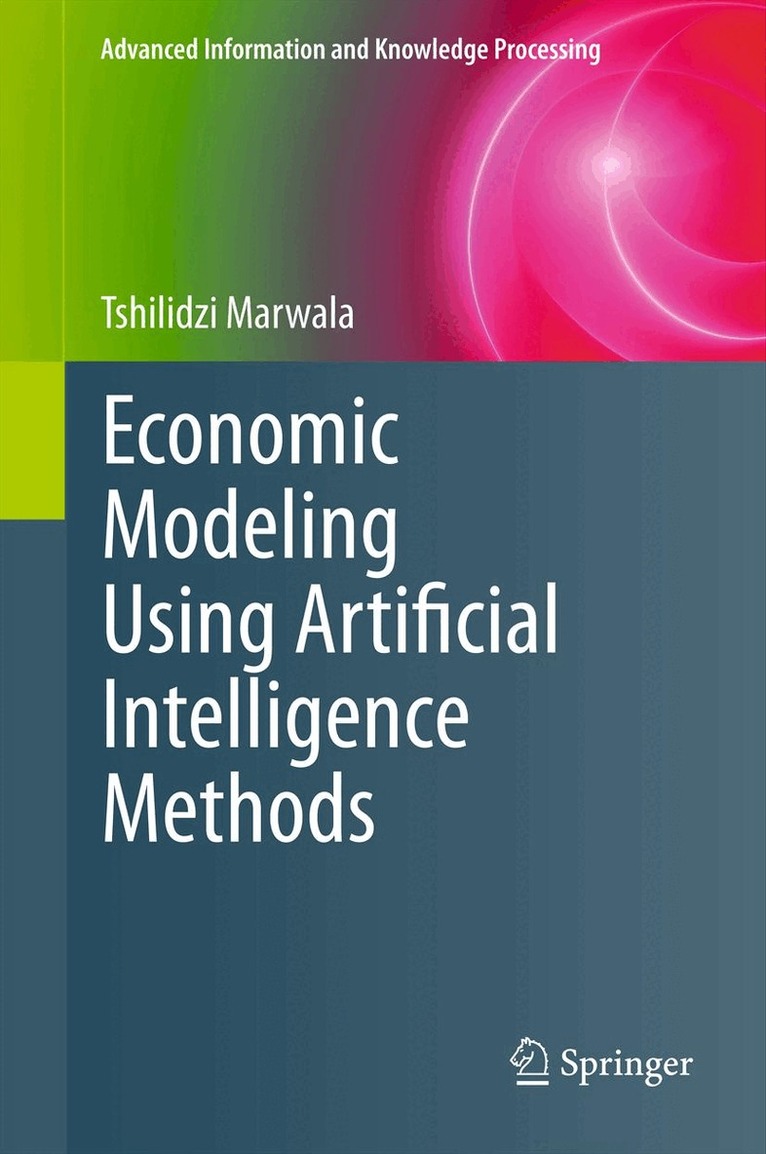
    Economic Modeling Using Artificial Intelligence Methods

    AvTshilidzi Marwala

    Inbunden, Engelska, 2013

    Del i serien Advanced Information and Knowledge Processing

    1 113 kr

    Beställningsvara. Skickas inom 10-15 vardagar. Fri frakt över 249 kr.

    Fler format och utgåvor

    E-bok

    1 413 kr

    Häftad

    1 113 kr

    Beskrivning

    Economic Modeling Using Artificial Intelligence Methods examines the application of artificial intelligence methods to model economic data. Traditionally, economic modeling has been modeled in the linear domain where the principles of superposition are valid. The application of artificial intelligence for economic modeling allows for a flexible multi-order non-linear modeling. In addition, game theory has largely been applied in economic modeling. However, the inherent limitation of game theory when dealing with many player games encourages the use of multi-agent systems for modeling economic phenomena.The artificial intelligence techniques used to model economic data include:multi-layer perceptron neural networksradial basis functionssupport vector machinesrough setsgenetic algorithmparticle swarm optimizationsimulated annealingmulti-agent systemincremental learningfuzzy networksSignal processing techniques are explored to analyze economic data, and these techniques are the time domain methods, time-frequency domain methods and fractals dimension approaches. Interesting economic problems such as causality versus correlation, simulating the stock market, modeling and controling inflation, option pricing, modeling economic growth as well as portfolio optimization are examined. The relationship between economic dependency and interstate conflict is explored, and knowledge on how economics is useful to foster peace – and vice versa – is investigated. Economic Modeling Using Artificial Intelligence Methods deals with the issue of causality in the non-linear domain and applies the automatic relevance determination, the evidence framework, Bayesian approach and Granger causality to understand causality and correlation.Economic Modeling Using Artificial Intelligence Methods makes an important contribution to the area of econometrics,and is a valuable source of reference for graduate students, researchers and financial practitioners.

    Produktinformation

    • Utgivningsdatum:2013-04-16
    • Mått:155 x 235 x 25 mm
    • Vikt:550 g
    • Format:Inbunden
    • Språk:Engelska
    • Serie:Advanced Information and Knowledge Processing
    • Antal sidor:261
    • Upplaga:2013
    • Förlag:Springer London Ltd
    • ISBN:9781447150091

    Utforska kategorier

    • Mikroekonomi inom Ekonomi och Ledarskap
    • Artificiell intelligens inom Data och IT

    Mer om författaren

    Tshilidzi Marwala, born in Venda (Limpopo, South Africa), is the Dean of Engineering at the University of Johannesburg. He is a senior member of the IEEE and distinguished member of the ACM. He is the youngest recipient of the Order of Mapungubwe and was awarded the President Award by the National Research Foundation. His research interests include the applications of computational intelligence to engineering, computer science, finance, social science and medicine.In addition to Economic Modeling Using Artificial Intelligence Methods, he has previously published 3 books with Springer: Condition Monitoring Using Computational Intelligence Methods (2012), Militarized Conflict Modeling Using Computational Intelligence Techniques (2011); and Finite Element Model Updating Using Computational Intelligence Techniques (2010).

    Recensioner i media

    From the reviews: "The book explores the application of artificial intelligence methods to economic data modelling. ... the book is well addressed to graduate students as well as researchers and practitioners in the field of finance and economics." (Vangelis Grigoroudis, zbMATH, Vol. 1269, 2013)

    Innehållsförteckning

    • Foreword.- Preface.- Acknowledgements.- Introduction to Economic Modeling.- Techniques for Economic Modeling: Unlocking the Character of Data.- Automatic Relevance Determination in Economic Modeling.- Neural Approaches to Economic Modeling.- Bayesian Support Vector Machines for Economic Modeling: Application to Option Pricing.- Rough Sets Approach to Economic Modeling: Unlocking Knowledge in Financial Data.- Missing Data Approaches to Economic Modeling: Optimization Approach.- Correlations versus Causality Approaches to Economic Modeling.- Evolutionary Approaches to Computational Economics: Application to Portfolio Optimization.- Real-time Approaches to Computational Economics: Self Adaptive Economic Systems.- Multi-Agent Approaches to Economic Modeling: Game Theory, Ensembles, Evolution and the Stock Market.- Control Approaches to Economic Modeling: Application to Inflation Targeting.- Modeling Interstate Conflict: The Role of Economic Interdependency for Maintaining Peace.- Conclusions and Further Work.- Index.