• Fri frakt över 249 kr
  • •
  • Snabba leveranser
  • •
  • Billiga böcker
Kundservice

Du är på sajten för privatpersoner.

Företag, bibliotek eller offentlig verksamhet?

Du handlar på classic.bokus.com, där alla dina funktioner finns intakta.
Till classic.bokus.com
Bokus logotyp. Gå till startsidan.
  • Erbjudanden
  • Nyheter
  • Student
  • Topplistor
  • Barn & ungdom
  • Bokus Play
  • E-böcker
  • Pocketböcker
  • Spel & pussel

10% rabatt på allt med kod NYSTART10 →

Sidfot

Mina sidor

    Hjälp

    • Kundservice
    • Vanliga frågor och svar
    • Frakt och leverans
    • Retur vid ångerrätt
    • Reklamera vara
    • Betalning
    • Köpvillkor
    • Allmänna villkor
    • Information om webbplatsens tillgänglighet

    Om Bokus

    • Om oss
    • Pressrum
    • För studenter
    • För företag
    • För bibliotek och offentlig verksamhet
    • För leverantörer
    • Hållbarhet

    Populärt

    • Aktuella erbjudanden
    • Presentkort
    • Studentlitteratur
    • Nya böcker
    • Topplistor
    • Signerade böcker
    • Engelska böcker

    Inspiration

    • Boktips
    • BookTok
    • Populära bokserier
    • Barnbokskaraktärer
    • Populära författare
    Logotyp för Bokus
    Följ oss på Facebook (extern länk)Följ oss på Instagram (extern länk)Följ oss på YouTube (extern länk)Följ oss på TikTok (extern länk)
    bokus @ CookiesAnpassa cookiesIntegritetspolicyKöpvillkor
    Till Citymail hemsida (extern länk)Till Budbee hemsida (extern länk)Till Postnord hemsida (extern länk)Till Schenker hemsida (extern länk)Till Early Bird hemsida (extern länk)Till Walleys hemsida (extern länk)
    1. Naturvetenskap och teknik
    2. Matematik och naturvetenskap
    3. Matematik
    4. Matematisk statistik

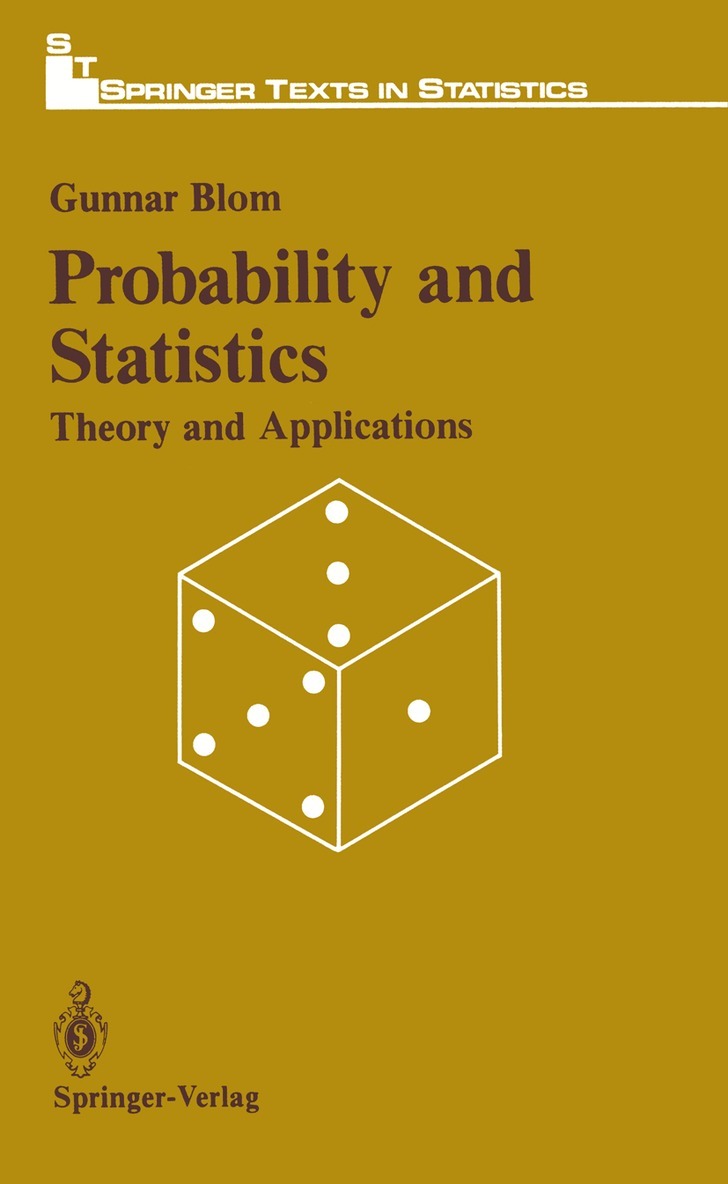
    Probability and Statistics

    Theory and Applications

    AvGunnar Blom

    Häftad, Engelska, 2011

    Del i serien Springer Texts in Statistics

    870 kr

    Beställningsvara. Skickas inom 10-15 vardagar. Fri frakt över 249 kr.

    Fler format och utgåvor

    E-bok

    1 026 kr

    Beskrivning

    This is a somewhat extended and modified translation of the third edition of the text, first published in 1969. The Swedish edition has been used for many years at the Royal Institute of Technology in Stockholm, and at the School of Engineering at Link6ping University. It is also used in elementary courses for students of mathematics and science. The book is not intended for students interested only in theory, nor is it suited for those seeking only statistical recipes. Indeed, it is designed to be intermediate between these extremes. I have given much thought to the question of dividing the space, in an appropriate way, between mathematical arguments and practical applications. Mathematical niceties have been left aside entirely, and many results are obtained by analogy. The students I have in mind should have three ingredients in their course: elementary probability theory with applications, statistical theory with applications, and something about the planning of practical investiga­ tions. When pouring these three ingredients into the soup, I have tried to draw upon my experience as a university teacher and on my earlier years as an industrial statistician. The programme may sound bold, and the reader should not expect too much from this book. Today, probability, statistics and the planning of investigations cover vast areas and, in 356 pages, only the most basic problems can be discussed. If the reader gains a good understanding of probabilistic and statistical reasoning, the main purpose of the book has been fulfilled.

    Produktinformation

    • Utgivningsdatum:2011-09-27
    • Mått:155 x 235 x 21 mm
    • Vikt:563 g
    • Format:Häftad
    • Språk:Engelska
    • Serie:Springer Texts in Statistics
    • Antal sidor:356
    • Förlag:Springer-Verlag New York Inc.
    • ISBN:9781461281580

    Utforska kategorier

    • Matematisk statistik inom Naturvetenskap och teknik
    • Tillämpad matematik inom Naturvetenskap och teknik

    Innehållsförteckning

    • 1 Introduction to Probability Theory.- 1.1. On the Usefulness of Probability Theory.- 1.2. Models, Especially Random Models.- 1.3. Some Historical Notes.- 2 Elements of Probability Theory.- 2.1. Introduction.- 2.2. Events.- 2.3. Probabilities in a General Sample Space.- 2.4. Probabilities in Discrete Sample Spaces.- 2.5. Conditional Probability.- 2.6. Independent Events.- 2.7. Some Theorems in Combinatorics.- 2.8. Some Classical Problems of Probability1.- 3 One-Dimensional Random Variables.- 3.1. Introduction.- 3.2. General Description of Random Variables.- 3.3. Distribution Function.- 3.4. Discrete Random Variables.- 3.5. Some Discrete Distributions.- 3.6. Continuous Random Variables.- 3.7. Some Continuous Distributions.- 3.8. Relationship Between Discrete and Continuous Distributions.- 3.9. Mixtures of Random Variables.- 4 Multidimensional Random Variables.- 4.1. Introduction.- 4.2. General Considerations.- 4.3. Discrete Two-Dimensional Random Variables.- 4.4. Continuous Two-Dimensional Random Variables.- 4.5. Independent Random Variables.- 4.6. Some Classical Problems of Probability1.- 5 Functions of Random Variables.- 5.1. Introduction.- 5.2. A Single Function of a Random Variable.- 5.3. Sums of Random Variables.- 5.4. Largest Value and Smallest Value.- 5.5. Ratio of Random Variables.- 6 Expectations.- 6.1. Introduction.- 6.2. Definition and Simple Properties.- 6.3. Measures of Location and Dispersion.- 6.4. Measures of Dependence.- 7 More About Expectations.- 7.1. Introduction.- 7.2. Product, Sum and Linear Combination.- 7.3. Arithmetic Mean. Law of Large Numbers.- 7.4. Gauss’s Approximation Formulae.- 7.5. Some Classical Problems of Probability1.- 8 The Normal Distribution.- 8.1. Introduction.- 8.2. Some General Facts About the Normal Distribution.- 8.3. Standard Normal Distribution.- 8.4. General Normal Distribution.- 8.5. Sums and Linear Combinations of Normally Distributed Random Variables.- 8.6. The Central Limit Theorem.- 8.7. Lognormal Distribution.- 9 The Binomial and Related Distributions.- 9.1. Introduction.- 9.2. The Binomial Distribution.- 9.3. The Hypergeometric Distribution.- 9.4. The Poisson Distribution.- 9.5. The Multinomial Distribution.- 10 Introduction to Statistical Theory.- 10.1. Introduction.- 10.2. Statistical Investigations.- 10.3. Examples of Sampling Investigations.- 10.4. Main Problems in Statistical Theory.- 10.5. Some Historical Notes.- 11 Descriptive Statistics.- 11.1. Introduction.- 11.2. Tabulation and Graphical Presentation.- 11.3. Measures of Location and Dispersion.- 11.4. Terminology.- 11.5. Numerical Computation.- 12 Point Estimation.- 12.1. Introduction.- 12.2. General Ideas.- 12.3. Estimation of Mean and Variance.- 12.4. The Method of Maximum Likelihood.- 12.5. The Method of Least Squares.- 12.6. Application to the Normal Distribution.- 12.7. Application to the Binomial and Related Distributions.- 12.8. Standard Error of an Estimate.- 12.9. Graphical Method for Estimating Parameters.- 12.10. Estimationof Probability Function, Density Function and Distribution Function1.- 12.11. Parameter with Prior Distribution1.- 13 Interval Estimation.- 13.1. Introduction.- 13.2. Some Ideas About Interval Estimates.- 13.3. General Method.- 13.4. Application to the Normal Distribution.- 13.5. Using the Normal Approximation.- 13.6. Application to the Binomial and Related Distributions.- 14 Testing Hypotheses.- 14.1. Introduction.- 14.2. An Example of Hypothesis Testing.- 14.3. General Method.- 14.4. Relation Between Tests of Hypotheses and Interval Estimation.- 14.5. Application to the Normal Distribution.- 14.6. Using the Normal Approximation.- 14.7. Application to the Binomial and Related Distributions.- 14.8. The Practical Value of Tests of Significance.- 14.9. Repeated Tests of Significance.- 15 Linear Regression.- 15.1. Introduction.- 15.2. A Model for Simple Linear Regression.- 15.3. Point Estimates.- 15.4. Interval Estimates.- 15.5. Several y-Values for Each x-Value.- 15.6. Various Remarks.-16 Planning Statistical Investigations.- 16.1. Introduction.- 16.2. General Remarks About Planning.- 16.3. Noncomparative Investigations.- 16.4. Comparative Investigations.- 16.5. Final Remarks.- Appendix: How to Handle Random Numbers.- Selected Exercises.- References.- Tables.- Answers to Exercises.- Answers to Selected Exercises.