• Fri frakt över 249 kr
  • •
  • Snabba leveranser
  • •
  • Billiga böcker
Kundservice

Du är på sajten för privatpersoner.

Företag, bibliotek eller offentlig verksamhet?

Du handlar på classic.bokus.com, där alla dina funktioner finns intakta.
Till classic.bokus.com
Bokus logotyp. Gå till startsidan.
  • Erbjudanden
  • Nyheter
  • Student
  • Topplistor
  • Barn & ungdom
  • Bokus Play
  • E-böcker
  • Pocketböcker
  • Spel & pussel

10% rabatt på allt med kod: NYSTART10 →

Sidfot

Mina sidor

    Hjälp

    • Kundservice
    • Vanliga frågor och svar
    • Frakt och leverans
    • Retur vid ångerrätt
    • Reklamera vara
    • Betalning
    • Köpvillkor
    • Allmänna villkor
    • Information om webbplatsens tillgänglighet

    Om Bokus

    • Om oss
    • Pressrum
    • För studenter
    • För företag
    • För bibliotek och offentlig verksamhet
    • För leverantörer
    • Hållbarhet

    Populärt

    • Aktuella erbjudanden
    • Presentkort
    • Studentlitteratur
    • Nya böcker
    • Topplistor
    • Signerade böcker
    • Engelska böcker

    Inspiration

    • Boktips
    • BookTok
    • Populära bokserier
    • Barnbokskaraktärer
    • Populära författare
    Logotyp för Bokus
    Följ oss på Facebook (extern länk)Följ oss på Instagram (extern länk)Följ oss på YouTube (extern länk)Följ oss på TikTok (extern länk)
    bokus @ CookiesAnpassa cookiesIntegritetspolicyKöpvillkor
    Till Citymail hemsida (extern länk)Till Budbee hemsida (extern länk)Till Postnord hemsida (extern länk)Till Schenker hemsida (extern länk)Till Early Bird hemsida (extern länk)Till Walleys hemsida (extern länk)
    1. Medicin
    2. Kirurgi
    3. Gastrointestinal och kolorektal kirurgi

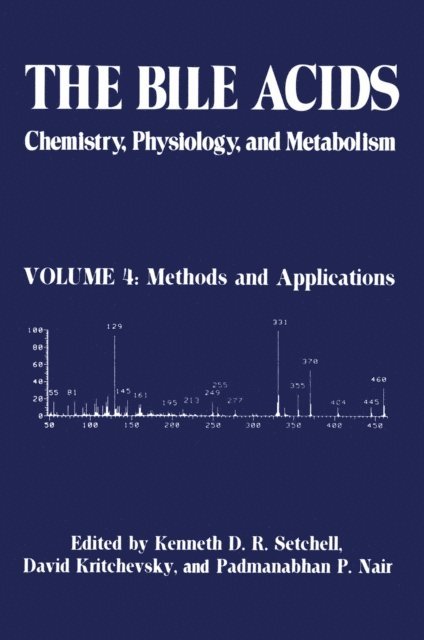
    Bile Acids: Chemistry, Physiology, and Metabolism

    Volume 4: Methods and Applications

    AvK.D.R. Setchell,David Kritchevsky

    Häftad, Engelska, 2011

    563 kr

    Beställningsvara. Skickas inom 10-15 vardagar. Fri frakt över 249 kr.

    Beskrivning

    Over a decade has elapsed since the last volume in this series was published. At that time we considered that we had comprehensively covered all aspects relating to bile acid chemistry and physiology. However, major strides have been made in our understanding of the physiology and pathophysiology of bile acids, due largely to the great advances which have taken place in analytical technology. As a result, the need to document these advances was felt acutely, and therefore this volume is devoted to methodologies in bile acid analysis and their applications. This volume includes twelve chapters written by prominent scientists in the field of bile acid research. The initial chapter discusses techniques of extraction and isolation of bile acids from biological fluids. It is followed by descriptions of physical methods of analysis and discussions of the way these techniques have been applied in the field of bile acid research. Of practical value is the inclusion of a comprehensive list of spectra obtained for refer­ ences by nuclear magnetic resonance spectroscopy and mass spectrometry . These chapters are followed by reviews of biological methods of immuno­ assay and bioluminescence. Specific applications of these techniques are then addressed in contributions relating to bile acid analysis of tissue, serum, urine, and feces. With this integrated approach we have attempted to provide a volume which represents a comprehensive review of the analytical field of bile acids, while also serving as a useful reference book for those workers involved in bile acid analysis.

    Produktinformation

    • Utgivningsdatum:2011-10-02
    • Mått:152 x 229 x 33 mm
    • Vikt:868 g
    • Format:Häftad
    • Språk:Engelska
    • Antal sidor:604
    • Förlag:Springer-Verlag New York Inc.
    • ISBN:9781461282365

    Utforska kategorier

    • Gastrointestinal och kolorektal kirurgi inom Medicin
    • Biokemi inom Naturvetenskap och teknik
    • Klinisk medicin och internmedicin inom Medicin

    Innehållsförteckning

    • 1 Techniques for Extraction and Group Separation of Bile Acids.- 1. Introduction.- 2. Extraction.- 3. Purification and Group Separation.- 4. Hydrolysis and Solvolysis.- 5. Conclusions.- References.- 2 High-Performance Liquid Chromatography.- 1. Introduction.- 2. Chromatographic Behavior of Bile Acids.- 3. Detection Methods.- 4. Application of HPLC to Biological Specimens.- 5. Conclusions.- References.- 3 Nuclear Magnetic Resonance.- 1. Introduction: Why Use NMR for Bile Acids?.- 2. Basic Principles of NMR.- 3. Proton NMR of Bile Acids.- 4. 13C NMR of Bile Acids.- 5. Recent Advances in NMR Spectroscopy.- 6. Application of NMR to the Physical Chemistry of Bile Acids.- 7. NMR in the Biosynthesis and Metabolism of Bile Acids.- 8. ConclUding Remarks.- References.- 4 X-Ray Crystallography.- l. Introduction.- 2. X-Ray Diffraction by Single Crystals.- 3. Sample Preparation.- 4. Experimental Measurements.- 5. Structure Determination.- 6. Interpretation of Results.- 7. Pitfalls.- 8. Examples.- References.- 5 Mass Spectrometry of Bile Acids.- 1. Introduction.- 2. Principles and Instrumentation.- 3. Ionization Methods.- 4. Methods of Sample Introduction.- 5. Mass Spectrometric Fragmentation of Bile Acids.- 6. Quantitative Analysis of Bile Acids.- 7. Bile Acids Labeled with Stable Isotopes.- 8. Application of Mass Spectrometry to the Determination of Bile Acids in Biological Fluids.- 9. Compendium of Mass Spectra of Bile Acids.- References.- 6 Immunological Methods for Serum Bile Acid Analysis.- 1. Introduction.- 2. Physicochemical State of Bile Acids in Serum.- 3. Immunoassay.- 4. Preparation of Antigenic Bile Acids.- 5. Antibodies.- 6. Labeled Bile Acids.- 7. Assay Procedure.- 8. Comparison of Methods.- 9. Comparison between Methods.- 10. Enzyme Immunoassay.- 11. Serum Bile Acidsin Physiology and Pathology.- References.- 7 Bioluminescence Assays Using Immobilized Enzymes in Bile Acid Analysis.- 1. Introduction.- 2. Bioluminescence Assays.- 3. Material.- 4. Methods.- 5. Results.- 6. Discussion.- 7. Summary.- References.- 8 Bile Acids in Extrahepatic Tissues.- 1. Introduction.- 2. Analytical Methods.- 3. Applications.- 4. Conclusions.- References.- 9 Tissue-Bound Bile Acids.- 1. Introduction.- 2. Methodology.- References.- 10 Serum Bile Acids.- 1. Introduction.- 2. Serum Bile Acids and the Different Enterohepatic Bile Acid Cycles in Normal Humans.- 3. Serum Bile Acid Measurements and the Dynamics of the Normal Enterohepatic Circulations.- 4. Serum Bile Acids and Liver Disease.- 5. Gas Chromatography-Mass Spectrometry and Monohydroxy Bile Acids in Liver Disease.- 6. Serum Bile Acid Composition in Other Circumstances.- 7. Conclusion.- References.- 11 Urinary Bile Acids.- 1. Introduction.- 2. Methodology.- 3. Bile Acids Detected in the Urine.- 4. Origin of the Atypical Bile Acids in the Urine.- 5. The Renal Clearance of Bile Acids.- 6. Conclusion.- References.- 12 Fecal Bile Acids.- 1. Introduction.- 2. Methods for Determination of Fecal Bile Acids.- 3. Fecal Bile Acid Excretion in Health.- 4. Fecal Bile Acid Excretion in Disease.- 5. Effect of Diet and Drugs on Fecal Bile Acid Excretion.- 6. Conclusions.- References.