• Fri frakt över 249 kr
  • •
  • Snabba leveranser
  • •
  • Billiga böcker
Kundservice

Du är på sajten för privatpersoner.

Företag, bibliotek eller offentlig verksamhet?

Du handlar på classic.bokus.com, där alla dina funktioner finns intakta.
Till classic.bokus.com
Bokus logotyp. Gå till startsidan.
  • Erbjudanden
  • Student
  • Topplistor
  • Barn & ungdom
  • Bokus Play
  • E-böcker
  • Ljudböcker
  • Pocketböcker
  • Spel och pussel

Pocketfynda! Hundratals böcker för 49 kr/st →

Sidfot

Mina sidor

    Hjälp

    • Kundservice
    • Vanliga frågor och svar
    • Frakt och leverans
    • Retur vid ångerrätt
    • Reklamera vara
    • Betalning
    • Köpvillkor
    • Allmänna villkor
    • Information om webbplatsens tillgänglighet

    Om Bokus

    • Om oss
    • Pressrum
    • För studenter
    • För företag
    • För bibliotek och offentlig verksamhet
    • För leverantörer
    • Hållbarhet

    Populärt

    • Aktuella erbjudanden
    • Presentkort
    • Studentlitteratur
    • Nya böcker
    • Topplistor
    • Signerade böcker
    • Engelska böcker

    Inspiration

    • Boktips
    • BookTok
    • Barnbokskaraktärer
    • Populära författare
    Logotyp för Bokus
    Följ oss på Facebook (extern länk)Följ oss på Instagram (extern länk)Följ oss på YouTube (extern länk)Följ oss på TikTok (extern länk)
    bokus @ CookiesAnpassa cookiesIntegritetspolicyKöpvillkor
    Till Citymail hemsida (extern länk)Till Budbee hemsida (extern länk)Till Postnord hemsida (extern länk)Till Schenker hemsida (extern länk)Till Early Bird hemsida (extern länk)Till Walleys hemsida (extern länk)
    1. Naturvetenskap och teknik
    2. Matematik och naturvetenskap
    3. Matematik
    4. Tillämpad matematik

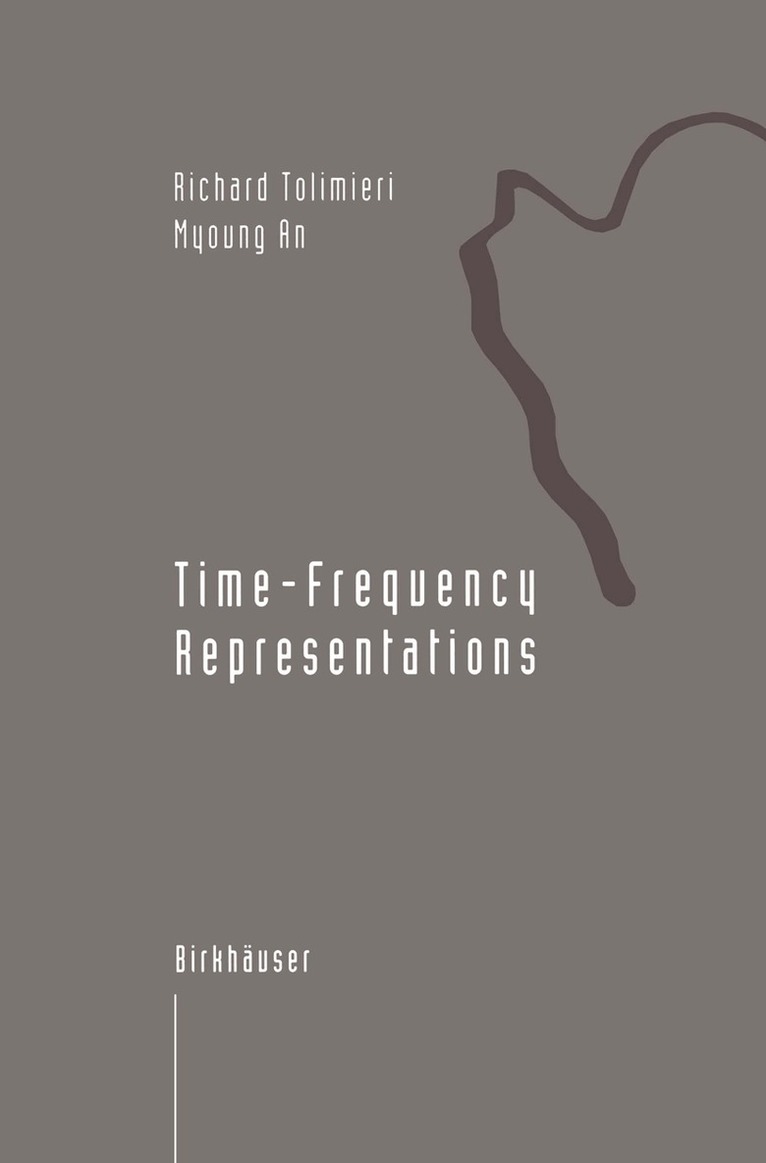
    Time-Frequency Representations

    AvRichard Tolimieri,Myoung An

    Häftad, Engelska, 2012

    Del i serien Applied and Numerical Harmonic Analysis

    1 078 kr

    Beställningsvara. Skickas inom 10-15 vardagar. Fri frakt över 249 kr.

    Fler format och utgåvor

    Inbunden

    1 078 kr

    Beskrivning

    The aim of this work is to present several topics in time-frequency analysis as subjects in abelian group theory. The algebraic point of view pre­ dominates as questions of convergence are not considered. Our approach emphasizes the unifying role played by group structures on the development of theory and algorithms. This book consists of two main parts. The first treats Weyl-Heisenberg representations over finite abelian groups and the second deals with mul­ tirate filter structures over free abelian groups of finite rank. In both, the methods are dimensionless and coordinate-free and apply to one and multidimensional problems. The selection of topics is not motivated by mathematical necessity but rather by simplicity. We could have developed Weyl-Heisenberg theory over free abelian groups of finite rank or more generally developed both topics over locally compact abelian groups. However, except for having to dis­ cuss conditions for convergence, Haar measures, and other standard topics from analysis the underlying structures would essentially be the same. A re­ cent collection of papers [17] provides an excellent review of time-frequency analysis over locally compact abelian groups. A further reason for limiting the scope of generality is that our results can be immediately applied to the design of algorithms and codes for time­ frequency processing.

    Produktinformation

    • Utgivningsdatum:2012-02-22
    • Mått:155 x 235 x 17 mm
    • Vikt:464 g
    • Format:Häftad
    • Språk:Engelska
    • Serie:Applied and Numerical Harmonic Analysis
    • Antal sidor:284
    • Upplaga:1998
    • Förlag:Springer-Verlag New York Inc.
    • ISBN:9781461286769

    Utforska kategorier

    • Tillämpad matematik inom Naturvetenskap och teknik
    • Beräkning och matematisk analys inom Naturvetenskap och teknik
    • Elektronik och kommunikationer inom Naturvetenskap och teknik

    Recensioner i media

    "On the one side, the book seems to be dedicated to theory-interested specialists in the area of harmonic analysis, on the other side the last chapter shows that highly theoretical constructs can efficiently be used in modern applications." -Simulation News Europe "[The book], devoted to the subject of time-frequency representation, shows that there are still many interesting and useful aspects of Gabor analysis, in particular, in the discrete setting." -Zentralblatt Math

    Innehållsförteckning

    • 1 Review of algebra.- 1.1 Introduction.- 1.2 Definitions and examples of groups.- 1.3 Subgroups, cosets, and quotients.- 1.4 Ideals.- 1.5 Mappings.- 1.6 Finitely generated abelian groups.- References.- 2 Linear algebra and abelian groups.- 2.1 Introduction.- 2.2 Vector space L(A).- 3 Fourier transform over A.- 3.1 Introduction.- 3.2 Character groups.- 3.3 Character formulas.- 3.4 Duality theory.- 3.5 Character group basis.- 3.6 Fourier transform.- 3.7 Shift and multiplication operators.- References.- Problems.- 4 Poisson summation formula.- 4.1 Introduction.- 4.2 Statement and proof.- 4.3 Fourier transform of periodic functions.- 4.4 Periodization-decimation operators.- References.- Problems.- 5 Zak transform.- 5.1 Introduction.- 5.2 Fourier analysis on A x A*.- 5.3 Zak transform.- 5.4 Functional equation.- 5.5 Fourier and Zak transform.- 5.6 Isometry.- 5.7 Algorithm for computing Zak transform.- References.- Problems.- 6 Weyl-Heisenberg systems.- 6.1 Introduction.- 6.2 Translates.- 6.3 W-H systems.- 6.4 Sampling rates.- 6.5 Divide-and-conquer.- References.- Problems.- 7 Zak transform and W-H systems.- 7.1 Introduction.- 7.2 Basic results.- 7.3 Fundamental formulas.- 7.4 Zak space characterization of W-H systems.- 7.5 Zero set characterization.- Problems.- 8 Algorithms for W-H systems.- 8.1 Introduction.- 8.2 Critical sampling algorithm.- 8.3 Integer over-sampling algorithm.- 8.4 General over-sampling algorithm.- References.- Problems.- 9 Orthogonal projection theorem.- 9.1 Introduction.- 9.2 Orthogonal projection algorithm.- 9.3 Iterative W-H coefficient set algorithm.- 10 Cross-ambiguity function.- 10.1 Introduction.- 10.2 Basic results.- 10.3 Direct algorithm.- 10.4 Critical sampling algorithm.- 10.5 Integer over-sampling algorithm.- 10.6 General divide-and-conquer algorithm.- References.- Problems.- 11 Ambiguity surfaces.- 11.1 Introduction.- 11.2 Fourier transform of ambiguity surfaces.- 11.3 Formulas D1 and D2.- References.- 12 Orthonormal W-H systems.- 12.1 Introduction.- 12.2 Orthonormal W-H systems.- References.- Problems.- 13 Duality.- 13.1 Introduction.- 13.2 Biorthogonal.- 13.3 Algorithms for computing biorthogonals.- References.- Problems.- 14 Frames.- 14.1 Introduction.- 14.2 Frame Operator.- 14.3 Frames.- 14.4 Frame biorthogonals.- 14.5 Operator interpretation.- 14.6 Tight frames.- References.- 15 Implementation.- 15.1 Introduction.- 15.2 Tensor product.- 15.3 Multidimensional arrays.- 15.4 Computing the Zak transform.- References.- Problems.- 16 Algebra of multirate structures.- 16.1 Introduction.- 16.2 Algebra.- 16.3 Exact sequences.- 16.4 Main theorem.- 16.5 Representatives mapping theorem.- 16.6 Integer matrices.- References.- Problems.- 17 Multirate structures.- 17.1 Introduction.- 17.2 Decimation operator.- 17.3 Polyphase representation.- 17.4 Integer rate bands.- 17.5 Reduction theorems.- 17.6 Decimators and expanders.- References.- 18 A Time-frequency search for stock market anomalies.- 18.1 Introduction.- 18.2 Time-frequency trees.- 18.3 Analysis of the log-differenced DJIA and S&P 500 data.- References.