• Fri frakt över 249 kr
  • •
  • Snabba leveranser
  • •
  • Billiga böcker
Kundservice

Du är på sajten för privatpersoner.

Företag, bibliotek eller offentlig verksamhet?

Du handlar på classic.bokus.com, där alla dina funktioner finns intakta.
Till classic.bokus.com
Bokus logotyp. Gå till startsidan.
  • Erbjudanden
  • Student
  • Topplistor
  • Barn & ungdom
  • Bokus Play
  • E-böcker
  • Ljudböcker
  • Pocketböcker
  • Spel och pussel

5% studentrabatt – använd koden KURSBOK27 →

Sidfot

Mina sidor

    Hjälp

    • Kundservice
    • Vanliga frågor och svar
    • Frakt och leverans
    • Retur vid ångerrätt
    • Reklamera vara
    • Betalning
    • Köpvillkor
    • Allmänna villkor
    • Information om webbplatsens tillgänglighet

    Om Bokus

    • Om oss
    • Pressrum
    • För studenter
    • För företag
    • För bibliotek och offentlig verksamhet
    • För leverantörer
    • Hållbarhet

    Populärt

    • Aktuella erbjudanden
    • Presentkort
    • Studentlitteratur
    • Nya böcker
    • Topplistor
    • Signerade böcker
    • Engelska böcker

    Inspiration

    • Boktips
    • BookTok
    • Barnbokskaraktärer
    • Populära författare
    Logotyp för Bokus
    Följ oss på Facebook (extern länk)Följ oss på Instagram (extern länk)Följ oss på YouTube (extern länk)Följ oss på TikTok (extern länk)
    bokus @ CookiesAnpassa cookiesIntegritetspolicyKöpvillkor
    Till Citymail hemsida (extern länk)Till Budbee hemsida (extern länk)Till Postnord hemsida (extern länk)Till Schenker hemsida (extern länk)Till Early Bird hemsida (extern länk)Till Walleys hemsida (extern länk)
    1. Samhälle och politik
    2. Samhälle och kultur
    3. Kultur och medier
    4. Referensverk och tvärvetenskap

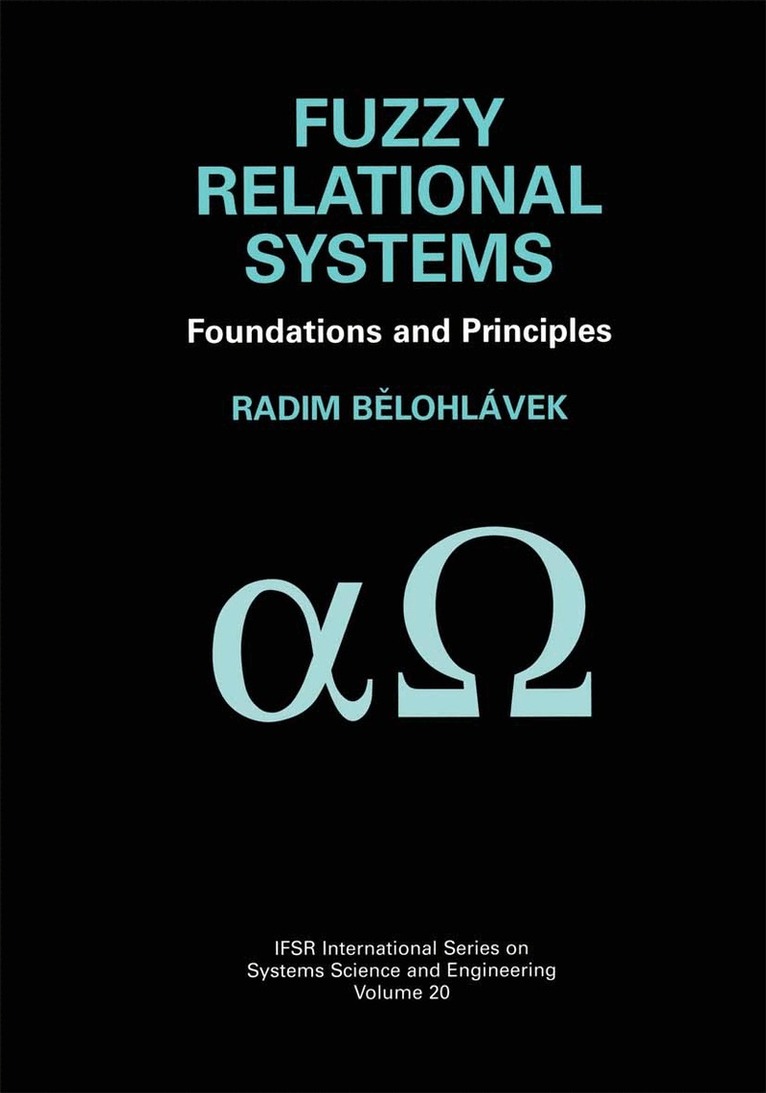
    Fuzzy Relational Systems

    Foundations and Principles

    AvRadim Belohlávek

    Häftad, Engelska, 2012

    Del i serien IFSR International Series in Systems Science and Systems Engineering

    1 617 kr

    Beställningsvara. Skickas inom 10-15 vardagar. Fri frakt över 249 kr.

    Fler format och utgåvor

    Inbunden

    1 617 kr

    E-bok

    2 044 kr

    Beskrivning

    Since their inception, fuzzy sets and fuzzy logic became popular. The reason is that the very idea of fuzzy sets and fuzzy logic attacks an old tradition in science, namely bivalent (black-or-white, all-or-none) judg­ ment and reasoning and the thus resulting approach to formation of scientific theories and models of reality. The idea of fuzzy logic, briefly speaking, is just the opposite of this tradition: instead of full truth and falsity, our judgment and reasoning also involve intermediate truth values. Application of this idea to various fields has become known under the term fuzzy approach (or graded truth approach). Both prac­ tice (many successful engineering applications) and theory (interesting nontrivial contributions and broad interest of mathematicians, logicians, and engineers) have proven the usefulness of fuzzy approach. One of the most successful areas of fuzzy methods is the application of fuzzy relational modeling. Fuzzy relations represent formal means for modeling of rather nontrivial phenomena (reasoning, decision, control, knowledge extraction, systems analysis and design, etc. ) in the pres­ ence of a particular kind of indeterminacy called vagueness. Models and methods based on fuzzy relations are often described by logical formulas (or by natural language statements that can be translated into logical formulas). Therefore, in order to approach these models and methods in an appropriate formal way, it is desirable to have a general theory of fuzzy relational systems with basic connections to (formal) language which enables us to describe relationships in these systems.

    Produktinformation

    • Utgivningsdatum:2012-09-16
    • Mått:178 x 254 x undefined mm
    • Format:Häftad
    • Språk:Engelska
    • Serie:IFSR International Series in Systems Science and Systems Engineering
    • Antal sidor:369
    • Förlag:Springer-Verlag New York Inc.
    • ISBN:9781461351689

    Utforska kategorier

    • Referensverk och tvärvetenskap inom Samhälle och politik
    • Matematikens grunder inom Naturvetenskap och teknik
    • Artificiell intelligens inom Data och IT

    Innehållsförteckning

    • 1. Preliminaries.- 1.1 Sets, relations, mappings.- 1.2 Ordered sets, lattices.- 1.3 Tolerances, equivalences.- 1.4 Algebras.- 2. Fuzzy Approach, Graded Truth, and Structures of Truth Values.- 2.1 Fuzzy approach: from resolving paradoxes to engineering applications.- 2.2 Graded truth and structures of truth values.- 2.3 Residuated lattices.- 2.4 Residuated lattices and t-norms.- 2.5 Bibliographical remarks.- 3. Fuzzy Structures.- 3.1 Fuzzy sets and fuzzy relations.- 3.2 Fuzzy logic: syntax and semantics.- 3.3 Similarity issues.- 3.4 Morphisms, products, substructures.- 3.5 Representation by crisp structures: cutlike semantics.- 3.6 Algebras with fuzzy equalities.- 3.7 Many-sorted case.- 3.8 Bibliographical remarks.- 4. Binary Fuzzy Relations.- 4.1 Operations and properties of binary fuzzy relations.- 4.2 Similarity: fuzzy equivalences.- 4.3 Hierarchy: fuzzy order.- 4.4 Bibliographical remarks.- 5. Object-Attribute Fuzzy Relations and Fuzzy Concept Lattices.- 5.1 Conceptual granulation: fuzzy context, fuzzy concepts, and fuzzy concept lattice.- 5.2 Similarity and logical precision.- 5.3 Fuzzy Galois connections.- 5.4 Main theorem of fuzzy concept lattices.- 5.5 Bibliographical remarks.- 6. Composition and Decomposition of Fuzzy Relations.- 6.1 Composition of fuzzy relations.- 6.2 Decomposition: fuzzy relational equations.- 6.3 Bibliographical remarks.- 7. Miscellanea.- 7.1 Fuzzy closure operators and similarity spaces.- 7.2 Applications of selected results to some problems and models.- 7.3 Fuzzy logic with truth degrees in residuated lattices.- 7.4 Bibliographical remarks.- References.