• Fri frakt över 249 kr
  • •
  • Snabba leveranser
  • •
  • Billiga böcker
Kundservice

Du är på sajten för privatpersoner.

Företag, bibliotek eller offentlig verksamhet?

Du handlar på classic.bokus.com, där alla dina funktioner finns intakta.
Till classic.bokus.com
Bokus logotyp. Gå till startsidan.
  • Erbjudanden
  • Nyheter
  • Student
  • Topplistor
  • Barn & ungdom
  • Bokus Play
  • E-böcker
  • Pocketböcker
  • Spel & pussel

10% rabatt på allt med kod NYSTART10 →

Sidfot

Mina sidor

    Hjälp

    • Kundservice
    • Vanliga frågor och svar
    • Frakt och leverans
    • Retur vid ångerrätt
    • Reklamera vara
    • Betalning
    • Köpvillkor
    • Allmänna villkor
    • Information om webbplatsens tillgänglighet

    Om Bokus

    • Om oss
    • Pressrum
    • För studenter
    • För företag
    • För bibliotek och offentlig verksamhet
    • För leverantörer
    • Hållbarhet

    Populärt

    • Aktuella erbjudanden
    • Presentkort
    • Studentlitteratur
    • Nya böcker
    • Topplistor
    • Signerade böcker
    • Engelska böcker

    Inspiration

    • Boktips
    • BookTok
    • Populära bokserier
    • Barnbokskaraktärer
    • Populära författare
    Logotyp för Bokus
    Följ oss på Facebook (extern länk)Följ oss på Instagram (extern länk)Följ oss på YouTube (extern länk)Följ oss på TikTok (extern länk)
    bokus @ CookiesAnpassa cookiesIntegritetspolicyKöpvillkor
    Till Citymail hemsida (extern länk)Till Budbee hemsida (extern länk)Till Postnord hemsida (extern länk)Till Schenker hemsida (extern länk)Till Early Bird hemsida (extern länk)Till Walleys hemsida (extern länk)
    1. Naturvetenskap och teknik
    2. Matematik och naturvetenskap
    3. Matematik
    4. Optimering

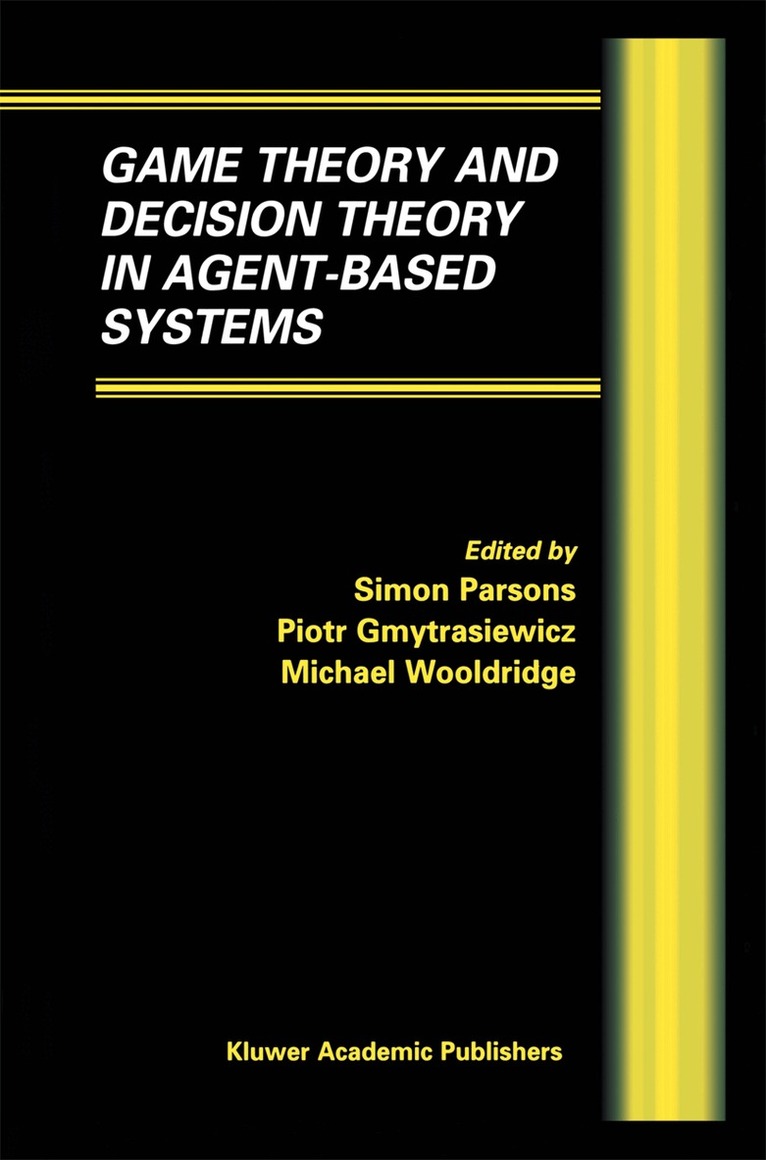
    Game Theory and Decision Theory in Agent-Based Systems

    AvSimon D. Parsons,Piotr Gymtrasiewicz

    Häftad, Engelska, 2012

    Del 5 i serien Multiagent Systems, Artificial Societies, and Simulated Organizations

    2 164 kr

    Beställningsvara. Skickas inom 10-15 vardagar. Fri frakt över 249 kr.

    Beskrivning

    Game Theory And Decision Theory In Agent-Based Systems is a collection of papers from international leading researchers, that offers a broad view of the many ways game theory and decision theory can be applied in agent-based systems, from standard applications of the core elements of the theory to more cutting edge developments. The range of topics discussed in this book provide the reader with the first comprehensive volume that reflects both the depth and breadth of work in applying techniques from game theory and decision theory to design agent-based systems. Chapters include: Selecting Partners; Evolution of Agents with Moral Sentiments in an IPD Exercise; Dynamic Desires; Emotions and Personality; Decision-Theoretic Approach to Game Theory; Shopbot Economics; Finding the Best Way to Join in; Shopbots and Pricebots in Electronic Service Markets; Polynomial Time Mechanisms; Multi-Agent Q-learning and Regression Trees; Satisficing Equilibria; Investigating Commitment Flexibility in Multi-agent Contracts; Pricing in Agent Economies using Multi-agent Q-learning; Using Hypergames to Increase Planned Payoff and Reduce Risk; Bilateral Negotiation with Incomplete and Uncertain Information; Robust Combinatorial Auction Protocol against False-name Bids.

    Produktinformation

    • Utgivningsdatum:2012-10-31
    • Mått:155 x 235 x 23 mm
    • Vikt:628 g
    • Format:Häftad
    • Språk:Engelska
    • Serie:Multiagent Systems, Artificial Societies, and Simulated Organizations
    • Antal sidor:379
    • Förlag:Springer-Verlag New York Inc.
    • ISBN:9781461353980

    Utforska kategorier

    • Optimering inom Naturvetenskap och teknik
    • Artificiell intelligens inom Data och IT

    Innehållsförteckning

    • 1 Game Theory and Decision Theory.- 1 Introduction.- 2 Decision Theory.- 3 Game Theory.- 4 The Prisoner’s Dilemma.- 5 Summary.- 2 Selecting Partners.- 1 Introduction.- 2 A Sample Problem.- 3 Coalition Formation.- 4 Payoff-structures of Partnerships.- 5 Selecting the Potentially most Beneficial Partnership for Limited Interactions.- 6 An Example Evaluation.- 7 Comparative Evaluation with a Decision Mechanism for Infinite Interactions.- 8 Evaluation Scenario.- 9 Experimental Results.- 10 Conclusions.- 3 Evolution of Agents with Moral Sentiments in an IPD Exercise.- 1 Introduction.- 2 Moral Sentiments in the Iterated Prisoner’s Dilemma.- 3 The Unwitting Benefits of Altruism.- 4 An Evolutionary Setting for the Simulations.- 5 Playing with Moral Sentiments Secures the Survival of the Group.- 6 A Case for Benevolence in Agents.- 7 Conclusions.- 4 Dynamic Desires.- 1 Introduction.- 2 Utilities, Desires and Goals.- 3 An Example from Negotiation.- 4 Dynamic Logic.- 5 Future Research.- 6 Concluding Remarks.- 5 Emotions and Personality.- 1 Introduction.- 2 Decision—Theoretic Preliminaries.- 3 Emotional States and Personality.- 4 Conclusions and Future Work.- 5 Acknowledgements.- 6 Decision-Theoretic Approach to Game Theory.- 1 Background on Decision—Theoretic Approach to Game Theory.- 2 Knowledge Base Design.- 3 RMM’s Solution Method.- 4 Rational Communication 109 5 Experiments in Air Defense Domain.- 6 Conclusions.- 7 Shopbot Economics.- 1 Introduction.- 2 Model.- 3 Sellers.- 4 Buyers.- 5 Shopbot.- 6 Related Work.- 7 Conclusions and Future Work.- Appendix: No Pure Strategy Nash Equilibrium.- 8 Finding the Best Way to Join in.- 1 Introduction.- 2 Game Theoretic Foundations.- 3 The Accession Game.- 4 Solving More General Games.- 5 Conclusions.- 9 Shopbots and Pricebots inElectronic Service Markets.- 1 Introduction and Definitions.- 2 Our Model of an Electronic Service Market.- 3 Comparisons.- 4 Related Literature.- 5 Conclusions.- Appendix: The Derivation of Equilibrium for the XX Market Configuration.- 10 Polynomial Time Mechanisms.- 1 Introduction.- 2 Mechanism Design.- 3 Polynomial Time Mechanisms.- 4 Dominant Strategy Implementation.- 5 Nash Implementation.- 6 Upper Bounds on Approximability.- 7 Conclusions.- 11 Multi-Agent Q-learning and Regression Trees.- 1 Introduction.- 2 Model Agent Economies.- 3 Single and Multi-Agent Q-learning.- 4 Q-learning with Regression Trees.- 5 Results.- 6 Conclusions.- 12 Satisficing Equilibria.- 1 Introduction.- 2 A Comparative Paradigm.- 3 Praxeic Utility.- 4 Multi-Agent Systems.- 5 Satisficing Games.- 6 Summary and Discussion.- 13 Investigating Commitment Flexibility in Multi-agent Contracts.- 1 Introduction.- 2 The Scenario.- 3 Some Analysis of Special Cases.- 4 Empirical Work.- 5 Conclusions and Further Work.- 14 Pricing in Agent Economies using Multi-agent Q-learning.- 1 Introduction.- 2 Model Agent Economies.- 3 Single-agent Q-learning.- 4 Multi-agent Q-learning.- 5 Conclusions.- 15 Using Hypergames to Increase Planned Payoff and Reduce Risk.- 1 Introduction.- 2 Discussion.- 3 Results.- 4 Conclusions.- 16 Bilateral Negotiation with Incomplete and Uncertain Information.- 1 Introduction.- 2 The Application Area.- 3 The Negotiation Mechanism.- 4 Evaluation.- 5 Related Work on Negotiation.- 6 Conclusions.- 17 Robust Combinatorial Auction Protocol against False-name Bids.- 1 Introduction.- 2 Generalized Vickrey Auction Protocol (GVA).- 3 Robust Protocol against False-name Bids.- 4 Proof of Incentive Compatibility.- 5 Evaluation.- 6 Discussion.- 7 Conclusions.