• Fri frakt över 249 kr
  • •
  • Snabba leveranser
  • •
  • Billiga böcker
Kundservice

Du är på sajten för privatpersoner.

Företag, bibliotek eller offentlig verksamhet?

Du handlar på classic.bokus.com, där alla dina funktioner finns intakta.
Till classic.bokus.com
Bokus logotyp. Gå till startsidan.
  • Erbjudanden
  • Student
  • Topplistor
  • Barn & ungdom
  • Bokus Play
  • E-böcker
  • Ljudböcker
  • Pocketböcker
  • Spel och pussel

5% studentrabatt – använd koden KURSBOK27 →

Sidfot

Mina sidor

    Hjälp

    • Kundservice
    • Vanliga frågor och svar
    • Frakt och leverans
    • Retur vid ångerrätt
    • Reklamera vara
    • Betalning
    • Köpvillkor
    • Allmänna villkor
    • Information om webbplatsens tillgänglighet

    Om Bokus

    • Om oss
    • Pressrum
    • För studenter
    • För företag
    • För bibliotek och offentlig verksamhet
    • För leverantörer
    • Hållbarhet

    Populärt

    • Aktuella erbjudanden
    • Presentkort
    • Studentlitteratur
    • Nya böcker
    • Topplistor
    • Signerade böcker
    • Engelska böcker

    Inspiration

    • Boktips
    • BookTok
    • Barnbokskaraktärer
    • Populära författare
    Logotyp för Bokus
    Följ oss på Facebook (extern länk)Följ oss på Instagram (extern länk)Följ oss på YouTube (extern länk)Följ oss på TikTok (extern länk)
    bokus @ CookiesAnpassa cookiesIntegritetspolicyKöpvillkor
    Till Citymail hemsida (extern länk)Till Budbee hemsida (extern länk)Till Postnord hemsida (extern länk)Till Schenker hemsida (extern länk)Till Early Bird hemsida (extern länk)Till Walleys hemsida (extern länk)
    1. Data och IT
    2. Systemvetenskap och AI

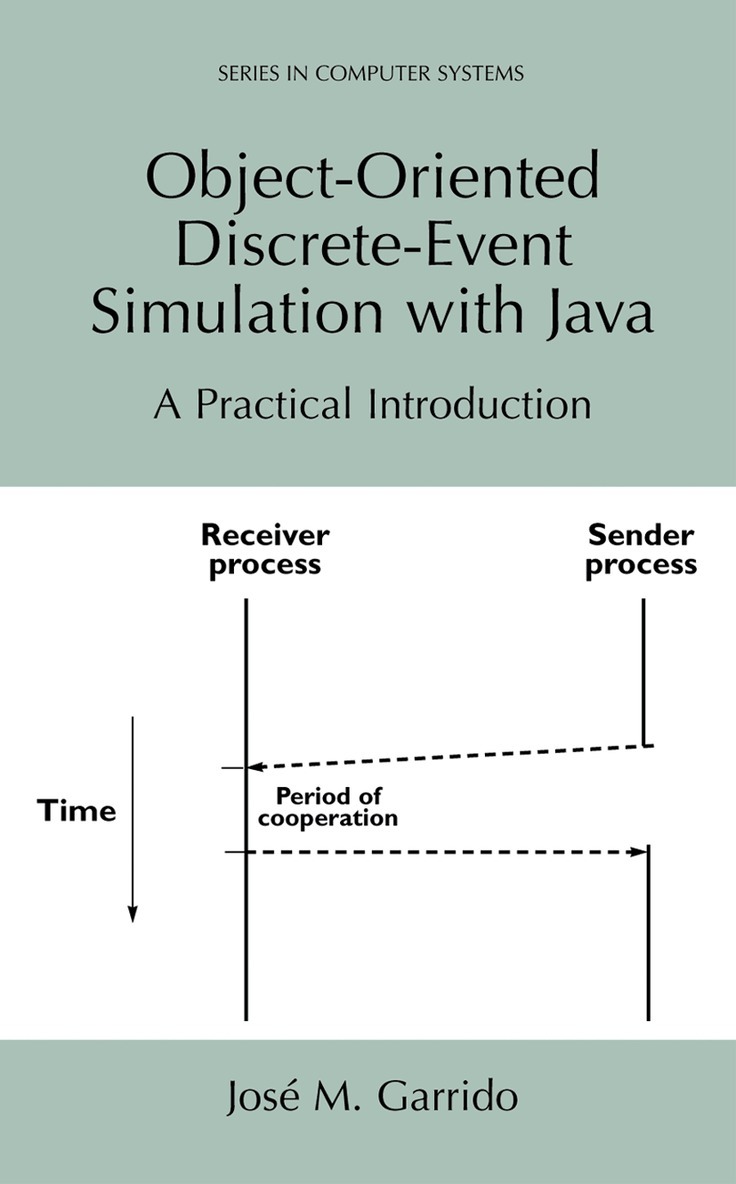
    Object-Oriented Discrete-Event Simulation with Java

    A Practical Introduction

    AvJosé M. Garrido

    Häftad, Engelska, 2013

    Del i serien Series in Computer Science

    1 619 kr

    Beställningsvara. Skickas inom 10-15 vardagar. Fri frakt över 249 kr.

    Fler format och utgåvor

    Inbunden

    1 668 kr

    E-bok

    2 044 kr

    Beskrivning

    Researches and developers of simulation models state that the Java program­ ming language presents a unique and significant opportunity for important changes in the way we develop simulation models today. The most important characteristics of the Java language that are advantageous for simulation are its multi-threading capabilities, its facilities for executing programs across the Web, and its graphics facilities. It is feasible to develop compatible and reusable simulation components that will facilitate the construction of newer and more complex models. This is possible with Java development environments. Another important trend that begun very recently is web-based simulation, i.e., and the execution of simulation models using Internet browser software. This book introduces the application of the Java programming language in discrete-event simulation. In addition, the fundamental concepts and prac­ tical simulation techniques for modeling different types of systems to study their general behavior and their performance are introduced. The approaches applied are the process interaction approach to discrete-event simulation and object-oriented modeling. Java is used as the implementation language and UML as the modeling language. The first offers several advantages compared to C++, the most important being: thread handling, graphical user interfaces (QUI) and Web computing. The second language, UML (Unified Modeling Language) is the standard notation used today for modeling systems as a collection of classes, class relationships, objects, and object behavior.

    Produktinformation

    • Utgivningsdatum:2013-04-19
    • Mått:155 x 235 x 16 mm
    • Vikt:423 g
    • Format:Häftad
    • Språk:Engelska
    • Serie:Series in Computer Science
    • Antal sidor:256
    • Förlag:Springer-Verlag New York Inc.
    • ISBN:9781461354956

    Utforska kategorier

    • Systemvetenskap och AI inom Data och IT
    • Programvaruutveckling inom Data och IT
    • Tillämpad matematik inom Naturvetenskap och teknik

    Innehållsförteckning

    • 1. Introduction to Simulation. 2. Objects, Classes and UML. 3. Relevant Aspects of the Java. 4. Discrete-Event Simulation. 5. Simulation with the Process Worldview. 6. Models of Multi-Server Systems. 7. Multi-Class Queuing Models. 8. Resources. 9. Basic Process Cooperation. 10. Synchronous Cooperation. 11. Conditional Waiting. 12. Interrupts. 13. More Simulation Models. 14. Basic Probability Theory and Random Numbers. 15. Overview of Model. Appendix A. Appendix B. About the Author. Index.