• Fri frakt över 249 kr
  • •
  • Snabba leveranser
  • •
  • Billiga böcker
Kundservice

Du är på sajten för privatpersoner.

Företag, bibliotek eller offentlig verksamhet?

Du handlar på classic.bokus.com, där alla dina funktioner finns intakta.
Till classic.bokus.com
Bokus logotyp. Gå till startsidan.
  • Erbjudanden
  • Nyheter
  • Student
  • Topplistor
  • Barn & ungdom
  • Bokus Play
  • E-böcker
  • Pocketböcker
  • Spel & pussel

10% rabatt på allt med kod NYSTART10 →

Sidfot

Mina sidor

    Hjälp

    • Kundservice
    • Vanliga frågor och svar
    • Frakt och leverans
    • Retur vid ångerrätt
    • Reklamera vara
    • Betalning
    • Köpvillkor
    • Allmänna villkor
    • Information om webbplatsens tillgänglighet

    Om Bokus

    • Om oss
    • Pressrum
    • För studenter
    • För företag
    • För bibliotek och offentlig verksamhet
    • För leverantörer
    • Hållbarhet

    Populärt

    • Aktuella erbjudanden
    • Presentkort
    • Studentlitteratur
    • Nya böcker
    • Topplistor
    • Signerade böcker
    • Engelska böcker

    Inspiration

    • Boktips
    • BookTok
    • Populära bokserier
    • Barnbokskaraktärer
    • Populära författare
    Logotyp för Bokus
    Följ oss på Facebook (extern länk)Följ oss på Instagram (extern länk)Följ oss på YouTube (extern länk)Följ oss på TikTok (extern länk)
    bokus @ CookiesAnpassa cookiesIntegritetspolicyKöpvillkor
    Till Citymail hemsida (extern länk)Till Budbee hemsida (extern länk)Till Postnord hemsida (extern länk)Till Schenker hemsida (extern länk)Till Early Bird hemsida (extern länk)Till Walleys hemsida (extern länk)
    1. Data och IT
    2. Systemvetenskap och AI

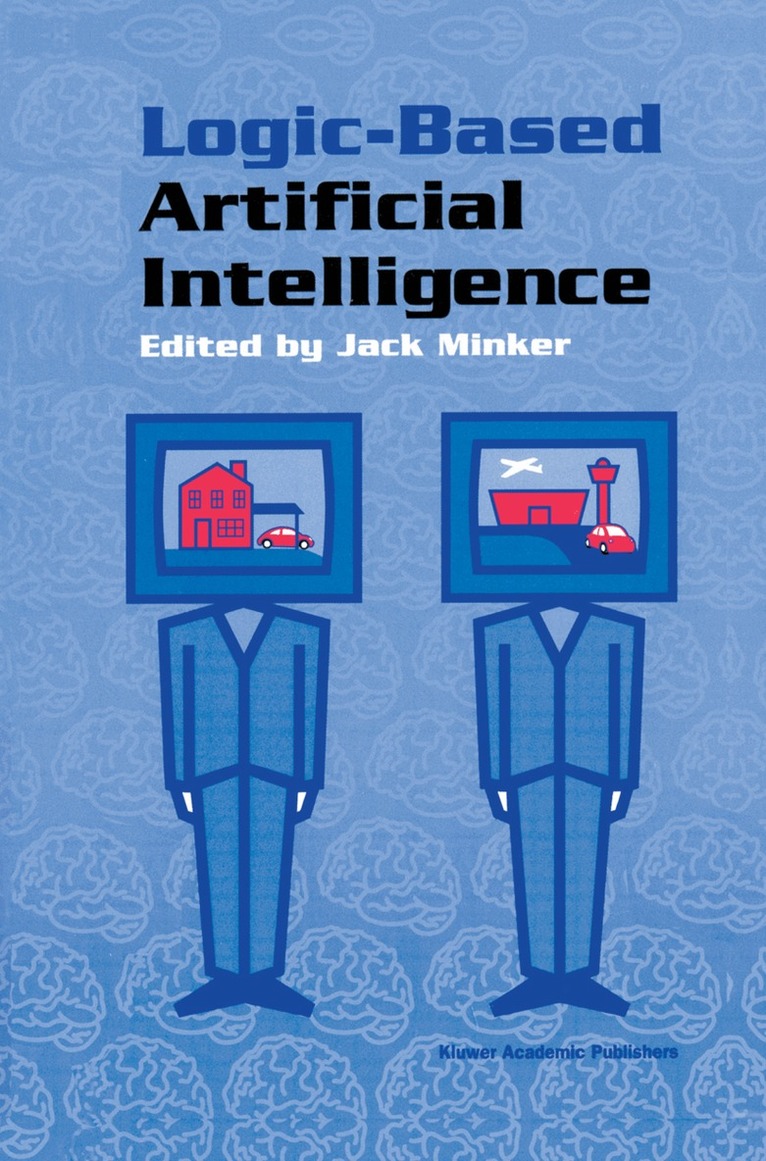
    Logic-Based Artificial Intelligence

    AvJack Minker

    Häftad, Engelska, 2012

    Del i serien Springer International Series in Engineering and Computer Science

    2 485 kr

    Beställningsvara. Skickas inom 10-15 vardagar. Fri frakt över 249 kr.

    Beskrivning

    The use of mathematical logic as a formalism for artificial intelligence was recognized by John McCarthy in 1959 in his paper on Programs with Common Sense. In a series of papers in the 1960's he expanded upon these ideas and continues to do so to this date. It is now 41 years since the idea of using a formal mechanism for AI arose. It is therefore appropriate to consider some of the research, applications and implementations that have resulted from this idea. In early 1995 John McCarthy suggested to me that we have a workshop on Logic-Based Artificial Intelligence (LBAI). In June 1999, the Workshop on Logic-Based Artificial Intelligence was held as a consequence of McCarthy's suggestion. The workshop came about with the support of Ephraim Glinert of the National Science Foundation (IIS-9S2013S), the American Association for Artificial Intelligence who provided support for graduate students to attend, and Joseph JaJa, Director of the University of Maryland Institute for Advanced Computer Studies who provided both manpower and financial support, and the Department of Computer Science. We are grateful for their support. This book consists of refereed papers based on presentations made at the Workshop. Not all of the Workshop participants were able to contribute papers for the book. The common theme of papers at the workshop and in this book is the use of logic as a formalism to solve problems in AI.
    Produktinformation

    • Utgivningsdatum:2012-11-09
    • Mått:155 x 235 x 34 mm
    • Vikt:943 g
    • Format:Häftad
    • Språk:Engelska
    • Serie:Springer International Series in Engineering and Computer Science
    • Antal sidor:606
    • Upplaga:2000
    • Förlag:Springer-Verlag New York Inc.
    • ISBN:9781461356189

    Utforska kategorier

    • Systemvetenskap och AI inom Data och IT
    • Artificiell intelligens inom Data och IT
    • Filosofiska discipliner inom Filosofi och religion

    Innehållsförteckning

    • I Introduction to Logic-Based Artificial Intelligence.- 1 Introduction to Logic-Based Artificial Intelligence.- II Commonsense Reasoning.- 2 Concepts of Logical AI.- III Knowledge Representation.- 3 Two Approaches to Efficient Open-World Reasoning.- 4 Declarative Problem-Solving in DLV.- IV Nonmonotonic Reasoning.- 5 The Role of Default Logic in Knowledge Representation.- 6 Approximations, stable operators, well-founded fixpoints and applications in nonmonotonic reasoning.- V Logic for Causation and Actions.- 7 Getting to the Airport: The Oldest Planning Problem in AI.- VI Planning and Problem Solving.- 8 Encoding Domain Knowledge for Propositional Planning.- 9 Functional Strips.- VII Logic, Planning and High Level Robotics.- 10 Planning with Natural Actions in the Situation Calculus.- 11 Reinventing Shakey.- VIII Logic for Agents and Actions.- 12 Reasoning Agents in Dynamic Domains.- 13 Dynamic Logic for Reasoning about Actions and Agents.- IX Inductive Reasoning.- 14 Logic-Based Machine Learning.- X Possibilistic Logic.- 15 Decision, Nonmonotonic Reasoning, Possibilistic Logic.- XI Logic and Beliefs.- 16 The Role(s) of Belief in AI.- 17 Modeling the Beliefs of Other Agents.- XII Logic and Language.- 18 The Situations We Talk about.- XIII Computational Logic.- 19 Linear Time Datalog and Branching Time Logic.- 20 On the Expressive Power of Planning Formalisms.- XIV Knowledge Base System Implementations.- 21 Extending the Smodels System with Cardinality and Weight Constraints.- 22 Nonmonotonic Reasoning in???.- XV Applications of Theorem Proving and Logic Programming.- 23 Towards a Mechanically Checked Theory of Computation.- 24 Logic-Based Techniques in Data Integration.