• Fri frakt över 249 kr
  • •
  • Snabba leveranser
  • •
  • Billiga böcker
Kundservice

Du är på sajten för privatpersoner.

Företag, bibliotek eller offentlig verksamhet?

Du handlar på classic.bokus.com, där alla dina funktioner finns intakta.
Till classic.bokus.com
Bokus logotyp. Gå till startsidan.
  • Erbjudanden
  • Nyheter
  • Student
  • Topplistor
  • Barn & ungdom
  • Bokus Play
  • E-böcker
  • Pocketböcker
  • Spel & pussel

10% rabatt på allt med kod: NYSTART10 →

Sidfot

Mina sidor

    Hjälp

    • Kundservice
    • Vanliga frågor och svar
    • Frakt och leverans
    • Retur vid ångerrätt
    • Reklamera vara
    • Betalning
    • Köpvillkor
    • Allmänna villkor
    • Information om webbplatsens tillgänglighet

    Om Bokus

    • Om oss
    • Pressrum
    • För studenter
    • För företag
    • För bibliotek och offentlig verksamhet
    • För leverantörer
    • Hållbarhet

    Populärt

    • Aktuella erbjudanden
    • Presentkort
    • Studentlitteratur
    • Nya böcker
    • Topplistor
    • Signerade böcker
    • Engelska böcker

    Inspiration

    • Boktips
    • BookTok
    • Populära bokserier
    • Barnbokskaraktärer
    • Populära författare
    Logotyp för Bokus
    Följ oss på Facebook (extern länk)Följ oss på Instagram (extern länk)Följ oss på YouTube (extern länk)Följ oss på TikTok (extern länk)
    bokus @ CookiesAnpassa cookiesIntegritetspolicyKöpvillkor
    Till Citymail hemsida (extern länk)Till Budbee hemsida (extern länk)Till Postnord hemsida (extern länk)Till Schenker hemsida (extern länk)Till Early Bird hemsida (extern länk)Till Walleys hemsida (extern länk)
    1. Medicin
    2. Klinisk medicin och internmedicin
    3. Sjukdomar och rubbningar
    4. Onkologi

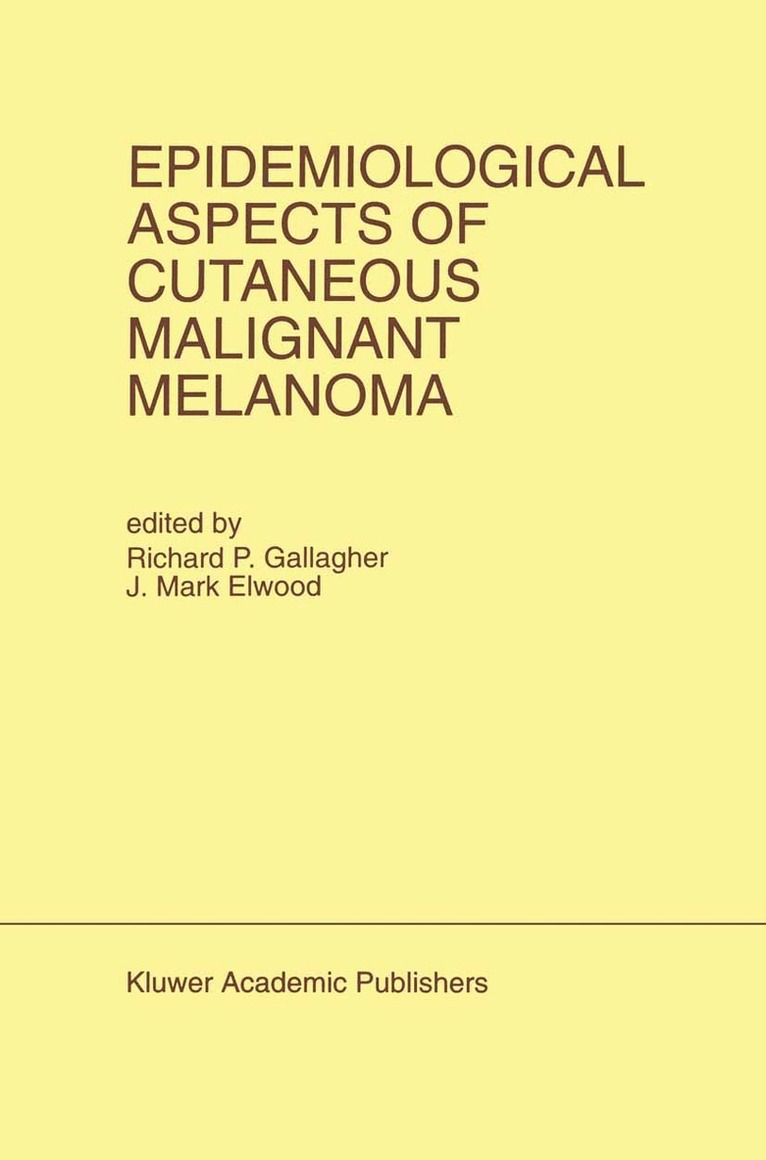
    Epidemiological Aspects of Cutaneous Malignant Melanoma

    AvRichard P. Gallagher,J. Mark Elwood

    Häftad, Engelska, 2012

    Del i serien Developments in Oncology

    1 119 kr

    Beställningsvara. Skickas inom 10-15 vardagar. Fri frakt över 249 kr.

    Beskrivning

    Significant progress has been made in recent years in understanding the origins of cutaneous maligant melanoma. Knowledge of the relationship between solar radiation and melanoma has changed and it now appears that both the character and timing of exposure may be more important than total cumulative dose in accounting for risk. The melanoma-sunlight model may prove an instructive heuristic exercise for environmental epidemiology, as we currently tend to restrict ourselves to a search for uniform total dose--response relationships between cancers and suspected environmental carcinogens. The study of the relationship between acquired melanocytic nevi and melanoma has led to useful new information about predictors of melanoma risk, and in addition has opened new perspectives on the development of nevi in children. Definition of the factors for nevus development in children may lead to the possibility of primary prevention programs for melanoma in younger generations of children. Recent new evidence suggests that certain occupational groups may be at elevated risk of melanoma. A great deal of work is going into the study of ways of screening high risk populations in order to detect melanoma at its earliest stages when current treatment protocols are most effective. The visibility of lesions on the skin challenges classical definitions of early detection and screening in epidemiology.

    Produktinformation

    • Utgivningsdatum:2012-10-10
    • Mått:155 x 235 x 19 mm
    • Vikt:528 g
    • Format:Häftad
    • Språk:Engelska
    • Serie:Developments in Oncology
    • Antal sidor:329
    • Förlag:Springer-Verlag New York Inc.
    • ISBN:9781461361268

    Utforska kategorier

    • Onkologi inom Medicin
    • Epidemiologi och medicinsk statistik inom Medicin
    • Dermatologi inom Medicin

    Innehållsförteckning

    • I. Recent Progress in Melanoma Research.- 1. Recent progress in the epidemiology of malignant melanoma..- II. Solar and Artificial Ultraviolet Radiation and Melanoma.- 2. Sun exposure and the epidemiology of malignant melanoma..- 3. Etiological clues from the anatomical distribution of cutaneous melanoma..- 4. Tables of ambient solar ultraviolet radiation for use in epidemiological studies of malignant melanoma..- 5. Non-solar sources of ultraviolet radiation and cutaneous malignant melanoma: a review of the evidence.- III. Nevi and Melanoma.- 6. Risk factors for prevalence of nevi: a review..- 7. The atypical mole syndrome - a definition of phenotype.- 8. Risk of cutaneous melanoma by number of melanocytic nevi and correlation of nevi by anatomic site.- IV. Occupation and Melanoma.- 9. Malignant melanoma of the skin in the telecommunications industry.- 10. Petroleum refinery exposure and risk of malignant melanoma.- 11. Methods for evaluating confounding and effect modification in a small occupational study of cutaneous malignant melanoma.- V. Pregnancy and Hormonal Factors and Melanoma.- 12. Melanoma and pregnancy.- 13. Cutaneous melanoma and oral contraceptives.- VI. Diet and Melanoma.- 14. Epidemiology of diet and melanoma incidence - a brief review.- 15. Dietary and other correlates of melanoma in Hawaii: preliminary findings.- VII Prevention and Early Detection of Melanoma.- 16. Early detection and lethal melanoma in Connecticut: a preliminary analysis.- 17. Risk factors for presentation with thick primary melanoma include older age, male sex, smoking, and may include occupation in certain industries.- 18. Skin cancer screening in Massachusetts: the program and methodologic questions.- VIII. Future Directions in Melanoma Research.- 19. The epidemiology of melanoma: where do we go from here?.- Index Page.