• Fri frakt över 249 kr
  • •
  • Snabba leveranser
  • •
  • Billiga böcker
Kundservice

Du är på sajten för privatpersoner.

Företag, bibliotek eller offentlig verksamhet?

Du handlar på classic.bokus.com, där alla dina funktioner finns intakta.
Till classic.bokus.com
Bokus logotyp. Gå till startsidan.
  • Erbjudanden
  • Nyheter
  • Student
  • Topplistor
  • Barn & ungdom
  • Bokus Play
  • E-böcker
  • Pocketböcker
  • Spel & pussel

10% rabatt på allt med kod: NYSTART10 →

Sidfot

Mina sidor

    Hjälp

    • Kundservice
    • Vanliga frågor och svar
    • Frakt och leverans
    • Retur vid ångerrätt
    • Reklamera vara
    • Betalning
    • Köpvillkor
    • Allmänna villkor
    • Information om webbplatsens tillgänglighet

    Om Bokus

    • Om oss
    • Pressrum
    • För studenter
    • För företag
    • För bibliotek och offentlig verksamhet
    • För leverantörer
    • Hållbarhet

    Populärt

    • Aktuella erbjudanden
    • Presentkort
    • Studentlitteratur
    • Nya böcker
    • Topplistor
    • Signerade böcker
    • Engelska böcker

    Inspiration

    • Boktips
    • BookTok
    • Populära bokserier
    • Barnbokskaraktärer
    • Populära författare
    Logotyp för Bokus
    Följ oss på Facebook (extern länk)Följ oss på Instagram (extern länk)Följ oss på YouTube (extern länk)Följ oss på TikTok (extern länk)
    bokus @ CookiesAnpassa cookiesIntegritetspolicyKöpvillkor
    Till Citymail hemsida (extern länk)Till Budbee hemsida (extern länk)Till Postnord hemsida (extern länk)Till Schenker hemsida (extern länk)Till Early Bird hemsida (extern länk)Till Walleys hemsida (extern länk)
    1. Naturvetenskap och teknik
    2. Matematik och naturvetenskap
    3. Biologi
    4. Biovetenskap

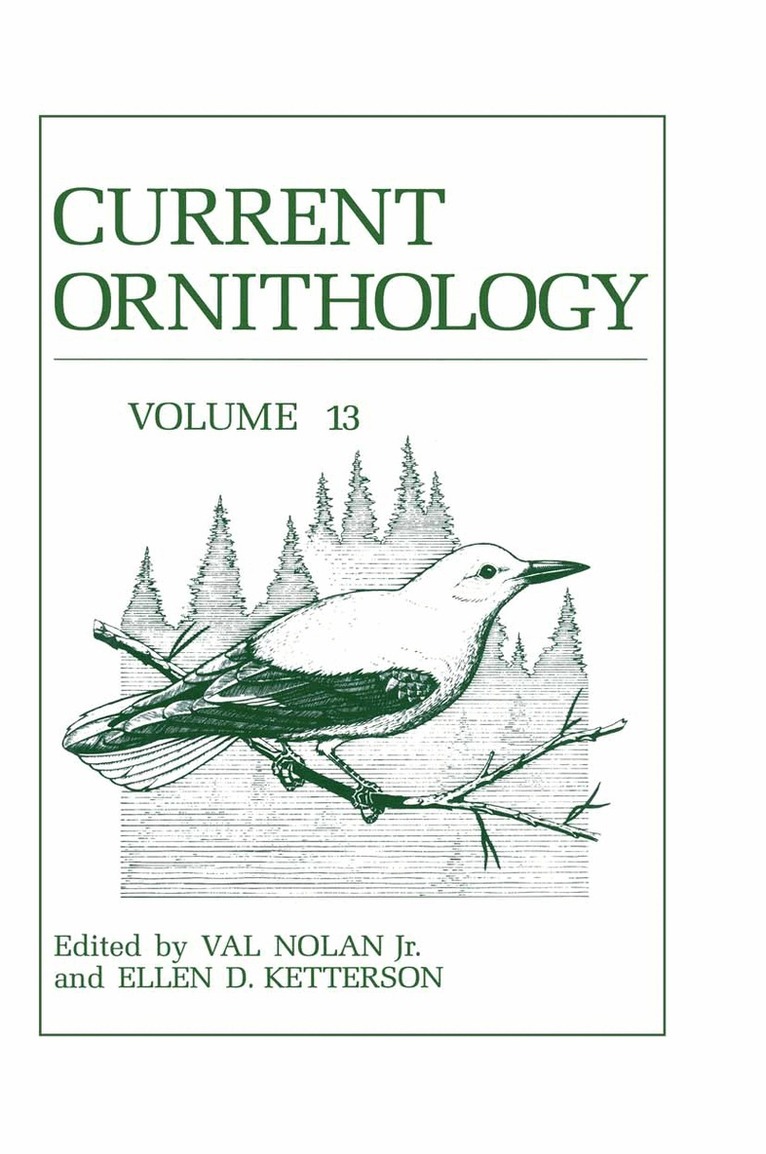
    Current Ornithology

    AvVal Nolan Jr.,Ellen D. Ketterson

    Häftad, Engelska, 2012

    Del 13 i serien Current Ornithology

    547 kr

    Beställningsvara. Skickas inom 10-15 vardagar. Fri frakt över 249 kr.

    Beskrivning

    As we assume the editorship of Current Ornithology, it seems useful to review the objectives of the series. We cannot improve on the state­ ments of our predecessors when they began their service as editors. In his preface to Volume 1 (1983), Richard F. Johnston wrote: The appearance of the first volume of a projected series is the occasion for comment on scope, aims, and genesis of the work. The scope of Current Or­ nithology is all of the biology of birds. Ornithology, as a whole-organism sci­ ence, is concerned with birds at every level of biological organization, from the molecular to the community, at least from the Jurassic to the present time, and over every scholarly discipline in which bird biology is done; to say this is merely to expand a dictionary definition of "ornithology. " The aim of the work, to be realized over several volumes, is to present reviews or position statements concerning the active fields of ornithological research. Dennis M. Power, who edited Volumes 6-12 (1989-1995), began his preface to Volume 6 (1989) as follows: This edited series has three principal goals. The first is to provide information in a relatively concise way for researchers needing an overview of specific disciplines. The second is to provide an update on specific schools of thought, bringing together ideas from colleagues whose works often appear in a variety of journals. And the third is to stimul&te and suggest directions for new re­ search.

    Produktinformation

    • Utgivningsdatum:2012-10-21
    • Mått:152 x 229 x 21 mm
    • Vikt:544 g
    • Format:Häftad
    • Språk:Engelska
    • Serie:Current Ornithology
    • Antal sidor:359
    • Upplaga:1996
    • Förlag:Springer-Verlag New York Inc.
    • ISBN:9781461376972

    Utforska kategorier

    • Biovetenskap inom Naturvetenskap och teknik
    • Zoologi inom Naturvetenskap och teknik
    • Djurböcker inom Djur och Natur

    Recensioner i media

    ' The Quality of the individual papers...[is] decidedly above average...I do suggest that university libraries buy this useful series.' Animal Behavior, 12. ' The discussions provided allow the beginner to quickly come up to speed in specific areas...For more experienced readers they provide new viewpoints, corrections of misconceptions, and a means of checking what we think we already know.' The Wilson Bulletin, 11.

    Innehållsförteckning

    • 1 Social Cognition: Are Primates Smarter Than Birds?.- 1. Preamble.- 2. Introduction.- 3. Social Learning: The Acquisition of New Stimulus Controls for Behavior.- 4. Social Learning. The Acquisition of New Motor Patterns.- 5. Tool Use and Its Acquisition.- 6. Cooperative Hunting.- 7. Complex Social Cognition.- 8. Communicative Behavior.- 9. Conclusions.- References.- 2 Predicting Cognitive Capacity from Natural History: Examples from four Species of Corvids.- 1. Introduction.- 2. General Problems and Approach.- 3. The Study of Cognitive Adaptations.- 4. The Comparative Study of Cognition.- 5. General Issues.- 6. Phylogenetic Considerations.- 7. Ontogenetic Considerations.- 8. Summary.- References.- 3 Assessing Body Condition in Birds.- 1. Introduction.- 2. Literature Survey of Body Condition Research.- 3. Methods of Assessing Condition.- 4. Conclusions.- Appendix: Literature Survey Summary.- References.- 4 Avian Chemical Defense.- 1. Introduction.- 2. Definitions and Overview.- 3. Chemical Defenses in Birds.- 4. Sources of Defensive Chemicals.- 5. Ecology of Chemical Defense.- 6. Evolution of Chemical Defense.- 7. Phenomena Related to Chemical Defense.- 8. Summary.- References.- 5 Past and Current Attempts to Evaluate the Role of Birds as Predators of Insect Pests in Temperate Agriculture.- 1. Introduction.- 2. Setting the Stage—A Brief History of the Rise and Decline of “Economic Ornithology”.- 3. Birds as Predators of Pests.- 4. Factors Determining the Impact of Predation on Invertebrates by Birds.- 5. Encouraging Avian Predators in Agroecosystems.- 6. Summary and Conclusions.- References.- 6 An Evolutionary Approach to Offspring Desertion in Birds.- 1. Introduction.- 2. Distribution of Offspring Desertion.- 3. Models of Desertion.- 4. Desertion and ParentalCare.- 5. Timing of Desertion.- 6. Sex of Deserter.- 7. The Process of Desertion.- 8. Hormonal Mechanisms.- 9. Recommendations for Future Research.- 10. Summary.- References.