• Fri frakt över 249 kr
  • •
  • Snabba leveranser
  • •
  • Billiga böcker
Kundservice

Du är på sajten för privatpersoner.

Företag, bibliotek eller offentlig verksamhet?

Du handlar på classic.bokus.com, där alla dina funktioner finns intakta.
Till classic.bokus.com
Bokus logotyp. Gå till startsidan.
  • Erbjudanden
  • Nyheter
  • Student
  • Topplistor
  • Barn & ungdom
  • Bokus Play
  • E-böcker
  • Pocketböcker
  • Spel & pussel

10% rabatt på allt med kod NYSTART10 →

Sidfot

Mina sidor

    Hjälp

    • Kundservice
    • Vanliga frågor och svar
    • Frakt och leverans
    • Retur vid ångerrätt
    • Reklamera vara
    • Betalning
    • Köpvillkor
    • Allmänna villkor
    • Information om webbplatsens tillgänglighet

    Om Bokus

    • Om oss
    • Pressrum
    • För studenter
    • För företag
    • För bibliotek och offentlig verksamhet
    • För leverantörer
    • Hållbarhet

    Populärt

    • Aktuella erbjudanden
    • Presentkort
    • Studentlitteratur
    • Nya böcker
    • Topplistor
    • Signerade böcker
    • Engelska böcker

    Inspiration

    • Boktips
    • BookTok
    • Populära bokserier
    • Barnbokskaraktärer
    • Populära författare
    Logotyp för Bokus
    Följ oss på Facebook (extern länk)Följ oss på Instagram (extern länk)Följ oss på YouTube (extern länk)Följ oss på TikTok (extern länk)
    bokus @ CookiesAnpassa cookiesIntegritetspolicyKöpvillkor
    Till Citymail hemsida (extern länk)Till Budbee hemsida (extern länk)Till Postnord hemsida (extern länk)Till Schenker hemsida (extern länk)Till Early Bird hemsida (extern länk)Till Walleys hemsida (extern länk)
    1. Naturvetenskap och teknik
    2. Matematik och naturvetenskap
    3. Matematik
    4. Matematisk statistik

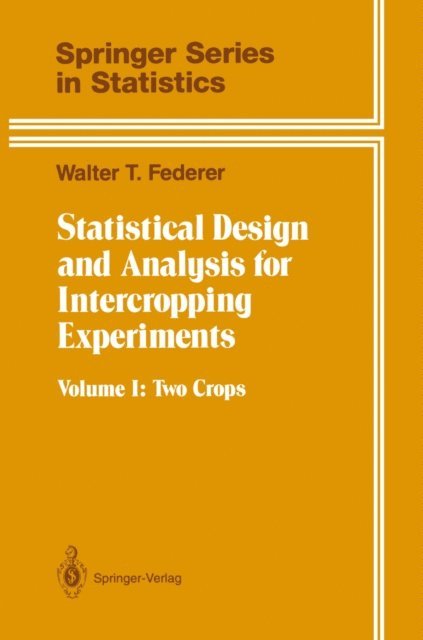
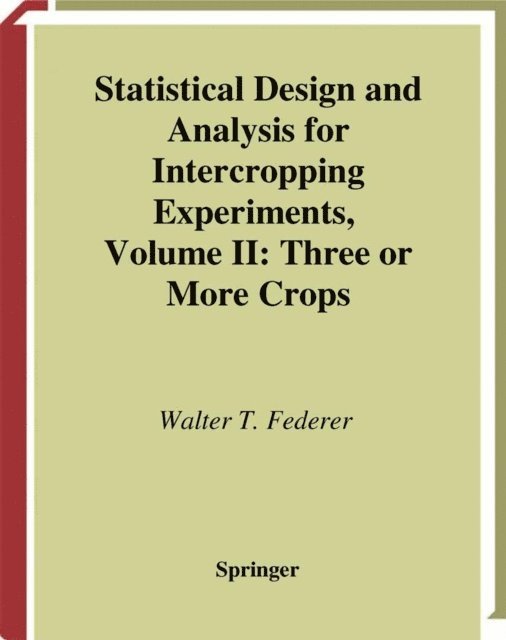
    Statistical Design and Analysis for Intercropping Experiments

    Volume 1: Two Crops

    AvWalter T. Federer

    Häftad, Engelska, 2011

    Del i serien Springer Series in Statistics

    546 kr

    Beställningsvara. Skickas inom 10-15 vardagar. Fri frakt över 249 kr.

    Fler format och utgåvor

    E-bok

    712 kr

    E-bok

    710 kr

    Häftad

    546 kr

    Beskrivning

    Intercropping is a method of sustaining or improving soil structure by growing two or more crops on the same field. It is a technique of wide application and of growing importance for both commercial and subsistence farmers. This textbook provides a comprehensive survey of the design and analysis of intercropping experiments. Its main themes are that techniques such as relative indices make it possible to cover a wide variety of conditions, and that statistical models for density-yield relations enable recommendations to be made to growers of crops. As a result, graduate students and researchers in statistics, biometry, and agriculture whose study involves intercropping will find this an invaluable text and reference.

    Produktinformation

    • Utgivningsdatum:2011-10-12
    • Mått:155 x 235 x 18 mm
    • Vikt:493 g
    • Format:Häftad
    • Språk:Engelska
    • Serie:Springer Series in Statistics
    • Antal sidor:298
    • Förlag:Springer-Verlag New York Inc.
    • ISBN:9781461393078

    Utforska kategorier

    • Matematisk statistik inom Naturvetenskap och teknik
    • Matematik inom Naturvetenskap och teknik
    • Agronomi inom Naturvetenskap och teknik

    Innehållsförteckning

    • 1 Introduction and Definitions.- 1.1. Introduction and Objectives.- 1.2. Statistical Design.- 1.3. Types of Treatment.- 1.4. Treatment Designs in Category 4 for Intercropping Experiments.- 1.5. Some Statistical Problems Associated with Response Model Equations, Statistical Analyses, and Inferences.- 1.6. Some Concepts and Definitions.- 1.7. Literature Cited.- 2 One Main Crop Grown with a Supplementary Crop.- 2.1. Objectives and Introduction.- 2.2. Some Examples of Main Crops Grown with a Supplemental Crop.- 2.3. Statistical Designs and Univariate Analyses of Main Crop Yields for Experiments on Main and Supplemental Crops.- 2.4. Some Additional Statistical Analyses for Yields of Main Crop Intercropped with a Supplemental Crop.- 2.5. Multivariate Analyses for a Main Crop Grown with Supplemental Crops and Grown as a Sole Crop.- 2.6. Summary and Discussion.- 2.7. Problems.- 2.8. Literature Cited.- 3 Both Crops Main Crops—Density Constant—Analyses for Each Crop Separately.- 3.1. Objectives and Introduction.- 3.2. Treatment and Experiment Designs.- 3.3. Univariate Analyses on Observed Variables for Each of the Two Main Crops.- 3.4. Multivariate Analyses on a Vector of Observed Variables of One Crop.- 3.5. Summary and Discussion.- 3.6. Problems.- 3.7. Literature Cited.- 4 Both Crops Main Crops—Density Constant—Combined Crop Responses.- 4.1. Objectives and Introduction.- 4.2. Univariate Analyses on Functions of Combined Variables of Both Crops.- 4.3. Land Equivalent Ratio or Relative Yield Total.- 4.4. Multivariate Analysis on an Observation Vector of the Intercropping Systems.- 4.5. Effect of Varying Proportions on Created Functions.- 4.6. Summary and Discussion.- 4.7. Problems.- 4.8. Literature Cited.- Appendix 4.1.- 5 Both Crops of Major Interest with VaryingDensities.- 5.1. Objectives and Introduction.- 5.2. Treatment Design and Statistical Analysis for Comparisons Among Density Combinations for Individual Crop Responses.- 5.3. Statistical Analyses for Responses from Both Crops for a Single Pair of Crops at Varying Densities.- 5.4. Models and Analyses for Monocultures and Mixtures of Two Crops over a Range of Densities.- 5.5. Analyses for c1 Lines of Crop 1 and c2 Lines of Crop 2.- 5.6. Summary and Discussion.- 5.7. Problems.- 5.8. Literature Cited.- Appendix 5.1. Derivation of Parameter Estimates and Their Variances Using a Generalized Least Squares Method for the Linear Model of Section 5.4 (Prepared by Anila Wijesinha).- Appendix 5.2. Distribution of Estimators and Hypothesis Tests (Prepared by Anila Wijesinha).- 6 Monocultures and Their Pairwise Combinations when Responses Are Available for Each Member of the Combination.- 6.1. Introduction.- 6.2. Treatment Design.- 6.3. A Response Model and Some Statistical Analyses.- 6.4. Summary and Discussion.- 6.5. Problems.- 6.6. Literature Cited.- Appendix 6.1.- Appendix 6.2.- 7 Monocultures and Their Pairwise Combinations when Separate Crop Responses Are Not Available.- 7.1. Introduction.- 7.2. Treatment Designs.- 7.3. Response Model Equations and Some Statistical Analyses.- 7.4. Response Models for a Crop Competition Experiment.- 7.5. Summary and Discussion.- 7.6. Problems.- 7.7. Literature Cited.- Appendix 7.1. Derivation of Solutions for Response Model for Design 3.- Appendix 7.2. Derivation of Solutions and Variances for Model 4, Example 7.5.- 8 Spatial and Density Arrangements.- 8.1. Introduction.- 8.2. Spatial Arrangements—Density Constant.- 8.3. Spatial Arrangements—Density Variable.- 8.4. Statistical Analyses for the Arrangements in Section 8.3.- 8.5. Summary andDiscussion.- 8.6. Problems.- 8.7. Literature Cited.- 9 Some Analytical Variations for Intercropping Studies.- 9.1. Introduction.- 9.2. Replacement Series.- 9.3. Other Indices.- 9.4. Linear Programming.- 9.5. Summary and Discussion.- 9.6. Problems.- 9.7. Literature Cited.- 10 Experiment Designs for Intercropping Experiments.- 10.1. Introduction.- 10.2. Principles of Design of Experiments.- 10.3. Zero-Way Elimination of Heterogeneity.- 10.4. One-Way Elimination of Heterogeneity.- 10.5. Two-Way Elimination of Heterogeneity.- 10.6. Split Plot and Split Block Designs.- 10.7. More Complex Experiment Designs.- 10.8. Plot Technique.- 10.9. Stability Concepts and Parsimonious Experiment Design.- 10.10. Problems.- 10.11. Literature Cited.