• Fri frakt över 249 kr
  • •
  • Snabba leveranser
  • •
  • Billiga böcker
Kundservice

Du är på sajten för privatpersoner.

Företag, bibliotek eller offentlig verksamhet?

Du handlar på classic.bokus.com, där alla dina funktioner finns intakta.
Till classic.bokus.com
Bokus logotyp. Gå till startsidan.
  • Erbjudanden
  • Nyheter
  • Student
  • Topplistor
  • Barn & ungdom
  • Bokus Play
  • E-böcker
  • Pocketböcker
  • Spel & pussel

10% rabatt på allt med kod NYSTART10 →

Sidfot

Mina sidor

    Hjälp

    • Kundservice
    • Vanliga frågor och svar
    • Frakt och leverans
    • Retur vid ångerrätt
    • Reklamera vara
    • Betalning
    • Köpvillkor
    • Allmänna villkor
    • Information om webbplatsens tillgänglighet

    Om Bokus

    • Om oss
    • Pressrum
    • För studenter
    • För företag
    • För bibliotek och offentlig verksamhet
    • För leverantörer
    • Hållbarhet

    Populärt

    • Aktuella erbjudanden
    • Presentkort
    • Studentlitteratur
    • Nya böcker
    • Topplistor
    • Signerade böcker
    • Engelska böcker

    Inspiration

    • Boktips
    • BookTok
    • Populära bokserier
    • Barnbokskaraktärer
    • Populära författare
    Logotyp för Bokus
    Följ oss på Facebook (extern länk)Följ oss på Instagram (extern länk)Följ oss på YouTube (extern länk)Följ oss på TikTok (extern länk)
    bokus @ CookiesAnpassa cookiesIntegritetspolicyKöpvillkor
    Till Citymail hemsida (extern länk)Till Budbee hemsida (extern länk)Till Postnord hemsida (extern länk)Till Schenker hemsida (extern länk)Till Early Bird hemsida (extern länk)Till Walleys hemsida (extern länk)
    1. Naturvetenskap och teknik
    2. Matematik och naturvetenskap
    3. Matematik
    4. Tillämpad matematik

    Introduction to Statistical Inference

    AvJack C. Kiefer,Gary Lorden

    Häftad, Engelska, 2011

    Del i serien Springer Texts in Statistics

    870 kr

    Beställningsvara. Skickas inom 10-15 vardagar. Fri frakt över 249 kr.

    Fler format och utgåvor

    E-bok

    1 108 kr

    Beskrivning

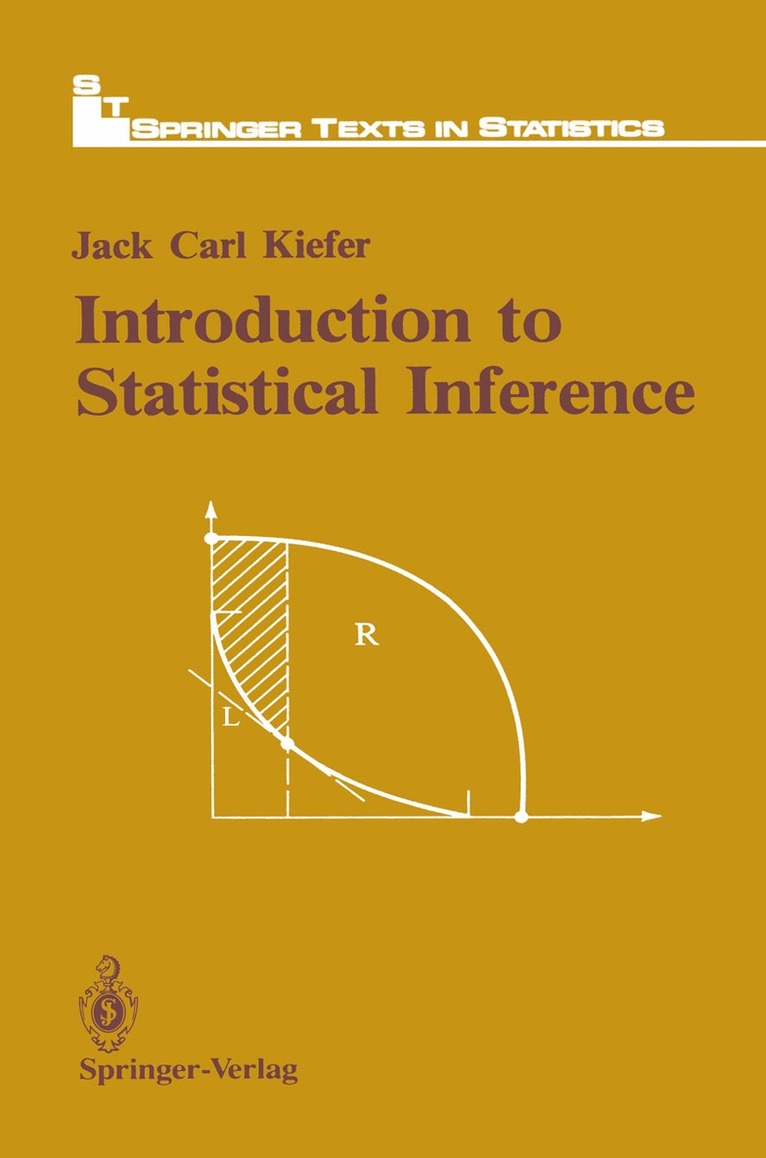
    This book is based upon lecture notes developed by Jack Kiefer for a course in statistical inference he taught at Cornell University. The notes were distributed to the class in lieu of a textbook, and the problems were used for homework assignments. Relying only on modest prerequisites of probability theory and cal­ culus, Kiefer's approach to a first course in statistics is to present the central ideas of the modem mathematical theory with a minimum of fuss and formality. He is able to do this by using a rich mixture of examples, pictures, and math­ ematical derivations to complement a clear and logical discussion of the important ideas in plain English. The straightforwardness of Kiefer's presentation is remarkable in view of the sophistication and depth of his examination of the major theme: How should an intelligent person formulate a statistical problem and choose a statistical procedure to apply to it? Kiefer's view, in the same spirit as Neyman and Wald, is that one should try to assess the consequences of a statistical choice in some quan­ titative (frequentist) formulation and ought to choose a course of action that is verifiably optimal (or nearly so) without regard to the perceived "attractiveness" of certain dogmas and methods.

    Produktinformation

    • Utgivningsdatum:2011-12-16
    • Mått:155 x 235 x 19 mm
    • Vikt:528 g
    • Format:Häftad
    • Språk:Engelska
    • Serie:Springer Texts in Statistics
    • Antal sidor:334
    • Förlag:Springer-Verlag New York Inc.
    • ISBN:9781461395805

    Utforska kategorier

    • Tillämpad matematik inom Naturvetenskap och teknik

    Innehållsförteckning

    • 1 Introduction to Statistical Inference.- 2 Specification of a Statistical Problem.- 2.1 Additional Remarks on the Loss Function.- 3 Classifications of Statistical Problems.- 4 Some Criteria for Choosing a Procedure.- 4.1 The Bayes Criterion.- 4.2 Minimax Criterion.- 4.3 Randomized Statistical Procedures.- 4.4 Admissibility: The Geometry of Risk Points.- 4.5 Computation of Minimax Procedures.- 4.6 Unbiased Estimation.- 4.7 The Method of Maximum Likelihood.- 4.8 Sample Functionals: The Method of Moments.- 4.9 Other Criteria.- 5 Linear Unbiased Estimation.- 5.1 Linear Unbiased Estimation in Simple Settings.- 5.2 General Linear Models: The Method of Least Squares.- 5.3 Orthogonalization.- 5.4 Analysis of the General Linear Model.- 6 Sufficiency.- 6.1 On the Meaning of Sufficiency.- 6.2 Recognizing Sufficient Statistics.- 6.3 Reconstruction of the Sample.- 6.4 Sufficiency: “No Loss of Information”.- 6.5 Convex Loss.- 7 Point Estimation.- 7.1 Completeness and Unbiasedness.- 7.2 The “Information Inequality”.- 7.3 Invariance.- 7.4 Computation of Minimax Procedures (Continued).- 7.5 The Method of Maximum Likelihood.- 7.6 Asymptotic Theory.- 8 Hypothesis Testing.- 8.1 Introductory Notions.- 8.2 Testing Between Simple Hypotheses.- 8.3 Composite Hypotheses: UMP Tests; Unbiased Tests.- 8.4 Likelihood Ratio (LR) Tests.- 8.5 Problems Where n Is to Be Found.- 8.6 Invariance.- 8.7 Summary of Common “Normal Theory” Tests.- 9 Confidence Intervals.- Appendix A Some Notation, Terminology, and Background Material.- Appendix B Conditional Probability and Expectation, Bayes Computations.- Appendix C Some Inequalities and Some Minimization Methods.- C.1 Inequalities.- C.2 Methods of Minimization.- References.