• Fri frakt över 249 kr
  • •
  • Snabba leveranser
  • •
  • Billiga böcker
Kundservice

Du är på sajten för privatpersoner.

Företag, bibliotek eller offentlig verksamhet?

Du handlar på classic.bokus.com, där alla dina funktioner finns intakta.
Till classic.bokus.com
Bokus logotyp. Gå till startsidan.
  • Erbjudanden
  • Nyheter
  • Student
  • Topplistor
  • Barn & ungdom
  • Bokus Play
  • E-böcker
  • Pocketböcker
  • Spel & pussel

10% rabatt på allt med kod: NYSTART10 →

Sidfot

Mina sidor

    Hjälp

    • Kundservice
    • Vanliga frågor och svar
    • Frakt och leverans
    • Retur vid ångerrätt
    • Reklamera vara
    • Betalning
    • Köpvillkor
    • Allmänna villkor
    • Information om webbplatsens tillgänglighet

    Om Bokus

    • Om oss
    • Pressrum
    • För studenter
    • För företag
    • För bibliotek och offentlig verksamhet
    • För leverantörer
    • Hållbarhet

    Populärt

    • Aktuella erbjudanden
    • Presentkort
    • Studentlitteratur
    • Nya böcker
    • Topplistor
    • Signerade böcker
    • Engelska böcker

    Inspiration

    • Boktips
    • BookTok
    • Populära bokserier
    • Barnbokskaraktärer
    • Populära författare
    Logotyp för Bokus
    Följ oss på Facebook (extern länk)Följ oss på Instagram (extern länk)Följ oss på YouTube (extern länk)Följ oss på TikTok (extern länk)
    bokus @ CookiesAnpassa cookiesIntegritetspolicyKöpvillkor
    Till Citymail hemsida (extern länk)Till Budbee hemsida (extern länk)Till Postnord hemsida (extern länk)Till Schenker hemsida (extern länk)Till Early Bird hemsida (extern länk)Till Walleys hemsida (extern länk)
    1. Historia och arkeologi
    2. Arkeologi

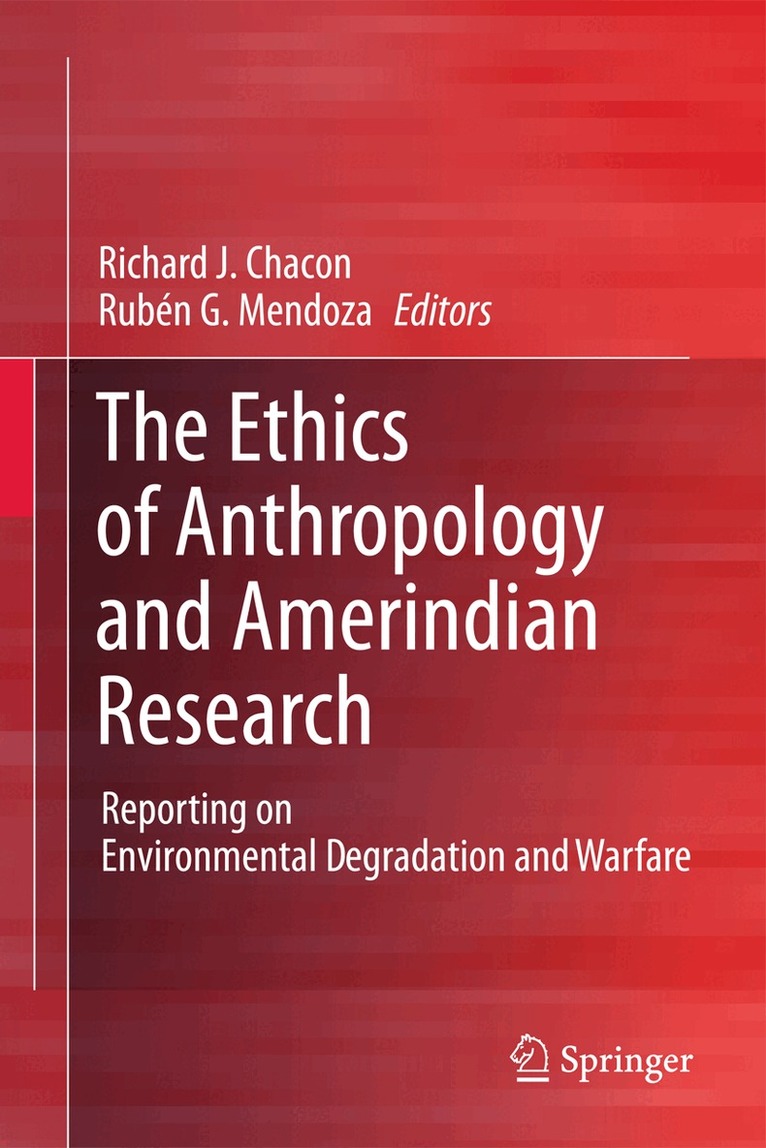
    Ethics of Anthropology and Amerindian Research

    Reporting on Environmental Degradation and Warfare

    AvRichard J. Chacon,Rubén G. Mendoza

    Inbunden, Engelska, 2011

    1 674 kr

    Beställningsvara. Skickas inom 10-15 vardagar. Fri frakt över 249 kr.

    Beskrivning

    The decision to publish scholarly findings bearing on the question of Amerindian environmental degradation, warfare, and/or violence is one that weighs heavily on anthropologists. This burden stems from the fact that documentation of this may render descendant communities vulnerable to a host of predatory agendas and hostile modern forces. Consequently, some anthropologists and community advocates alike argue that such culturally and socially sensitive, and thereby, politically volatile information regarding Amerindian-induced environmental degradation and warfare should not be reported. This admonition presents a conundrum for anthropologists and other social scientists employed in the academy or who work at the behest of tribal entities.This work documents the various ethical dilemmas that confront anthropologists, and researchers in general, when investigating Amerindian communities. The contributions to this volume explore the ramifications of reporting--and, specifically,--of non-reporting instances of environmental degradation and warfare among Amerindians. Collectively, the contributions in this volume, which extend across the disciplines of archaeology, anthropology, ethnohistory, ethnic studies, philosophy, and medicine, argue that the non-reporting of environmental mismanagement and violence in Amerindian communities generally harms not only the field of anthropology but the Amerindian populations themselves.

    Produktinformation

    • Utgivningsdatum:2011-12-14
    • Mått:155 x 235 x 32 mm
    • Vikt:969 g
    • Format:Inbunden
    • Språk:Engelska
    • Antal sidor:524
    • Upplaga:2012
    • Förlag:Springer-Verlag New York Inc.
    • ISBN:9781461410645

    Utforska kategorier

    • Arkeologi inom Historia och arkeologi
    • Antropologi inom Samhälle och politik
    • Etnicitet inom Samhälle och politik

    Mer om författaren

    Dr. Richard John Chacon is an associate professor of Anthropology in the Department of Sociology and Anthropology at Winthrop University. His research interests include human behavioral ecology, natural resource conservation, warfare, belief systems, medical anthropology, and the indigenous peoples of the Americas. Dr. Ruben G. Mendoza is a professor of Anthropology in the Department of Social, Behavioral, and Global Studies at the California State University, Monterey Bay. His research interests and publications address pre-Hispanic and Colonial era art, architecture, cosmology, and Amerindian warfare, ritual violence, and social complexity. .

    Innehållsförteckning

    • Shepard Krech III (Brown University) “Foreword.” 1. Richard J. Chacon (Winthrop University) and Rubén G. Mendoza (California State U. Monterey Bay) “Introduction.”-.2. Christopher W. Schmidt (University of Indianapolis) and Rachel A. Lockhart Sharkey (University of Indianapolis) “Ethical and Political Ramifications of the Reporting/Non-reporting of Native American Ritualized Violence.”.- 3. Charles R. Cobb (South Carolina Institute of Archaeology and Anthropology) and Dawnie Wolfe Steadman (Binghamton University) “Pre-Columbian Warfare and Indecorous Images in Southeastern North America.”.-4. David H. Dye (University of Memphis) and M. Franklin Keel (Bureau of Indian Affairs) “The Portrayal of Native American Violence and Warfare: Who Speaks for the Past?”.- 5. Brooke Bauer (University of North Carolina, Chapel Hill) “Catawba Indians’ Adaptive Response to Colonialism.”.-6. Kitty F. Emery (Florida Museum of Natural History) and Linda Brown (George Washington University) “Maya Hunting Sustainability: Perspectives From Past and Present.”.-7. Arthur A. Demarest (Vanderbilt) and Brent Woodfill (U. of Louisiana, Lafayette) “Sympathetic Ethnocentrism, Repression, and Auto-repression of Q’eqchi’ Maya Blood Sacrifice.”.-8. Richard D. Hansen (Idaho State University) “Relativism, Revisionism, Aboriginalism, and Emic/Etic Truth: The Case Study of Apocalypto.”.-9. Rubén G. Mendoza (California State U. Monterey Bay) and Shari René Harder (California State U. Monterey Bay) “Mythologies of Conquest: Demystifying Amerindian Warfare and European Triumphalism in the Americas.”.-10. John W. Hoopes (University of Kansas) “Imagining Human Alteration of Ancient Landscapes in Central and South America.”.-11.Dennis E. Ogburn (UNC Charlotte) “Overstating, Downplaying and Denying Indigenous Conquest Warfare in Prehispanic Empires of the Andes.”.-12. Elizabeth Arkush (University of Pittsburg) “Violence, indigeneity, andarchaeological interpretation in the central Andes.”.-13. Richard J. Chacon (Winthrop University) “Conservation or Resource Maximization? Analyzing Subsistence Hunting Among the Achuar (Shiwiar) of Ecuador.”.- 14. Robert L. Carneiro (American Museum of Natural History). “The Studied Avoidance of War as an Instrument of Political Evolution.”.- 15. John Walden (Marshall University School of Medicine) “Medical Ramifications of Failing to Acknowledge Amerindian Warfare, Violence, Social Inequality and Cultural Enigmas.”.-16. Antonio Chavarria (Museum of Indian Arts and Culture) and Rubén G. Mendoza (California State U. Monterey Bay). “Ancestral Pueblos and Modern Diatribes: An Interview with Antonio Chavarria of Santa Clara Pueblo, Curator of Ethnology, Museum of Indian Arts and Culture, Santa Fe, New Mexico.”.- 17. Alberto Esquit-Choy (Kaqchikel Maya Foundation) “Indigenous Peoples and Environmental Degradation: An Indigenous Perspective.”.- 18. M. Gregory Oakes (Winthrop University) “The Logic of Indigenous Voice.”.-19. Richard J. Chacon (Winthrop University) and Rubén G. Mendoza (California State U. Monterey Bay) “Discussion and Conclusions.”.-